


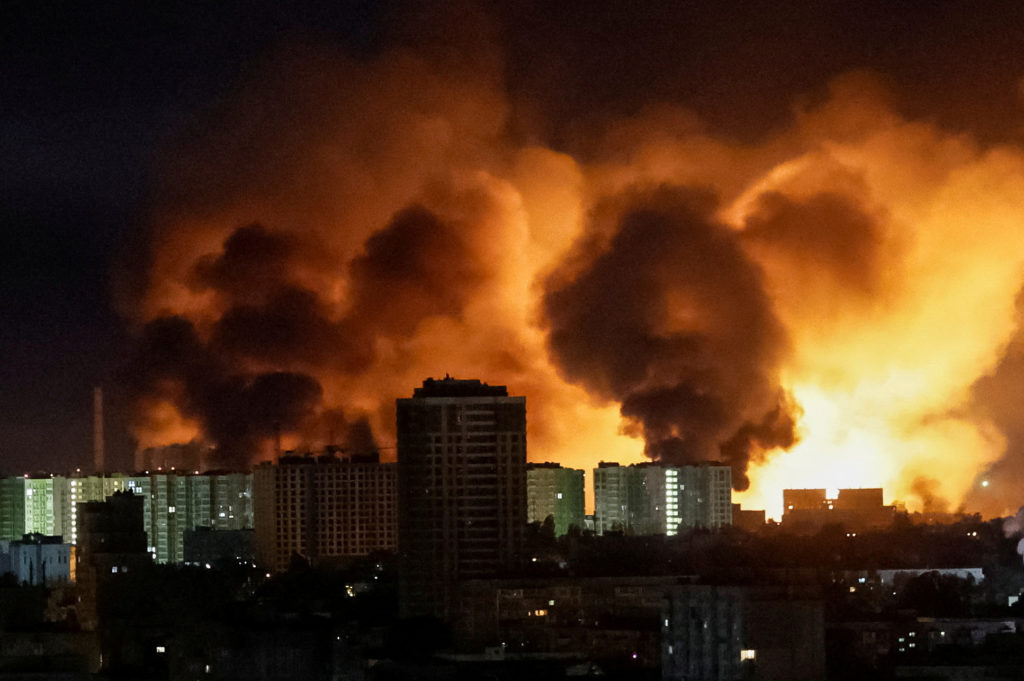
KYIV, November 1, 2026 — Hundreds of thousands of households across Ukraine were left without electricity after Russian attacks struck energy infrastructure in four regions overnight, while Kyiv reported that its air defences had intercepted or suppressed 371 of 433 Russian drones launched during the assault.
The overnight barrage was accompanied by Ukrainian attacks on targets inside Russia, according to statements reported by Reuters. The exchanges underscored how both sides continue to use long-range drones against infrastructure far from the front line, even as limited diplomatic efforts focus on restricting attacks on energy facilities.
President Volodymyr Zelensky said the Russian strikes hit power infrastructure in Dnipropetrovsk, Vinnytsia, Zhytomyr and Khmelnytskyi regions. He said the intensity of the attacks was high and pointed to Ukraine’s shortage of ballistic-missile interceptors as a vulnerability. The number of households without electricity was described by Ukrainian officials as being in the hundreds of thousands; the full duration of the outages was not yet clear.
Also read: Russian Attacks Hit Ukraine’s Energy Infrastructure, Disrupting Power and Heating
Ukraine’s Air Force said Russia launched 433 unmanned aircraft from 6 p.m. local time on Saturday, October 31, into Sunday morning. The force said the drones included Shahed-type attack drones, Gerbera drones and decoys, with 64 of the aircraft described as jet-powered Shaheds.
In its preliminary update at 7.30 a.m. on Sunday, the Air Force said 371 drones had been shot down or suppressed. It recorded impacts at 16 locations and debris from intercepted aircraft at 14 other locations. The figures were reported by Ukrainska Pravda from the Air Force statement and separately by the Kyiv Independent.
The interception figure is Ukraine’s official account of its defensive operation, not an independently verified count. It also does not mean that every drone not included in the 371 figure hit an intended target: the military’s initial report described a developing operation and said more than 40 attack drones were still in the air at the time of its morning update.
The scale of the launch matters because a large drone wave can force air-defence crews to track multiple threats at once across a wide area. Ukraine uses a mix of aircraft, surface-to-air missile units, electronic-warfare systems, unmanned systems and mobile fire groups to respond, the Air Force said. The available reporting does not provide a complete breakdown of which systems engaged individual drones or how many weapons were used.
The energy damage was reported across four regions, but officials had not released a single consolidated figure showing how many homes remained without electricity in each area by Sunday evening. Zelensky said hundreds of thousands of families were affected. Kyiv also introduced emergency power outages after the overnight attacks, according to the Kyiv Independent.
Energy facilities are particularly consequential targets because electricity networks depend on connected generation, transmission and distribution equipment. Damage to a substation, transformer or high-voltage line can interrupt supply even if a power station itself remains operational. Repairs may require specialist equipment and must be carried out only when crews judge the area safe from further strikes.
The Kyiv Independent reported that three workers from private energy company DTEK were injured while dealing with damage to the energy system. DTEK said repair teams were working to restore equipment when conditions allowed. The company’s statement did not establish a timetable for restoring all affected connections.
Regional casualty reports covered a wider period of attacks and should not be read as a count attributable solely to the overnight energy strikes. The Kyiv Independent, citing local authorities, reported one death and at least 47 injuries across Ukraine over the preceding day. The reports included casualties in Dnipropetrovsk, Donetsk, Sumy, Kharkiv, Poltava, Volyn and Kyiv regions. Local officials’ figures may change as hospitals and emergency services complete their assessments.
In Dnipropetrovsk region, the outlet reported 17 people injured over the previous 24 hours, including three children. Donetsk regional authorities reported one person killed in Sloviansk and eight injured elsewhere in the region, while Sumy officials reported 12 injuries. Those figures describe separate regional reports and do not establish that all casualties resulted from the same attack or weapon type.
Ukraine also reported striking the Kamensky plant in Russia’s Rostov region. Zelensky said the facility was involved in manufacturing Russian missiles. Reuters reported that Moscow had not commented on that specific claim by the time of its report, and the available material did not independently establish the extent of damage or whether production had been interrupted.
In Russia’s Nizhny Novgorod region, Governor Gleb Nikitin said a large Ukrainian drone attack caused significant damage to an industrial facility. He did not identify the site. The region is home to the NORSI oil refinery, but that fact alone does not establish that the refinery was hit. Russian authorities urged motorists to buy fuel only as needed and avoid panic buying while officials worked to maintain supplies to filling stations.
Russia’s Defence Ministry said its forces had downed 235 Ukrainian drones over Russian regions overnight. That number is Moscow’s official claim and has not been independently verified in the reports reviewed. Kyiv did not immediately claim responsibility for the Nizhny Novgorod attack, according to Reuters.
The competing accounts illustrate a recurring problem in reporting long-range strikes: military statements can identify claimed targets and interception totals, but the physical damage, operational consequences and full casualty toll often take longer to establish. An official announcement that a facility was targeted is not, by itself, proof that its intended function was disabled.
The latest attacks came amid disagreement over a possible halt to strikes on energy facilities. Ukraine says it supports a full ceasefire covering energy targets, including its own power grid, but maintains that Russia is unwilling to accept such an arrangement. Russian officials, meanwhile, have accused Ukraine of renewed attacks on oil refineries and argued that these strikes contribute to instability in fuel markets.
Russian Deputy Prime Minister Alexander Novak, who oversees the energy sector, said Ukrainian attacks on Russian refineries were adding to global fuel-market imbalances and affecting prices, Reuters reported. The report did not establish a measurable price effect attributable specifically to the latest drone attack, and the identity of the damaged Nizhny Novgorod facility remained unconfirmed.
The local six-day ceasefire around Oleshky, a Russian-controlled town in Ukraine’s Kherson region, reached its final day on Sunday. Reuters reported that the limited arrangement did not bring a wider pause in fighting elsewhere along the front line, where both sides continued long-range air attacks.
That distinction is important. A local pause intended to facilitate a humanitarian operation does not amount to a nationwide ceasefire, nor does it automatically restrict attacks on energy infrastructure elsewhere. A broader agreement would require clear terms, monitoring and agreement on what counts as an energy target, how violations would be assessed and what response would follow.
Ukraine’s energy system has faced repeated attacks since Russia launched its full-scale invasion in February 2022. Power plants, substations, transmission lines and other infrastructure have been damaged in successive campaigns. The cumulative effect can be greater than the impact of a single strike: a network with fewer functioning components has less room to reroute electricity when another facility is hit.
As colder weather approaches, electricity demand can rise as households and businesses use more power for heating and other essential needs. Outages can also affect water pumping, public transport, communications and services that rely on stable electricity. The effects differ by locality, however, and the reports available on Sunday did not establish a nationwide collapse of the grid or a common duration for the latest outages.
Repair work is therefore only one part of the response. Grid operators must assess damage, isolate unsafe equipment, restore connections where possible and manage the remaining supply. Emergency outages can be used to stabilise a strained system, but their location and duration depend on the condition of the network and the balance between available generation and demand.
Air defence is another constraint. Ukraine’s reported interception of 371 drones demonstrates the scale of the defensive effort, but the remaining impacts and damage show why a high interception rate does not guarantee that infrastructure will be protected. Zelensky’s warning about shortages of ballistic-missile interceptors also points to a distinction between the systems used against different kinds of threats; the reports did not provide enough technical detail to assign specific interception outcomes to particular weapons.
The attacks add uncertainty to energy planning in Ukraine and to the wider debate over whether infrastructure can be kept outside the conflict. The immediate effects are local outages, repair demands and risks to workers. Any broader economic consequences depend on the scale and duration of the damage, whether fuel or electricity flows are disrupted for an extended period, and whether additional attacks follow.
Russia’s warning about fuel supplies in Nizhny Novgorod drew attention to the possible link between a drone strike and energy logistics, but the facility involved was not identified. It would be premature to infer that the NORSI refinery has stopped operating or that Russian fuel exports have been reduced. Such conclusions would require confirmation from the operator, regional authorities, satellite imagery or other reliable evidence.
For countries that import energy, including India, the relevant issue is whether repeated attacks produce sustained disruption to export facilities, shipping or prices—not simply whether a fire or strike is reported. The reporting available on Sunday did not show a new disruption to Indian crude supplies or establish a direct price impact from this round of attacks.
The next evidence to watch is practical rather than rhetorical: updates from Ukrainian grid operators on restored connections; revised outage schedules; official assessments of damage in the four regions; and independent confirmation of the reported damage inside Russia. Any statement about a ceasefire will also need to be assessed against its exact scope and whether both sides publicly accept the same terms.
For now, the clearest picture is of a large overnight drone attack, substantial power disruption reported by Ukrainian officials and a continuing exchange of long-range strikes. The final civilian toll, the duration of outages and the operational impact on the Russian sites remain subject to further verification.






Comments (0)
Be the first to comment. Comments are published after moderation.