


New Delhi | November 1, 2026
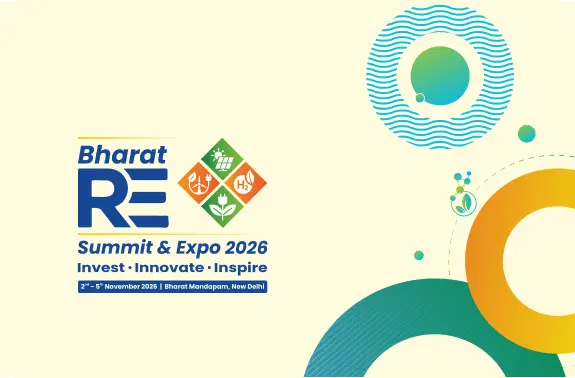
India’s renewable energy sector is set for a major international gathering as the Bharat Renewable Energy Summit & Expo (BRESE) 2026 opens at Bharat Mandapam in New Delhi on Monday, November 2. The four-day event, scheduled to run until November 5, will bring together policymakers, investors, manufacturers, developers, researchers and international partners to discuss clean-energy investment, technology and deployment.
The summit is being organised under the theme “Invest. Innovate. Inspire.” The Government of India expects participation from more than 130 countries, including over 40 ministers, while an Indian Embassy event announcement lists more than 75,000 participants, 500-plus speakers and over 400 exhibitors. The Ministry of New and Renewable Energy has separately confirmed that the accompanying expo will feature more than 400 exhibitors showcasing technologies and manufacturing capabilities across the sector.
Prime Minister Narendra Modi is scheduled to inaugurate the summit at around 4:30 pm on November 2 at Bharat Mandapam and address the gathering, according to a Prime Minister’s Office release issued on November 1. The event will be hosted by the Ministry of New and Renewable Energy (MNRE) in collaboration with the International Solar Alliance (ISA).
BRESE 2026 will take place alongside two other international gatherings: the 9th Session of the International Solar Alliance Assembly and the 4th International Conference on Green Hydrogen. Together, the three platforms are intended to connect discussions on renewable-energy investment with international solar cooperation and the development of green-hydrogen technology and markets.
The Bharat Renewable Energy Summit will focus on investment, industry partnerships, manufacturing, technology and project development across the clean-energy value chain. The ISA Assembly, as the alliance’s main decision-making forum, will consider cooperation on solar deployment, financing and institutional capacity. The green-hydrogen conference will focus on technologies, investment and the scale-up of hydrogen production and use.
The Ministry has said the programme will include high-level plenary sessions, ministerial discussions, chief executive roundtables, country and state sessions, and business-to-business, business-to-government and government-to-government engagements. The format is designed to bring public authorities, project developers, financiers and technology providers into the same discussions.
The expo will showcase products and solutions across solar and wind power, green hydrogen, energy storage and other emerging clean-energy technologies. The Ministry says the exhibition will include manufacturers, developers, technology providers, public- and private-sector companies, startups and research institutions from India and abroad.
An event notice published by the Embassy of India in Beijing gives an expected attendance of more than 75,000 people, over 500 speakers and more than 400 exhibitors, with participation from over 130 countries. These are projections published ahead of the event, not final attendance figures. The Ministry’s latest announcement also lists nine country partners: Australia, Denmark, the European Union, France, Germany, the Netherlands, Norway, Sweden and the United Kingdom.
Thirteen states and Union Territories are expected to showcase their renewable-energy potential, investment opportunities and manufacturing capabilities. They are Andhra Pradesh, Assam, Bihar, Chhattisgarh, Delhi, Gujarat, Karnataka, Madhya Pradesh, Maharashtra, Odisha, Rajasthan, Uttar Pradesh and West Bengal.
Investment, storage and grid capacity at the centre of India’s transition
The summit comes as India works towards its 2030 clean-energy goals while addressing the practical requirements of adding more variable renewable power to the electricity system. Solar and wind projects require transmission capacity, balancing resources, storage, reliable supply chains and financing structures that can support projects from development to commissioning.
In its October 28 briefing, the Ministry of New and Renewable Energy said India had 308 GW of installed non-fossil-fuel capacity and was working towards a 500 GW target by 2030. The non-fossil figure is broader than renewable energy alone and should not be read as a measure of solar and wind capacity by themselves.
MNRE Secretary Santosh Sarangi said realising the country’s ambition would require about US$220 billion in investment between 2027 and 2030, alongside faster deployment of energy storage, stronger transmission networks and expanded domestic manufacturing. The estimate was presented by the Ministry as part of the case for linking global capital and technology with India’s clean-energy project pipeline.
These requirements are closely connected. Additional solar and wind capacity can increase the need for transmission upgrades and flexible power resources, particularly when generation varies by time of day and weather. Storage can help shift electricity across hours, while grid planning and stronger inter-state connections are important for moving power from renewable-rich areas to demand centres. The economics of these investments will influence how quickly projects can be added and how effectively they can be used.
Also read: ACME Solar Battery Storage: 88 MW Added in Rajasthan
Also read: What 50 GWh of Battery Storage Could Mean for India’s Power Grid
Also read: Grid-India Warns North India’s Power Network Faces Strain During Solar Hours
Green hydrogen and domestic manufacturing in focus
Green hydrogen is another major part of the programme. Produced using renewable electricity to split water, it is being explored for industrial uses and sectors where direct electrification can be difficult. Its wider adoption depends on the cost and availability of renewable power, electrolyser manufacturing, water and infrastructure requirements, storage and transport, as well as the development of reliable buyers.
The co-located International Conference on Green Hydrogen is expected to bring these questions into discussions on technology development, investment and scale-up. For industry participants, the challenge is not only to demonstrate new equipment but to identify commercially workable projects and the infrastructure needed to connect production with end users.
Domestic manufacturing is also expected to feature prominently. The expo will provide a platform for companies to showcase Indian manufacturing capabilities and products across solar, wind, storage and other clean-energy segments. The Ministry has said the event will also host the Bharat Renewable Energy Hackathon awards, the final of the RE National Renewable Energy Quiz 2026 and the REGen Pavilion for students, entrepreneurs and researchers.
The scale of the gathering is one measure of the interest in India’s energy transition, but its practical value will depend on the partnerships and projects that follow. Investors will be looking for clarity on policy, project pipelines, risk allocation and long-term revenue arrangements. Developers and manufacturers will need to assess demand, supply-chain capacity, access to finance and the pace at which infrastructure can be built.
For state governments, the summit offers an opportunity to present land, resources, industrial clusters and investment proposals to domestic and international companies. For the central government and multilateral partners, the meetings provide a forum to discuss financing, technology transfer, standards and cooperation across borders. The participation of 13 states and nine country partners gives the event a mix of domestic project opportunities and international engagement.
The four days at Bharat Mandapam will therefore bring together several parts of the clean-energy transition: generation, storage, transmission, manufacturing, finance and emerging fuels. The announcements made during the summit will offer an early indication of where companies and governments see opportunities. Whether those discussions translate into projects will depend on implementation, investment decisions and the ability to resolve infrastructure and market constraints.
Event details: Bharat Renewable Energy Summit & Expo 2026; November 2–5, 2026; Bharat Mandapam, New Delhi. Theme: “Invest. Innovate. Inspire.” Official event information: bresummit.in.
Sources
- Prime Minister’s Office / Press Information Bureau — PM to Inaugurate Bharat Renewable Energy Summit & Expo 2026 on 2 November, November 1, 2026.
- Ministry of New and Renewable Energy / Press Information Bureau — Summit announcement and India’s clean-energy investment priorities, October 28, 2026.
- Embassy of India, Beijing — Bharat Renewable Energy Summit & Expo 2026 event information.
- Bharat Renewable Energy Summit & Expo — Official event website.
Comments (0)
Be the first to comment. Comments are published after moderation.