


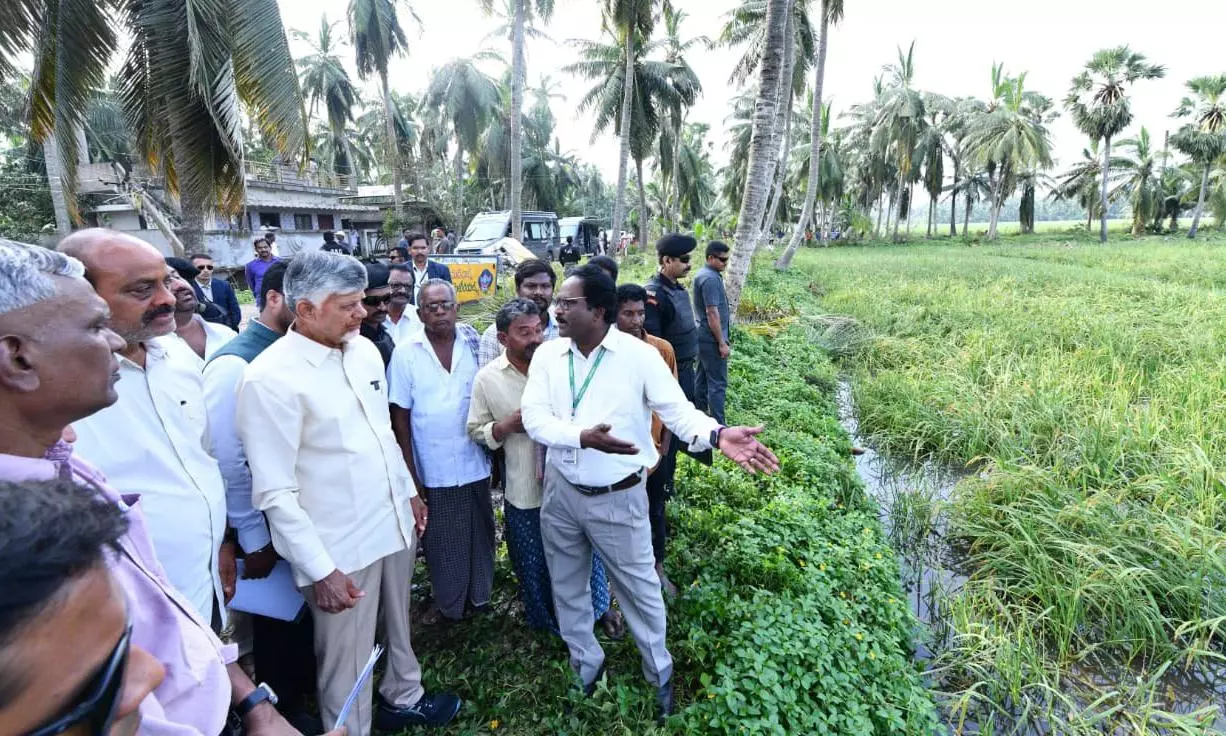
Andhra Pradesh Chief Minister N. Chandrababu Naidu has cancelled his scheduled visit to Delhi on Monday and directed officials to strengthen preparations for Cyclone Murasu, which is forecast to approach the state’s southern coast early on November 3. The state government’s directions were reported by PTI in a report published by Hindustan Times at 5:45 p.m. IST on November 1. NDTV later carried an ANI report at 9:46 p.m. IST confirming the cancellation and the review of preparedness.
At a review meeting, Naidu asked departments to remain ready for relief and rescue operations, move staff and equipment towards vulnerable locations in advance, and prepare clear timelines for restoring electricity if the storm damages power infrastructure. He also asked officials to issue cyclone situation bulletins every four hours and coordinate with telecom operators to reduce the risk of mobile-network disruption in affected areas.
The directions come days after Cyclone Arnab crossed the Andhra Pradesh coast on October 28 and caused damage across parts of the state. During the review, officials briefed Naidu on damage from Cyclone Arnab and the progress of relief operations. They told him that power supply was expected to be restored across affected areas by Sunday night, according to the PTI report. That was the officials’ projection at the time of the meeting, not a later statewide confirmation that every connection had been restored. The state is preparing for Murasu while assessing the residual effects of the previous storm.
Also read: Cyclone Arnab: Power Repairs Continue as Death Toll Reports Differ
The official statement carried by PTI said preliminary assessments indicate that strong winds could damage about 15,128 electricity poles across 12 districts. This is a preparedness estimate, not a report of damage already caused by Murasu. Officials have been asked to keep manpower and equipment ready and to communicate restoration timelines to residents if power supply is interrupted.
Telecom operators have also been asked to take advance precautions against mobile-service disruptions. The chief minister referred to problems experienced during Cyclone Arnab and asked the companies to work with the administration before Murasu reaches the coast. The four-hour bulletin schedule is intended to provide residents and local agencies with regular updates as forecasts and district-level instructions change.
The same statement projected extremely heavy rainfall in 20 mandals, including nine in Eluru district, five each in Krishna and NTR, and one in Bapatla. It gave forecast district-average rainfall figures for November 3 of about 179 mm in Eluru, 163 mm in Krishna, 161 mm in NTR, 147 mm in West Godavari, 119 mm in Guntur and 104 mm in Bapatla. These are forecast estimates, not measured rainfall totals.
Also read: Andhra Puts Cyclone Arnab Damage at ₹4,600 Crore; Central Team Due Friday
The India Meteorological Department (IMD) said Murasu formed over the southwest and adjoining west-central Bay of Bengal at 11:30 a.m. IST on November 1. Its November 1 press release forecast that the system would strengthen into a severe cyclonic storm over the west-central Bay of Bengal before moving towards the south Andhra Pradesh coast.
The IMD’s forecast in that release put the likely crossing between Nellore and Narsapur from 11:30 p.m. on November 2 to 4 a.m. on November 3, with sustained winds of 100–110 kmph and gusts reaching 120 kmph. Naidu’s official statement, as reported by PTI, described the expected crossing as near Bapatla, which lies within that broader coastal stretch. These timings and wind speeds are forecasts and may change with later observations. The Andhra Pradesh State Disaster Management Authority’s cyclone information portal directs residents to follow IMD bulletins and district orders, and cautions that model guidance shown on the portal is not itself an official warning.
In a report published at 8:23 p.m. IST, The Times of India said the IMD had recorded the system moving west-northwestwards at 27 kmph over the preceding six hours. The report said red rainfall warnings had been issued for Krishna, Guntur, Bapatla, Prakasam and Nellore for November 2, with other districts under orange or yellow warnings.
The IMD also warned that a storm surge of about 1.0 metre above the astronomical tide could inundate low-lying parts of south coastal Andhra Pradesh during landfall, with the highest peak surge expected over Bapatla, Krishna and Prakasam districts. It advised fishermen not to venture into the specified Bay of Bengal areas and off the Andhra Pradesh coast during the warning period. Residents should follow the latest district instructions as the forecast is updated.
Also read: Odisha Begins Fresh Evacuations as Cyclone Murasu Nears Andhra Coast
The latest PTI report on Odisha’s preparations said Cyclone Arnab and the flooding that followed had affected about 1.18 lakh people, damaged 1,672 houses and affected 75,388 hectares of crop area in the state. Officials also reported landslides in southern districts. Those figures relate to the earlier storm and should not be confused with projected impacts from Murasu.
The experience of Arnab has made power restoration, mobile connectivity, safe access to shelters and landslide monitoring important parts of the new response. Residents in low-lying areas and places identified as vulnerable to flooding or slope failure should follow evacuation instructions from district administrations. Fishermen should follow the current marine warnings and avoid going to sea while restrictions remain in force.
For the next 24 to 48 hours, the key developments to watch are the IMD’s updated track and intensity bulletins, district-specific rainfall warnings, evacuation directions and the readiness of electricity and telecom services. The forecast does not establish that the cyclone will cause the projected level of damage; the eventual impact will depend on its track, intensity, rainfall distribution and local conditions.


Comments (0)
Be the first to comment. Comments are published after moderation.