


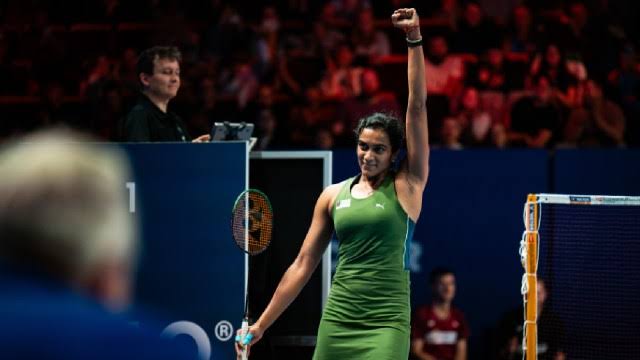
SAARBRÜCKEN, November 1, 2026 — PV Sindhu won the Hylo Open women’s singles title on Sunday, beating Denmark’s Line Højmark Kjærsfeldt 21-12, 21-14 in 39 minutes to claim her second BWF World Tour title of the year. The second-seeded Indian controlled the final from the opening exchanges, denying the Danish eighth seed the extended rallies and attacking opportunities that might have made the match more competitive.
The Super 500 victory gives Sindhu a stronger finish to a season that has included both a title and several deep runs at major events. She won the Japan Open in July, reached the French Open final last week and now leaves Germany with another championship. The Times of India reported that the Hylo Open win earned her 9,200 ranking points and kept her in contention for the season-ending BWF World Tour Finals.
Sindhu’s 21-12, 21-14 scoreline reflected a match in which she maintained control of the pace. The Indian opened a lead in the first game and did not allow Kjærsfeldt to turn the contest into a sequence of long, uncertain rallies. In the second game, Sindhu continued to move the Dane around the court and took the points needed to close out the title without a deciding game.
The result was consistent with the pre-match record reported by Indian outlets: Sindhu had won six of her previous seven meetings with Kjærsfeldt. That record did not guarantee the outcome, but it gave the Indian a familiar tactical reference. The Danish player, ranked 25th in the world and seeded eighth for the tournament, had earned her place in the final; Sindhu’s task was to translate her experience into a clean performance rather than rely on reputation.
The 39-minute duration also suggests that Sindhu did not need to spend long stretches defending under pressure. A short final is not, by itself, proof that one player dominated every rally, but the straight-game score and the margin in both games show that Kjærsfeldt was unable to force the match into a more uncertain phase. The win gives Sindhu a tournament result she can build on as the international season moves towards its final events.
Sindhu’s path to the trophy has been one of steady progress rather than a sudden return to form. She won the Japan Open in July, her first BWF title since December 2024, and then reached the final of the French Open in Paris last week. She lost that final to South Korea’s world No. 1 An Se Young, but her run through Paris put her back in a position to compete for a major title a week later.
At the French Open, Sindhu won the first game against An before the South Korean adjusted and took the next two. The loss was a reminder of the gap Sindhu still needs to close against the strongest players, but it also showed that she could start aggressively and make a final competitive. The Hylo Open was a different test: Kjærsfeldt is a capable top-30 opponent, but not the same benchmark as the current world No. 1.
The difference matters when assessing the significance of the result. A title at a Super 500 event is a meaningful achievement and adds ranking points, but it does not automatically prove that Sindhu has resolved every weakness exposed in higher-level finals. Her next challenge will be to carry the control she showed in Saarbrücken into matches against opponents who can sustain pressure, vary the pace and punish loose returns.
The 9,200 points reported for the Hylo Open are valuable as the BWF World Tour season approaches its conclusion. Qualification for the World Tour Finals is based on results accumulated across the season, and a title can make a material difference to a player’s position in that race. The exact qualification picture depends on the wider field and the points held by other contenders, so the win should be described as keeping Sindhu in contention rather than guaranteeing her a place.
A late-season title also matters for tournament seeding and confidence, although those benefits should not be overstated. Rankings are calculated from results across a defined period, and one event cannot erase earlier losses or guarantee a favourable draw. The immediate value is clearer: Sindhu has added another Super 500 trophy to her season, taken ranking points and shown that she can close out a final in straight games after reaching the championship match in Paris.
The schedule can be demanding at this stage of the season. Players must balance travel, recovery and preparation, particularly after reaching consecutive finals. Sindhu’s run from Paris to Saarbrücken means she has had to maintain her physical condition and tactical focus across two weeks of high-level competition. Her victory in Germany suggests she managed that transition well, but the longer-term measure will be how she performs in the next tournaments and against the top-ranked players.
The Hylo Open is a useful indicator of form because it required Sindhu to win several matches in a tournament setting rather than produce one strong performance. Her straight-game final followed a semifinal victory over compatriot Anmol Kharb, who had reached only her second Super 500 semifinal. Sindhu’s experience showed in the final, where she kept the match under control instead of allowing momentum to swing.
The semifinal against Kharb was also a notable all-Indian meeting. Kharb’s progress to that stage offered a chance to test herself against a player with Olympic medals and years of experience on the world circuit. Sindhu won 21-13, 21-16, according to the Times of India, and advanced to her second final in as many weeks. The result was a reminder that India’s women’s singles pipeline includes emerging players as well as established names.
For Indian badminton, Sindhu’s win is the most immediate headline, but the wider picture includes the need for depth across singles and doubles, strong coaching support and a calendar that allows athletes to recover between events. One title cannot answer those structural questions. It can, however, provide a useful reference point for selectors, coaches and players assessing the form of a leading athlete as the season ends.
The win also gives Sindhu a positive result after the disappointment of losing the French Open final. That does not mean the earlier defeat should be dismissed or that the two results are directly comparable. The opponents and match conditions were different. The more precise conclusion is that Sindhu has shown she can recover from a final loss, prepare for another tournament and convert a second opportunity into a title.
The next questions are how Sindhu’s ranking position changes after the Hylo Open, whether the points are enough to keep her in the World Tour Finals qualification race, and which events she will play before the season closes. The available reports do not establish her final qualification position. That will depend on the results of other contenders and the official standings, not on this title alone.
Sindhu will also need to preserve the tactical elements that worked in Germany: taking initiative early, using court coverage to control the rally and limiting the opportunities for an opponent to dictate the pace. Against the best players, those choices need to hold up under sustained pressure. The Hylo Open final was a convincing win, but the next events will show whether that level can be maintained against a wider range of opponents.
For now, the result is straightforward. Sindhu has won the Hylo Open Super 500, beaten Kjærsfeldt in straight games and claimed her second BWF title of 2026. It is a meaningful addition to her season and a timely boost in the closing stretch of the World Tour calendar, while the final standings and her qualification status remain to be confirmed.



Comments (0)
Be the first to comment. Comments are published after moderation.