


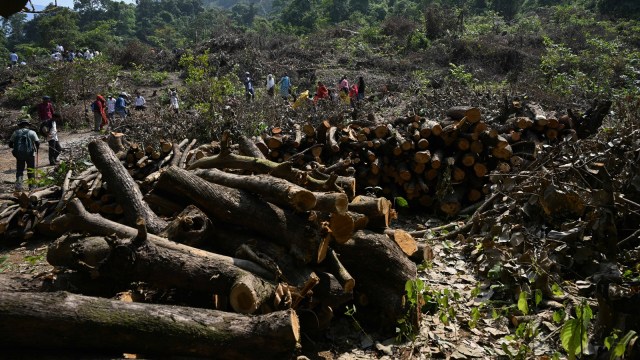
MUMBAI, November 2, 2026: A new investigation into Torrent Power’s proposed 3,000-megawatt Saidongar-1 pumped-storage project in Karjat, Maharashtra, has brought renewed attention to the forest land, tree felling and local livelihoods affected by the scheme. The Indian Express reported at 7:00 am IST on Monday that nearly 1,100 trees had been cut on Saidongar hill before felling was halted last week following protests by residents and activists.
The project requires about 233 hectares of forest land within a total footprint of roughly 377 hectares. The Indian Express reported that more than 32,000 trees are involved; a formal Maharashtra forest-department order dated October 14 authorised the felling of 32,490 trees, according to The Times of India. The project is being developed by Torrent Power at an estimated cost of ₹13,505 crore, with operations targeted for 2029, The Indian Express reported.
The dispute centres on a difficult question for India’s energy transition: how to expand electricity storage for a power system using more solar and wind while accounting for the ecological and social costs of the infrastructure required to do so.
Saidongar-1 is designed as an off-stream, open-loop pumped-storage hydropower project. Such facilities use electricity when demand is lower to pump water from a lower reservoir to an upper reservoir. When electricity demand rises, the stored water is released through turbines to generate power. The system shifts electricity across time; it does not create a new source of primary energy, and some energy is lost in the storage-and-release cycle.
Equipment supplier ANDRITZ said in April that it would supply ten pump-turbine units and associated equipment for the 3,000-MW facility. Torrent has presented the project as a way to support grid stability, integrate variable renewable generation and reduce reliance on coal-fired power during evening peak hours. The company’s position was reported by PTI in a report carried by The Economic Times.
Also read: What 50 GWh of Battery Storage Could Mean for India’s Power Grid
The project’s climate benefits are projections rather than measured outcomes. Torrent’s October statement estimated annual avoided carbon dioxide emissions of about 5.85 million tonnes, while ANDRITZ’s April announcement cited about 4.55 million tonnes a year. The estimates use different public figures and should not be treated as independently verified reductions before the plant is operating.
The project requires about 233 hectares of forest land within a wider footprint of roughly 377 hectares, according to the figures cited by The Indian Express. Its reporting said tree felling began on Dussehra morning and that nearly 1,100 trees had been cut before the operation was stopped last week after protests in the area. A forest official described the halt as temporary and said no decision had been taken on when work would resume.
The location is part of the Sahyadri range in the Western Ghats. The Indian Express reported that the Western Ghats Ecology Expert Panel’s 2011 map placed Pali in its highest-protection category, ESZ 1. Those panel recommendations were not implemented as a final notification, so the historical classification should not be confused with a current legal designation for the project site.
Torrent has said the project is about 16 kilometres from Bhimashankar Wildlife Sanctuary and that its components are outside the sanctuary boundary and its eco-sensitive zone. The company has also cited wildlife-management, catchment-treatment and compensatory-afforestation measures. Those claims describe the company’s position; they do not by themselves resolve questions about the wider forest landscape, local resource use or the project’s effects on nearby communities.
Also read: India Approves ₹1.86 Trillion Grid and Battery Storage Push
The Indian Express reported that around 150 families in six hamlets near the site, most from the Katkari tribal community, depend on the forest for activities including collecting firewood, honey, fruit and medicinal plants. Some residents also use the Pej river and surrounding forest for food and income. Residents told the newspaper that access restrictions following the felling operation had affected their ability to collect and sell forest produce.
The same investigation reported that forest-dependent households had not been recorded in the local process used to assess rehabilitation or compensation. A Karjat forest official told the newspaper that the Gram Sabha had not submitted records identifying the families and their use of the forest, despite requests to do so. The absence of those records is a reported explanation from the official; it is not, on its own, a legal determination that all community rights have been settled or that no claims exist.
The Ministry of Tribal Affairs’ explanation of the Forest Rights Act, 2006 says the law recognises individual and community rights of forest-dwelling Scheduled Tribes and other traditional forest dwellers, including access to forest resources linked to livelihood and habitation. It also gives Gram Sabhas a central role in receiving, verifying and forwarding claims. The project’s implementation therefore raises questions about whether the relevant claims and records were properly identified and considered before affected forest land was transferred.
The ecological concern is not limited to the number of trees at the construction site. A 2018 study published in Geophysical Research Letters modelled the contribution of Western Ghats vegetation to southwest monsoon rainfall over Tamil Nadu. The researchers estimated that evapotranspiration from the region’s vegetation contributed about 25–40 per cent of the monsoon rainfall over the state in their simulations, with higher contributions during some dry spells and deficient monsoon years.
The study does not measure the effect of the Saidongar-1 project and does not establish that this individual development will change rainfall in Tamil Nadu. It does, however, show why forest loss in the Western Ghats can have hydrological implications beyond the immediate construction area. Any site-specific assessment would need to examine the project’s actual land footprint, water use, catchment changes and cumulative impacts alongside the wider research.
Also read: India Could Drive 25% of Global Energy Demand Growth
Torrent’s public response says the project has received environmental and forest-related statutory clearances and that compensatory measures include planting trees on project land and on separate land identified for afforestation. The company’s regulatory page lists its environmental-clearance documents and compliance material for the Saidongar-1 Karjat project. The company’s submissions and official clearance conditions should be read alongside independent reporting and the concerns raised by residents.
Several issues remain important for public scrutiny: whether all forest-rights claims were identified and processed; how the 32,490-tree felling permission and the temporary halt are being implemented; what monitoring will apply to biodiversity, catchment conditions and river flows; and how compensatory afforestation will be measured over time. The status of any decision to resume felling should be confirmed by the relevant authorities rather than inferred from the project’s construction schedule.
Pumped storage can help balance a grid with more variable renewable electricity. The Karjat case shows why that role should be assessed together with land use, water, biodiversity and the rights of communities living in the project landscape. A credible transition depends not only on the amount of storage added, but also on transparent approvals, enforceable safeguards and clear public accounting of environmental costs and claimed benefits.
Frequently asked questions
What is the Saidongar-1 pumped-storage project?
It is a proposed 3,000-MW pumped-storage hydropower facility in Karjat, Maharashtra, being developed by Torrent Power. It is designed to pump water to an upper reservoir when electricity is available and release it through turbines when demand rises.
How much forest land and how many trees are involved?
The reporting cites about 233 hectares of forest land within a total project footprint of roughly 377 hectares, with permission for felling 32,490 trees.
How many trees had been cut before work was halted?
The Indian Express reported that nearly 1,100 trees had been felled before the operation was halted last week after protests. The halt was described by a forest official as temporary.
Why are forest rights part of the dispute?
The Ministry of Tribal Affairs says the Forest Rights Act recognises individual and community rights of forest-dwelling communities. The reporting has raised questions about whether families using the forest were adequately recorded in the local process.





Comments (0)
Be the first to comment. Comments are published after moderation.