


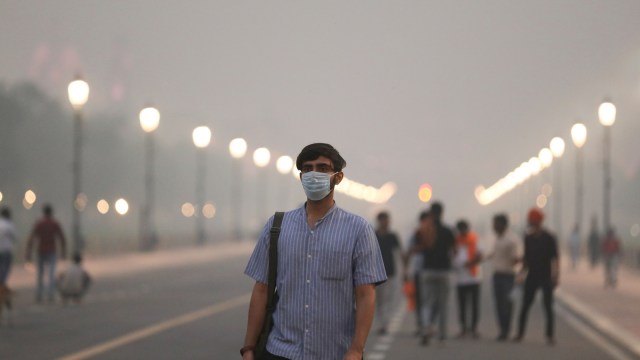
NEW DELHI, November 2, 2026 — Delhi’s city-wide Air Quality Index (AQI) reached 310 at 8.05 am on Monday, moving into the “very poor” category for the first time this season, according to Central Pollution Control Board (CPCB) data reported by Indian news outlets. Several monitoring stations recorded higher readings, including Jahangirpuri at 420, which falls in the “severe” category.
The CPCB figures showed Rohini and Punjabi Bagh at 399 each, ITO at 351, Alipur at 382, Mundka at 377 and Vivek Vihar at 376. Narela recorded 375, while RK Puram and Sonia Vihar were both at 370. The readings were not uniform across the capital: among 58 stations with available data, Tikri Kalan recorded 160, while Ghummanhera and Maidan Garhi registered 186 and 189 respectively.
The 8.05 am city-wide reading was also higher than the 307 recorded at 7 am in a separate CPCB snapshot reported earlier by Business Standard. The two figures refer to different observation times. The Indian Express also reported a city reading of 310 at 8.05 am and said neighbouring Noida was at 311.
Also read: Delhi AQI Reaches 261 as Winter Pollution Curbs Begin
What the latest readings show
Under the national AQI scale, readings from 301 to 400 are classified as “very poor”, while readings from 401 to 500 are classified as “severe”. Delhi’s average of 310 therefore placed the city in the very poor band, while Jahangirpuri’s station reading of 420 was in the severe band. A high reading at one monitor should not be treated as the city-wide average: the station figures show how sharply conditions can vary between neighbourhoods.
The CPCB’s Sameer app advisory, cited by The Indian Express, warned that prolonged exposure to very poor air could cause respiratory illness. The figures are a measure of ambient air quality, not a diagnosis of individual health risk. Residents should follow public-health advice, particularly when local readings are high, and avoid assuming that conditions at one monitoring station represent every part of Delhi.
The deterioration followed a brief improvement after rainfall late in October. India Today reported that Delhi’s AQI had fallen to 60 on October 30 before rising again, and said the 8.05 am reading on November 2 was the first time the city average had entered the very poor category this season. The return of higher readings does not, by itself, identify the contribution of any single pollution source.
Also read: Delhi AQI Improves After Record October Rain, but Relief May Be Brief
GRAP categories and vehicle restrictions
The Commission for Air Quality Management’s revised Graded Response Action Plan (GRAP), dated September 29, places AQI readings of 301–400 in Stage II, “Very Poor”. It defines Stage III as “Severe” for readings of 401–450 and Stage IV as “Severe+” above 450. The schedule says measures can be invoked in advance when forecasts indicate that a higher pollution level is likely to persist; it also provides for immediate implementation of measures that can be applied at once when a threshold is breached under specified conditions. The classification should not be confused with a separate order specifying which restrictions are currently in force.
Delhi tightened vehicle-entry restrictions from November 1 under the revised GRAP framework. The Indian Express reported that petrol and diesel vehicles registered outside Delhi that do not meet BS-VI emission standards are barred from entering the capital until January 31, 2027, while electric and CNG vehicles are exempt. Non-compliant commercial goods vehicles and buses also face restrictions, with checks at entry points using number-plate recognition and RFID systems.
The CAQM’s revised GRAP schedule sets out the stage-wise measures for the National Capital Region. The AQI reading alone does not show whether every measure associated with a higher stage has been separately ordered or implemented; residents and commuters should check the latest notices issued by CAQM and Delhi authorities.
Also read: Delhi-NCR Imposes GRAP-1 Curbs After AQI Rises to 244
The latest readings came as the capital entered the early-November period when air quality can become more difficult to manage. Rain had temporarily improved conditions, but the return of elevated readings shows that the improvement did not last. Weather, transport, road and construction dust, industrial activity, biomass burning and other sources can all affect pollution levels; the AQI snapshots published on Monday do not quantify each source’s contribution.
Delhi’s monitoring network also shows why city-wide averages need to be read alongside local data. While Jahangirpuri was in the severe band, several other stations were in the very poor range and a small number remained below 200. Conditions can change during the day as emissions and weather patterns shift, so a morning reading should not be treated as a forecast for the whole day.
For commuters, the immediate issue is compliance with vehicle-entry rules and the possibility of additional restrictions if air quality worsens. For residents, the practical step is to check current station readings and official advisories rather than rely on old screenshots or a single neighbourhood figure. The next assessment will show whether the increase persists and whether authorities announce further measures.
Frequently asked questions
What was Delhi’s average AQI on November 2, 2026?
Delhi’s city-wide AQI was reported at 310 at 8.05 am on November 2, placing it in the very poor category.
Which Delhi monitoring station recorded the highest reading?
Jahangirpuri recorded an AQI of 420, in the severe category. Rohini and Punjabi Bagh were at 399 each, while ITO recorded 351.
What does an AQI of 310 mean under the revised GRAP schedule?
The Commission for Air Quality Management classifies AQI readings from 301 to 400 as Stage II, or Very Poor. The schedule also provides for measures to be invoked based on forecasts and specified threshold conditions.
Sources: Central Pollution Control Board


Comments (0)
Be the first to comment. Comments are published after moderation.