


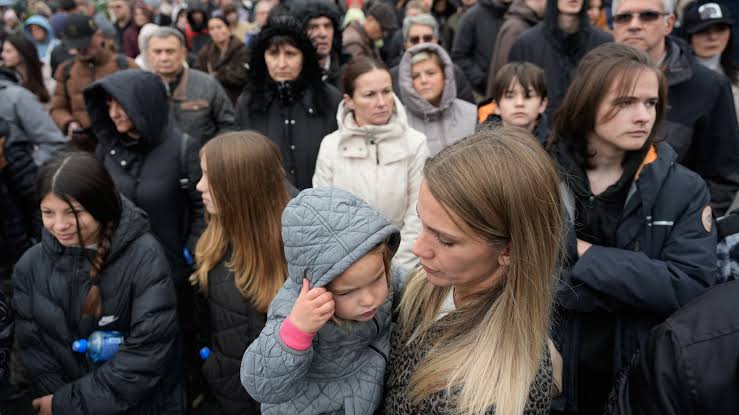
NOVI SAD, November 1, 2026 — Thousands of people gathered at Serbia’s Novi Sad railway station on Sunday to remember the 16 people killed when a concrete canopy collapsed two years ago, a disaster that became the starting point for a student-led protest movement and a major challenge to the country’s political establishment. The anniversary comes days after the movement’s “Student List” won Serbia’s parliamentary election, turning a campaign for accountability into a test of whether the incoming political order can deliver it.
Mourners observed 16 minutes of silence and left flowers, candles and wreaths at the station, according to Reuters. The Associated Press reported that people also placed 16 wreaths and red hearts, one for each victim. Memorials were held elsewhere in the country. The gathering was both a remembrance of the dead and a reminder that the legal case surrounding the collapse has not reached trial.
The canopy fell on November 1, 2024, at a station that had been renovated as part of a China-backed high-speed rail project. Sixteen people died. The collapse prompted questions about construction quality, oversight and the transparency of the renovation, then grew into nationwide demonstrations over corruption and accountability. Authorities and defendants have rejected or disputed allegations of wrongdoing; the collapse itself does not establish criminal responsibility by any particular person.
The first demands focused on the station disaster: publish the relevant documents, establish how the canopy failed and prosecute anyone whose actions contributed to the deaths. As demonstrations continued, student groups and supporters broadened their demands to include government accountability, the rule of law and action against corruption. The movement drew support well beyond university campuses and became one of the most consequential challenges to Serbia’s political leadership in years.
The protest movement did not begin with a single party leader. Students organised assemblies and public actions, while supporters from different professional and civic backgrounds joined the demonstrations. That loose structure helped the movement present itself as a public campaign rather than a conventional party machine. It also leaves questions about how a diverse group will translate protest demands into government policy, budgets and institutional reform.
The government of then-President Aleksandar Vučić and the Serbian Progressive Party had faced sustained criticism over the handling of the collapse and broader allegations of corruption. Vučić and his allies denied accusations of wrongdoing and argued that the political process should proceed through elections and institutions. The student-led movement, meanwhile, treated the stalled accountability process as evidence that existing institutions had not provided convincing answers.
The anniversary therefore arrives at a turning point. The movement has won an election, but the original questions about the station remain: what caused the canopy to fail, whether the renovation was properly supervised, and whether any official or contractor should be held legally responsible. A change in political leadership does not itself answer those questions.
Serbia held parliamentary elections on October 25. The Republic Electoral Commission’s preliminary results, based on 97.56% of polling stations processed as of October 26, gave the student-backed “Student List – Students Win” 52.71% of votes, compared with 39.17% for the list led by Vučić. Reuters reported that the student list was on course to take 141 of the National Assembly’s 250 seats.
The official results remain a key reference point because they distinguish verified electoral data from political claims made during the campaign. The commission’s figures were preliminary, and the final confirmation process still mattered. But the scale of the lead indicated that the student movement had moved beyond street mobilisation and secured a broad electoral mandate.
Reuters reported after the vote that Vučić acknowledged defeat and left office, with a presidential election expected by the end of the year. The parliamentary result does not automatically settle every question about the formation of a new government or the country’s future direction. The Student List still has to turn its seat count into a functioning governing majority, select leadership and agree on a programme that can pass through the legislature.
The victory also raises expectations among people who supported the movement because of the station collapse. Electoral success can create the authority to investigate failures more aggressively, but it cannot replace independent evidence, due process or a court’s assessment. If the new leadership is to restore confidence, it will have to show that accountability is pursued through institutions rather than used only as a political slogan.
Serbian prosecutors indicted 13 people in connection with the collapse, including former construction and infrastructure minister Goran Vesić, according to Reuters reporting in September 2025. The case concerns alleged failures linked to the renovation and the decision to put the station into use while work was continuing. The defendants deny wrongdoing, and an indictment is not a conviction.
Reuters reported on Sunday that pretrial proceedings had stalled. The Associated Press also said that no trial had taken place, despite the charges. The delay has become a central grievance for demonstrators who believe that the disaster exposed failures in public oversight. It has also left families of the victims waiting for a legal process that can establish responsibility on the evidence.
Some allegations about the renovation have been serious. AP reported that an independent expert report alleged political pressure and a systematic decline in construction standards. Such findings should be treated as claims contained in a report, not as a judicial determination. The legal case must still establish which decisions were made, what duties applied, whether those duties were breached and whether any breach caused the collapse.
The distinction matters in a country emerging from a heated political contest. A government that wants to demonstrate a break with the past must avoid treating a prosecution as proof of guilt before a court has considered the evidence. At the same time, an investigation that remains stalled risks deepening public distrust. Transparent procedures, access to relevant documents and clear explanations of delays would help show whether the process is moving on legal grounds.
The station was renovated as part of a wider transport project intended to modernise rail connections. The canopy collapse turned that infrastructure programme into a question of public safety and government oversight. When a recently renovated public building fails in a way that kills people, investigators have to look at design, materials, construction supervision, approvals, maintenance and the chain of decisions that allowed the structure to be used.
Those questions cannot be resolved by photographs of the collapse or by political speeches alone. Technical evidence is needed to identify the physical failure, while contracts and official records can help show how the project was managed. Witness testimony and expert assessments may establish whether warnings were missed or whether responsibility was divided across several institutions and contractors.
The wider lesson is not that every infrastructure project is unsafe, nor that the involvement of a foreign contractor proves wrongdoing. It is that major public works need transparent procurement, independent engineering review and accessible records of changes made during construction. Where a failure causes deaths, the public has a legitimate interest in understanding how those safeguards worked and who was accountable for them.
Serbia’s political transition may create an opportunity to review those systems. It will also test whether the new authorities can maintain the independence of investigators and courts. A credible result would need to be based on the evidence even if it implicates people connected to the incoming movement or its opponents.
The Student List’s victory gives it a strong parliamentary position, but a governing mandate is different from a protest platform. The incoming representatives will have to decide how to organise a government, manage public finances and work with institutions that were built under the previous political leadership. They will also need to show that their coalition can make decisions across a range of policy areas without losing the public participation that helped it win.
Reuters has reported that the student-backed list drew candidates from varied professional backgrounds, many of whom were not established national politicians. That breadth may help it present itself as an alternative to the old political class, but it also creates practical questions about experience, internal coordination and the ability to agree on legislation. The movement’s promise to strengthen the rule of law will be judged in part by how it handles the station investigation.
The immediate challenge is to avoid allowing the anniversary to become only a symbol. The families of the victims need a credible account of what happened. The public needs confidence that public works are overseen properly. And the new political leadership needs to show that an election victory can lead to institutional change without undermining the independence of the justice system.
The next milestones are likely to be procedural as well as political: confirmation of the election results, the formation of a new parliamentary majority and government, and any movement in the pretrial process related to the collapse. A clear timetable from the relevant authorities would help the public understand whether the case is progressing. Any new evidence or court decision should be assessed on its own terms, rather than treated as confirmation of claims made by either political camp.
There is also a broader test for the student movement. It won support by arguing that public institutions must answer to citizens and that the deaths at Novi Sad could not be allowed to fade from view. If it governs, its credibility will depend on whether it applies those standards consistently — to the station case, to other public-safety failures and to the conduct of officials from every political background.
Two years after the collapse, the memorials honour the 16 people who died. The election has changed Serbia’s political direction, but the central promise that emerged from the tragedy remains unfinished: establish what happened, determine responsibility through a fair process and make public infrastructure safer so that a similar failure does not happen again.


Comments (0)
Be the first to comment. Comments are published after moderation.