


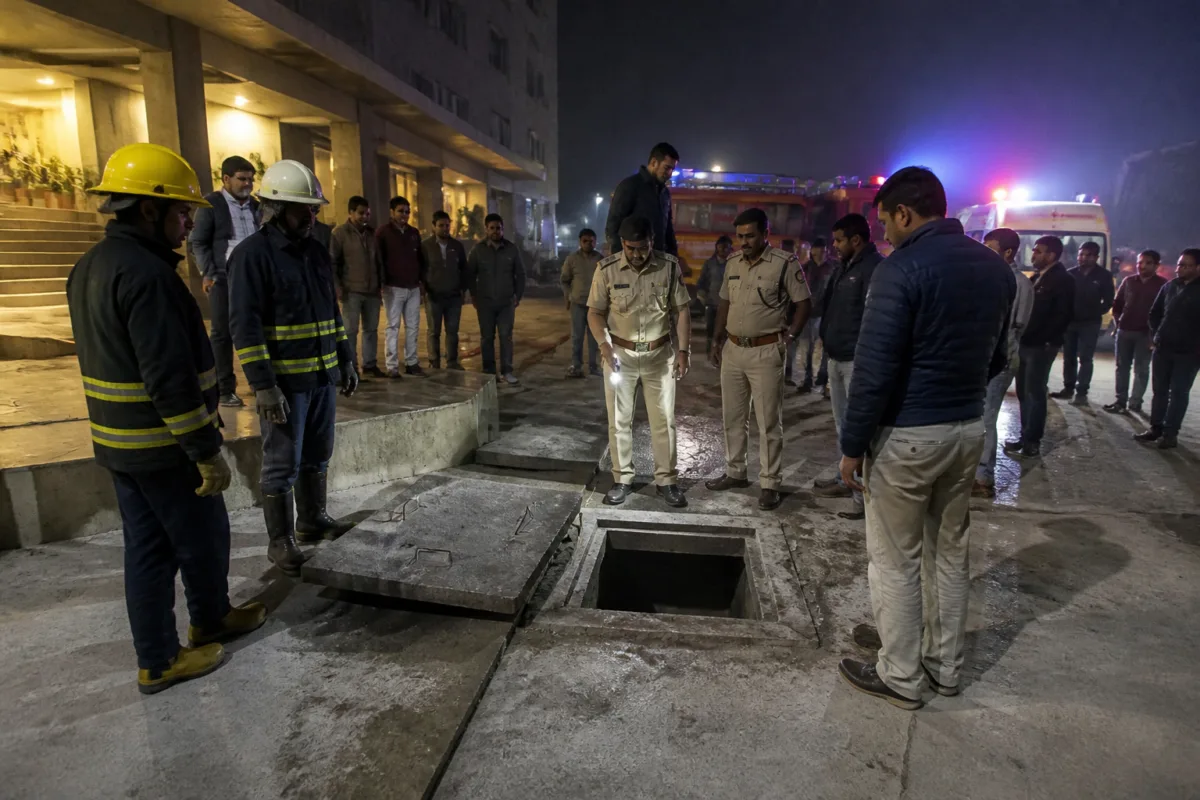
UJJAIN, November 1, 2026 — Madhya Pradesh has announced financial assistance of ₹4 lakh for each of the four families whose relatives died inside a waste chamber at a hotel in Ujjain, as investigators work to establish what happened during a cleaning operation late on Saturday night. The deaths at Shri Ganga Hotel on the Ujjain–Dewas road are being treated as a suspected suffocation incident, but authorities have not released a final medical or forensic finding identifying the gas, if any, that caused the deaths.
The fresh compensation announcement is a material update to the incident first reported on Sunday morning. The Indian Express reported at 9.01 p.m. IST that Chief Minister Mohan Yadav had directed the state to provide ₹4 lakh to each bereaved family. Earlier reports from PTI and The New Indian Express said two other people who entered the chamber in an attempt to rescue the trapped workers also became unwell. The Telegraph reported that the two were discharged after initial treatment.
According to police accounts reported by PTI, the incident occurred at about 11 p.m. on Saturday. Two people entered a chamber used to collect food waste, apparently to clean it, and became trapped or collapsed inside. Two more people then entered in an attempt to rescue them. All four died. The exact sequence is still being investigated: the district administration said it would establish whether the workers entered the chamber to clean it or fell into it accidentally.
Also read: Bengaluru Hotel Pool Deaths: Conrad Management Booked as Electrical Probe Widens
The chamber was described in reports as a food-waste tank connected to the hotel’s sweets and dairy-products unit. That description is important because the contents and ventilation of a waste chamber can affect the risks faced by anyone entering it, but the available reports do not provide a technical inspection, a gas reading or a complete diagram of the structure. It would therefore be premature to state that a particular gas was present or to attribute the deaths to a specific chemical.
Ujjain Superintendent of Police Pradeep Sharma told reporters that the four people were pulled out and police attempted cardiopulmonary resuscitation, but they could not be revived. The victims were taken to hospital, where doctors declared them dead. The bodies were sent for post-mortem examination, and the police investigation was continuing. Those details establish the rescue sequence reported by officials; they do not yet establish the medical cause of death.
The two people who entered the chamber after the first pair were affected during the rescue attempt, according to the reports. Early accounts said they were receiving treatment; a later report said they had been discharged after initial care. Their experience underlines an important feature of confined-space incidents: a person attempting a rescue can be exposed to the same hazard as the person already inside. No report reviewed here established what protective equipment, if any, was available to the rescuers.
Chief Minister Mohan Yadav expressed grief over the deaths and directed that ₹4 lakh be provided to each family, according to an IANS report carried by The Presidency and the Indian Express’s evening update. The assistance is immediate relief. It does not determine the cause of the incident, settle questions of responsibility or replace any compensation that might later be ordered under applicable law or through other arrangements.
The public reports have not yet supplied a complete account of each worker’s employment arrangement, whether they were employed directly by the hotel or through a contractor, or who was responsible for the cleaning operation. Those details matter because responsibility for a workplace hazard can depend on who controlled the site, who instructed the work, what training was provided and whether the people entering the chamber had the equipment and information needed to do so safely.
Police and the district administration have said that the circumstances will be investigated. That inquiry should distinguish between the immediate cause of the deaths, the decisions that led the workers to enter the chamber and any failures in the system meant to prevent an unsafe entry. A compensation announcement is an important response to bereaved families, but it is not a substitute for answers about how the incident occurred or how a similar event can be prevented.
Enclosed tanks and chambers can present hazards that are not visible from the entrance. Depending on the material stored, decomposition can produce gases; oxygen can be displaced; and a worker may be unable to climb out quickly after becoming dizzy or losing consciousness. A chamber can also be difficult to ventilate, inspect or access. These are general risks associated with confined spaces, not a finding that a particular gas or oxygen deficiency has been confirmed at the Ujjain hotel.
The sequence described by police is consistent with a dangerous pattern seen in confined-space emergencies: one person becomes incapacitated, another enters to help, and the second person is exposed to the same unseen hazard. A rescue plan has to account for that possibility. Simply having colleagues nearby is not a substitute for testing the atmosphere, isolating equipment where necessary, providing appropriate protective gear and arranging a rescue method that does not send unprotected people into the same space.
The investigation will need to establish whether the chamber had been emptied or ventilated, whether its contents were known, whether air quality was tested before entry and whether the workers had been trained to recognise the danger. It should also examine access arrangements, the condition of the chamber, any mechanical equipment connected to it and the instructions given before work began. These are questions for investigators and technical specialists, not conclusions that can be drawn from the death toll alone.
A further question is whether anyone assessed the risks before the cleaning began. A job that appears routine can become hazardous when it involves entering a tank, pit or enclosed chamber. Safe procedures normally require an assessment of the space, control of any source of danger, a way to verify that the atmosphere is safe, suitable equipment, communication with a person outside and a planned response if something goes wrong. The available reports do not say whether such measures were in place at Shri Ganga Hotel.
Post-mortem findings and any toxicology tests will be important in determining whether the workers died from oxygen deprivation, toxic exposure or another cause. Investigators may also need to examine the chamber’s contents, ventilation, access points and maintenance records. If a gas is suspected, a properly documented assessment of the site can help distinguish a plausible explanation from a confirmed cause. No final report was available in the sources reviewed for this article.
The authorities also need to establish the workers’ roles and the instructions they received. Were they trained for the task? Did anyone supervise the entry? Was the chamber normally cleaned by staff or by a specialist contractor? Was the work being done under time pressure? The answers will help determine whether the incident arose from an unforeseen hazard, an unsafe work method, inadequate equipment or a combination of factors. None of those possibilities should be treated as established before evidence is examined.
If the investigation identifies a failure to follow safety requirements, the next question will be which person or organisation had the relevant duty and control. The hotel’s ownership or management should not be declared responsible merely because the incident occurred on its premises; equally, investigators should not stop at describing the event as an accident if the evidence points to avoidable risks. The legal assessment will depend on records, witness accounts, technical findings and the applicable provisions.
Also read: Six Killed in Uttarakhand Helicopter Crash Near Joshimath
The inquiry should also account for the two people who became ill during the rescue. Their medical records and statements may help reconstruct the sequence and the effects of the suspected exposure. The fact that they survived does not make their experience less important: their accounts could clarify how quickly people became unwell, whether anyone recognised the danger before the second entry and what rescue equipment was available.
The Ujjain deaths raise a broader question about how hotels, restaurants, food-processing units and other businesses manage waste chambers and other enclosed spaces. The hazards can be overlooked because cleaning is routine and the space may not look like industrial equipment. But the risks depend on the contents, ventilation and access conditions, not on whether the premises are described as a hotel, a small business or a factory.
The case also illustrates why emergency plans need to protect would-be rescuers. People often act quickly when a colleague collapses, but entering an enclosed space without assessing the atmosphere can multiply the number of casualties. Training should make clear when to call emergency services, when to isolate the area and why an unprotected rescue attempt may be fatal. The specific arrangements at the hotel remain unknown, so these points are safety considerations rather than findings about its staff.
For workers, the practical question is whether they can refuse an unsafe task, ask for protective equipment and receive clear instructions without being penalised. For employers and contractors, the task is to make safety procedures workable on the ground, not merely to keep a policy document. For regulators, a fatal incident should prompt a review of the conditions at the site and whether similar operations elsewhere are being carried out under comparable risks.
As of Sunday night, the reports reviewed did not establish the precise cause of death, the gas or atmosphere inside the chamber, the workers’ employment arrangements, the equipment they were given or whether a formal safety assessment had been completed. The district administration has said the sequence will be investigated, and post-mortem findings remain central to the next stage. It is also not clear from the available reporting whether any specific regulatory inspection or enforcement action has been ordered.
The next meaningful update should come from the police, district administration or medical authorities with the results of their examination. The families need timely information about the investigation as well as the announced relief. Any finding of negligence must be supported by evidence and due process, but a final report should also explain what safeguards were present, what failed if anything did, and what action will reduce the risk of another fatal chamber entry.



Comments (0)
Be the first to comment. Comments are published after moderation.