


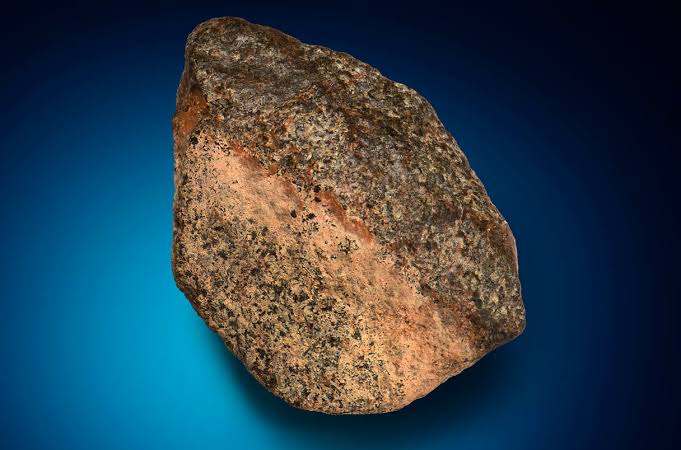
NEW DELHI, November 1, 2026 — A meteorite found in Mali’s Sahara region has been dated to more than 4.1 billion years ago, giving planetary scientists a rare piece of evidence about the early crust of Mars. Named Teghaza 001 after a nearby salt plain, the roughly 800-gram rock was discovered in 2022. A NASA-funded study published in the journal Science on October 29 describes mineral evidence that water interacted with the rock’s source material while Mars was still young. The finding helps reconstruct the planet’s early geology, but it is not evidence that life existed there.
Teghaza 001 is one of roughly 435 Martian meteorites known on Earth, according to the researchers’ account. Most such rocks reached Earth after an impact on Mars blasted material away from the planet and sent it into space. Their journey makes them scientifically valuable but also difficult to interpret: scientists can study the fragments in laboratories, yet often cannot identify the precise crater or geological setting from which they came.
Researchers analyzed Teghaza 001’s mineral grains to establish its age. Zircon crystals preserve clues about a rock’s formation, while the study also describes a specialized in situ rubidium-strontium dating method that measures tiny mineral grains without dissolving the entire sample. That approach allows scientists to retain more of a rare meteorite for future work. The researchers concluded that Teghaza 001 formed more than 4.1 billion years ago, placing it among the oldest known Martian meteorites. The age estimate rests on mineral analysis rather than a single visual feature, and the different measurements help researchers distinguish the rock’s formation from later alteration.
Dating a meteorite is not the same as dating the moment it landed in the Sahara. The rock’s formation on Mars, its ejection into space, its travel through the solar system, and its arrival on Earth are separate events. The study establishes an ancient formation age, while the exact date when the meteorite fell to Earth remains unknown. That distinction matters because the scientific claim concerns the history of Mars, not the age of the desert fall itself.
The scientific interest lies not only in the age but also in the rock’s mineral chemistry. The researchers reported evidence that water interacted with material in Mars’s crust as it cooled. Chemical and isotopic clues can reveal whether minerals formed directly from molten rock, changed as fluids moved through it, or were altered later. In Teghaza 001, the findings point to water-rock interaction in the ancient Martian crust during a period when the planet’s surface environment was very different from the cold, dry world seen today.
Water can alter rocks without producing any biological activity. On Earth, fluids move through fractures and pores, dissolve some minerals, transport chemical elements, and leave new minerals behind. Similar processes on Mars can preserve clues about temperature, chemistry, and the movement of fluids. The meteorite therefore offers a sample of an ancient environment that cannot be reconstructed from photographs alone.
The findings add to a broader scientific picture in which early Mars may have been warmer and wetter in some regions and at some times. Other evidence from orbiters and rovers has identified ancient lake beds, river channels, hydrated minerals, and sedimentary deposits. Each line of evidence answers a different question: surface features can reveal how water moved, while minerals can record chemical conditions in the rocks themselves.
Mars formed alongside the other planets more than four billion years ago. Its earliest geological record is difficult to study because impact cratering, volcanic activity, erosion, and later chemical alteration have changed much of the surface. Earth’s active plate tectonics and water cycle also recycle crust, making the oldest rocks comparatively rare. Mars lacks Earth-like global plate tectonics, so some ancient materials may remain preserved for longer, although impacts and volcanic processes still modify the crust.
A meteorite from the early crust provides a laboratory sample that can be examined with instruments too large or complex to send to Mars. Scientists can cut thin sections, map mineral grains, measure isotopes, and compare the results with experiments. The work is painstaking because a small sample may contain several histories: original crystallization, alteration on Mars, shock from the impact that launched it, and weathering after it reached Earth.
Not with certainty. The team compared the meteorite’s mineralogy and chemistry with possible source regions and identified several locations that could be consistent with the evidence. The study’s mapping analysis highlighted 13 potential origins, with clues pointing towards ancient terrain in Mars’s southern hemisphere and the broader Hellas Basin region. These are candidate locations, not a confirmed landing crater or a precise point of origin.
The uncertainty is a familiar problem in meteorite science. An impact can launch rocks over large distances, and the ejection process may alter them through intense shock pressure. Once the fragment arrives on Earth, desert exposure can add further changes. Scientists therefore combine several independent lines of evidence rather than relying on one mineral or a single chemical signature.
The study does not demonstrate that life existed on Mars. Liquid water is one factor relevant to habitability, but life also depends on other conditions, including suitable chemistry, energy sources, and an environment that persists long enough for biological processes to occur. A rock can show that water interacted with minerals without revealing whether microorganisms were ever present.
Also read: ISRO Gaganyaan Mission: India’s Historic Space Launch in 2027
Researchers distinguish between evidence of habitability and evidence of life. Ancient river channels, clay minerals, and chemical compounds may indicate that a place could once have supported some forms of life. A convincing claim of past life would require much stronger evidence, careful exclusion of non-biological explanations, and independent verification. Teghaza 001 contributes to the environmental history, not a biological verdict.
The meteorite’s age is particularly useful because it captures an early period in Mars’s evolution. If water was present in parts of the crust more than 4.1 billion years ago, researchers can investigate how long such conditions lasted, how widespread they were, and how they changed as the planet cooled and lost much of its atmosphere. These questions are central to understanding why Mars became so different from Earth.
Also read: Space Debris Travels 10X Faster Than Bullets
Rovers can analyze rocks in their original geological setting and relate samples to layers, landforms, and surrounding terrain. Meteorites provide a different advantage: scientists can perform extensive laboratory measurements on Earth with specialized equipment. Neither method is a substitute for the other. A rover may establish the context of a mineral deposit, while a laboratory can measure isotopic ratios with precision that is difficult to achieve remotely.
Mars sample-return efforts are intended to bring carefully selected material from the planet back to Earth for detailed analysis. Meteorites already provide Martian material, but they arrive without a known collection site and may have been altered during ejection and transport. A sample collected directly from a mapped location could answer different questions about age, environmental history, and possible biosignatures.
The comparison also highlights the importance of contamination control. Scientists must separate signatures formed on Mars from changes that happened during the rock’s journey and time on Earth. Desert meteorites can absorb terrestrial water or acquire minerals after landing. Researchers therefore examine the texture and chemistry of individual grains, use controls, and test whether a proposed interpretation fits multiple measurements.
Further work can refine the meteorite’s geological context, compare its chemistry with other Martian samples, and test models of the region where it may have formed. Additional isotope measurements may help separate the age of crystallization from later alteration events. Comparing Teghaza 001 with material studied by Mars orbiters and rovers may also show whether its water-related mineral signatures are local or part of a broader pattern.
The discovery is valuable because it adds a new data point to a limited collection of Martian rocks. It does not settle every question about early Mars, and the proposed source region remains uncertain. The strongest conclusion is narrower: a rock formed more than 4.1 billion years ago preserves mineral evidence of water interacting with the early Martian crust.
That is enough to make Teghaza 001 important without overstating what it proves. Understanding Mars requires combining mineral records, surface geology, atmospheric history, and observations from spacecraft. The meteorite adds a physical sample to that effort and gives researchers another way to test how the Red Planet evolved from an early world with episodes of liquid water into the colder planet explored today.
A meteorite is a fragment, not a complete geological map. Its minerals preserve information about the conditions under which they formed, but scientists must infer the wider environment from a small amount of material. Different grains may record different stages of cooling or alteration, and impact shock can complicate measurements. The researchers therefore compare several mineral and isotopic observations rather than treating one age measurement as a complete account of Mars’s history.
The candidate source regions also remain hypotheses. A rock launched by an impact can travel far from its original location, and a matching chemical signature may be consistent with more than one terrain. Future orbital mapping and comparison with other Martian samples may narrow the possibilities, but the study does not identify a confirmed crater. Keeping that uncertainty visible is important because the meteorite’s strongest contribution is its ancient mineral record, not a precise address on Mars.
Researchers also need to distinguish alteration on Mars from weathering after the rock reached Earth. Sahara meteorites can be exposed to moisture, salts and temperature changes, all of which may affect some minerals. Laboratory preparation, microscopy and chemical tests help identify which features belong to the original rock and which may be later changes. That work is one reason planetary conclusions are based on multiple independent measurements and peer review.
Sources: NASA-funded study on Teghaza 001, NASA Jet Propulsion Laboratory (October 29, 2026); Reuters report on the meteorite’s age and mineral evidence (October 29, 2026); NASA/JPL image and mineral-analysis description.
How old is Teghaza 001?
Researchers estimate that the meteorite formed more than 4.1 billion years ago, making it one of the oldest known Martian meteorites.
Does the meteorite prove that life existed on Mars?
No. The study provides evidence of ancient water-rock interaction, which is relevant to habitability but does not demonstrate that life existed.
Where was Teghaza 001 found?
It was discovered in 2022 in the Sahara region of Mali and named after the nearby Teghaza salt plain. Its precise source location on Mars is not known.






Comments (0)
Be the first to comment. Comments are published after moderation.