


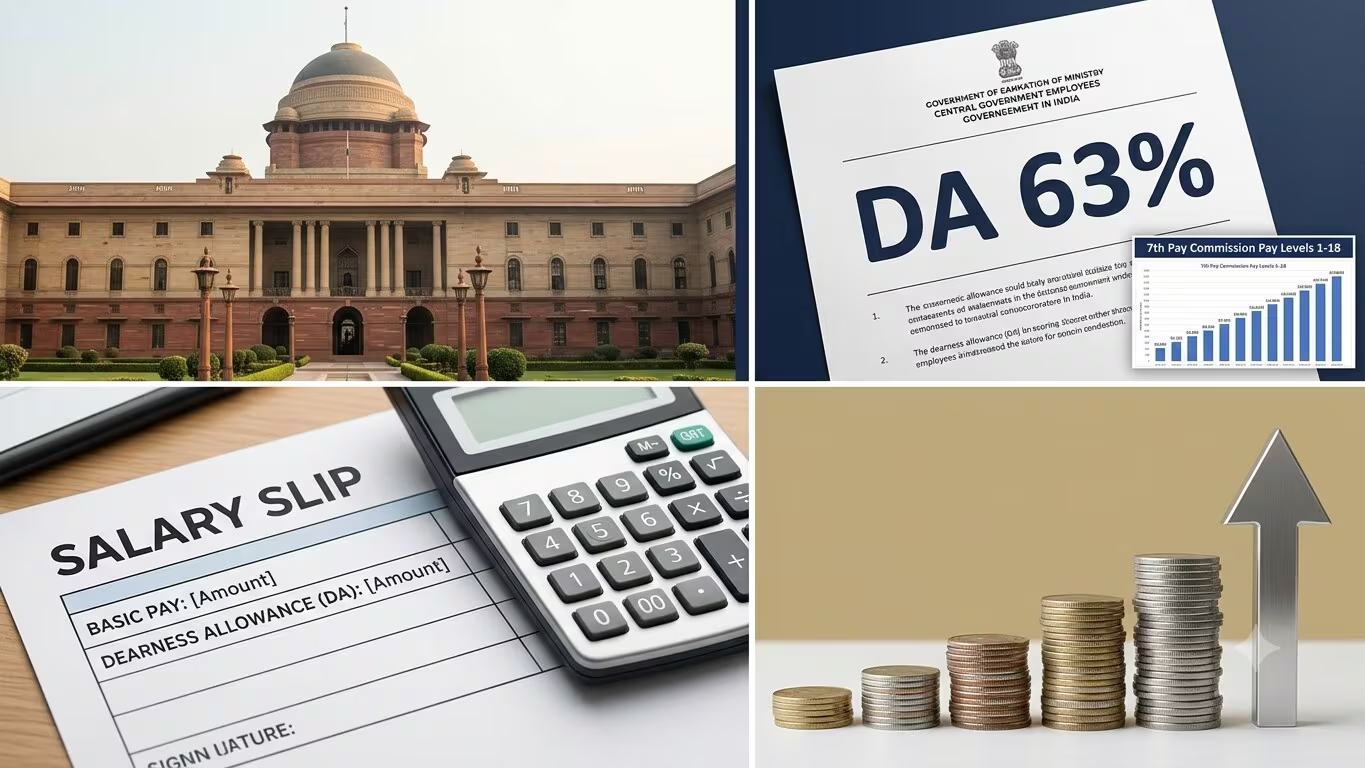
New Delhi, November 1, 2026: The Union Cabinet has approved a three-percentage-point increase in dearness allowance for central government employees, taking the rate from 60% to 63% of basic pay with effect from July 1, 2026. Pensioners covered by the corresponding dearness-relief decision will receive the same three-point increase against their basic pension.
The Prime Minister’s Office said the revision is expected to benefit about 48.54 lakh central government employees and 68.71 lakh pensioners. The government estimates the combined annual impact on the exchequer at ₹10,016.10 crore. The decision follows the accepted formula based on recommendations of the Seventh Central Pay Commission, according to the official Cabinet announcement.
The increase is effective from July 1, but the revised percentage should not be confused with a 3% rise in every employee’s total salary or a uniform increase in take-home pay. DA is calculated as a share of basic pay; other salary components, deductions, pension rules, and individual circumstances affect the amount received.
The new rate is 63% of basic pay, up from 60%. For pensioners receiving dearness relief, the corresponding rate also rises by three percentage points. The government’s announcement specifies July 1, 2026, as the effective date, even though the Cabinet decision was announced later in October.
Dearness allowance is intended to help government employees manage changes in the cost of living. Dearness relief serves a similar purpose for eligible pensioners. The allowance is linked to basic pay rather than being calculated as a percentage of the employee’s entire gross salary, which may include other allowances or benefits.
The revision follows the formula accepted under the Seventh Central Pay Commission framework. The official announcement does not mean that the Eighth Pay Commission’s recommendations have already been implemented, nor does it establish a new pay matrix. Those are separate policy processes and should not be treated as part of this DA decision.
The simplest way to understand the change is to calculate the difference between 63% and 60% of basic pay. The difference is three percentage points, not 3% of total salary.
- Illustration for ₹30,000 basic pay: DA at 60% is ₹18,000. At 63%, it is ₹18,900. The difference is ₹900 a month before any applicable tax or payroll adjustments.
- Illustration for ₹50,000 Basic pay: DA at 60% is ₹30,000. At 63%, it is ₹31,500. The difference is ₹1,500 a month before deductions.
- Illustration for ₹25,000 basic pension: DR at 60% is ₹15,000. At 63%, it is ₹15,750. The difference is ₹750 a month before any pension-specific adjustments.
These examples show the arithmetic only; they are not official payment estimates for a particular employee. Actual amounts depend on the basic pay or pension recognized by the payroll authority, the applicable service or pension rules, and any relevant rounding or adjustment provisions.
Because the decision is effective from July 1, employees and pensioners may reasonably look for the difference between the earlier and revised rate for the period covered by the implementation order. The actual calculation and payment timing depend on the formal instructions issued to the relevant departments, payroll offices, and pension-disbursing authorities.
Recipients should check their salary slip, pension statement, and official department circular rather than relying on social media tables. A table that assumes the same basic pay, number of eligible months, or pension category for everyone can produce an incorrect figure. Employees who have joined, retired, taken leave without pay, or changed pay levels during the period may need a calculation based on their individual records.
The Cabinet announcement establishes the revised rate and effective date, but it is not a substitute for each department’s implementation instructions. Where a payment appears inconsistent, the first step is to compare the basic pay or pension used in the calculation with the applicable service records and the official order.
The government’s announcement refers to central government employees and pensioners covered by the decision. It does not automatically change the DA rates of state government employees, public-sector staff governed by separate rules, or every worker in the private sector. State governments may announce their own decisions, and organizations can have different service conditions.
Employees should confirm which pay commission structure applies to them and whether their employer follows the central government order. Pensioners should check the category and rules under which their pension is paid. Family pension, disability pension, employees under older pay structures, and other special cases can be governed by separate instructions, so the headline percentage alone may not answer every question.
Private-sector salaries are generally governed by employment contracts and company policy, not by the central government’s DA decision. A private employer may use a cost-of-living allowance or another compensation structure, but the Cabinet announcement does not create an automatic entitlement for private employees.
For eligible households, a higher DA rate can improve the monthly cash flow available for food, transport, rent, education, healthcare, and savings. The actual effect depends on basic pay or pension and on how household expenses have changed. It is therefore useful to calculate the difference using the individual’s basic figure rather than estimate the benefit from gross salary.
Also read: IMF Raises India Growth Forecast to 7% for 2026-27
The revision is also one element of a broader public-pay framework. It should not be read as proof that inflation has fallen or that all household costs are rising at the same pace. DA is adjusted through an established process, while the prices a household faces depend on its spending pattern, location, and exposure to food, fuel, housing, and medical costs.
Energy prices and wider economic conditions can influence household budgets, but they do not directly determine the precise amount each employee receives from this particular decision. The rate and effective date are set out in the government announcement; the personal amount depends on the basic-pay or pension figure.
The DA revision does not by itself settle questions about the next pay commission, the future pay matrix, or a possible merger of DA with basic pay. Those subjects require separate government decisions and official orders. Employees should be cautious about online calculators or posts that present an implementation date or salary increase as confirmed without a published notification.
Also read: Jio Platforms Lists at ₹1,358, 21.36% Above IPO Price
For budgeting, it is safer to treat the DA difference as a specific allowance adjustment and not assume that it will automatically change every other salary component. Any future change in pay structure, pension calculation, or allowance treatment should be assessed against the relevant official documents when they are issued.
How to verify your revised amount
- Check the basic pay or basic pension shown in the latest official statement.
- Confirm that the applicable DA or DR rate was 60% before the revision and 63% after it.
- Use the three-percentage-point difference against basic pay or pension, not against gross salary.
- Check the department’s implementation instructions for arrears, rounding, and the relevant payment period.
- If the amount does not match, contact the payroll office, pension-disbursing authority, or department grievance channel with the official order and your calculation.
Employees should not pay a third party to “unlock” arrears or share bank credentials with someone claiming to process a DA payment. Official salary and pension changes are handled through the relevant employer or pension system, not through unsolicited links.
The immediate next step is implementation by the departments and pension authorities that administer payments. Employees should look for the formal instructions governing revised monthly payments and any arrears from July 1. The Cabinet decision gives the headline rate, effective date, estimated beneficiaries, and annual fiscal impact; the implementation documents determine how those details are applied in individual cases.
The practical takeaway is that the DA rate has moved from 60% to 63% of basic pay, with a corresponding DR revision for eligible pensioners, effective July 1, 2026. The increase is three percentage points of basic pay or pension, not a flat 3% increase in total income.
Sources: Prime Minister’s Office, “Cabinet approves Dearness Allowance to Central Government Employees and Dearness Relief to Pensioners,” official announcement; The Financial Express, “Cabinet approves 3% DA hike for central government employees,” October 2026.
Analysis: The Fortune Post
What is the new central government DA rate?
The Cabinet approved an increase from 60% to 63% of basic pay, effective 1 July 2026. Eligible pensioners receive a corresponding dearness-relief revision.
Is the DA increase 3% of total salary?
No. It is a three-percentage-point increase in the DA rate applied to basic pay. Gross salary and take-home pay include other components and deductions.
Will all state government employees receive the same increase?
Not automatically. The Cabinet decision covers eligible central government employees and pensioners. State governments and other employers may issue separate orders.



Comments (0)
Be the first to comment. Comments are published after moderation.