


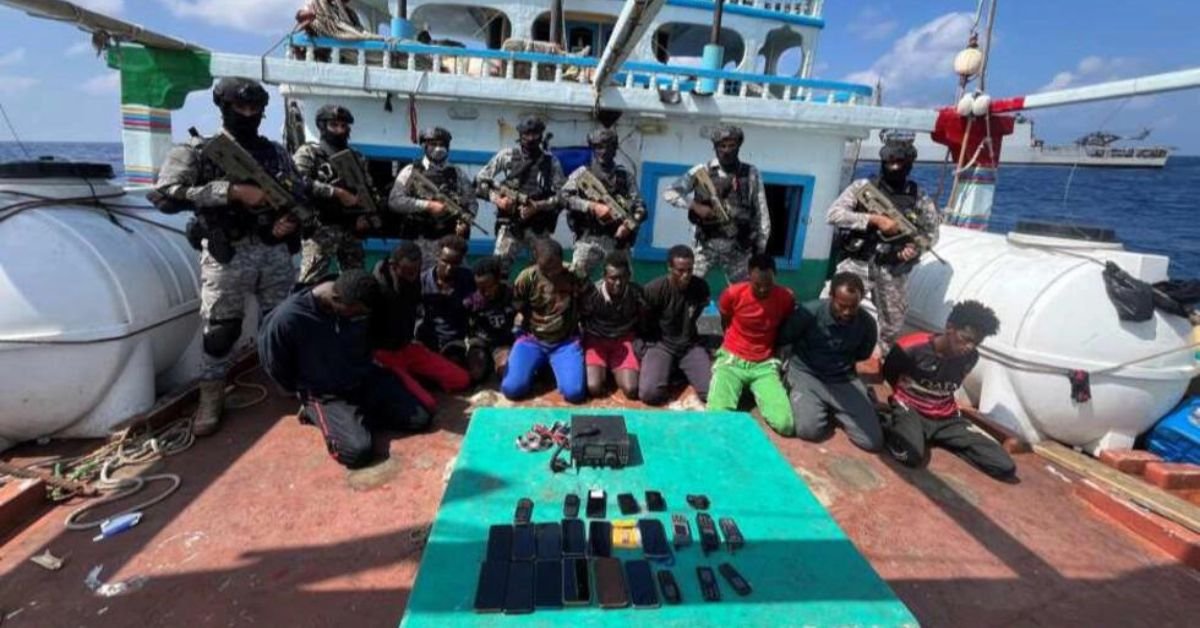
GULF OF ADEN, November 10, 2026 — The Somali piracy resurgence is again placing commercial shipping under pressure across the Gulf of Aden and the western Indian Ocean, as regional conflicts and prolonged instability create conditions that armed groups can exploit. A new Associated Press field report from an European Union naval patrol describes a renewed threat around the Bab el-Mandeb, while an Atalanta commander told the agency that the mission had recorded 79 pirate attacks in the region since November 2023, including roughly 30 after the Iran war began in February 2026.
The naval commander stressed that the relationship is indirect. The conflicts in Yemen, the Horn of Africa and Iran have not been shown to direct individual pirate operations, but they have added pressure to a region already affected by weak institutions, economic hardship and disrupted trade routes. The distinction matters: piracy is a criminal enterprise with local networks and financial incentives, not simply another front in the wars around the Red Sea.
The latest concern follows a series of vessel seizures between April and August. AP has tracked six commercial-vessel hijackings during that period. Five were subsequently freed, while the Tanzanian-flagged tanker MT Asana remained under pirate control in Somali territorial waters in the latest update cited by the agency. The International Maritime Organization said 22 seafarers were still being held aboard the vessel. An earlier EU Naval Force update said the Asana case remained open while four other named piracy incidents had been closed.
The EU mission’s October 16 update identified the closed cases as the motor tanker Honour 25, merchant vessel Sward, motor tanker Eureka and motor tanker Sibu 1, also known as Seamull. It said the Asana case remained open. The sequence shows that the threat is not limited to a single ship or a short-lived incident. Each hijacking can tie up a vessel, hold its crew for months and force shipping companies, insurers and governments to coordinate a difficult response.
The recovery of the Honour 25 in September demonstrated the danger faced by seafarers even when a hijacked vessel is retaken. The IMO said 44 crew members were freed from the Honour 25, Eureka and Sibu 1, but five seafarers were reported killed during the operation to recover the Honour 25. Two others were injured. The agency’s October 2 statement mourned the deaths and called attention to the human cost of rescue operations in which crews can be caught between armed groups and the forces trying to free them.
The Asana’s crew has remained a particular concern because of the number of people still held. An earlier Operation Atalanta update said the vessel carried up to 22 crew members, around half of them Indian nationals. The later IMO and AP reporting continued to identify 22 seafarers as captive. The crew’s nationality makes the case relevant to India, but the danger is shared by seafarers from every country whose ships transit the western Indian Ocean.
Fishing vessels have also featured in the renewed attacks. Pirates can use a seized fishing boat as a mobile base from which to approach larger merchant ships, extending their reach beyond the immediate coastline. AP reported that the Indian Navy freed the Iranian-flagged fishing vessel Azini in early November after an operation lasting more than 48 hours. India’s Ministry of Defence said all 20 crew members were rescued without casualties or injuries. The vessel had been hijacked off Somalia and was considered a possible mother ship for further attacks on merchant traffic.
The Gulf of Aden sits beside one of the world’s most important maritime chokepoints. The Bab el-Mandeb, between Yemen and the Horn of Africa, connects the Red Sea to the Gulf of Aden and the wider Indian Ocean. AP cited estimates that around 12 per cent of global trade, including about a quarter of container traffic, normally passes through the strait on the Asia-Europe route. The waterway has gained further importance as disruption in the Strait of Hormuz has altered the movement of oil and other cargoes from the Gulf.
Houthi attacks on commercial shipping since November 2023 have already changed the security calculations of shipowners and naval forces. The Iran war has added another layer of uncertainty, while conflict and political instability in Yemen and parts of the Horn of Africa have complicated efforts to maintain maritime security. These developments can draw naval resources in several directions at once. They can also make it harder for coastal authorities to monitor remote waters and respond quickly when a vessel sends a distress signal.
Vice Admiral Ignacio Villanueva, the commander of Operation Atalanta, told AP that the connection between instability and piracy is not a simple chain of command. Portuguese Commodore José Rodrigues Pedra, the mission’s commander at sea, made a similar distinction, saying the mission could see the effects of wider crises without claiming that one conflict directly caused a specific hijacking. The assessment is important because it avoids treating Somali pirates as proxies of the Houthis or Iran without evidence.
Local conditions remain central. AP cited analysts who pointed to economic hardship, malnutrition, political deadlock and civil conflict in Somalia. The agency also reported that the United Nations had warned in February that around 30 per cent of the population faced critical levels of food insecurity amid deep cuts to international aid. Such conditions do not excuse piracy, but they help explain why criminal groups may find recruits, local support or opportunities to operate from areas where state authority is weak.
Somali piracy had fallen sharply from its peak in the late 2000s and early 2010s after international naval patrols, private security teams aboard ships, improved reporting and prosecutions made attacks more difficult. The decline encouraged some shipowners to reduce the expensive security measures introduced during the earlier crisis. The renewed hijackings show that those gains can be reversed when surveillance weakens, political instability grows or armed groups find gaps in the protection of commercial routes.
Operation Atalanta, launched by the European Union in 2008, patrols the western Indian Ocean and the Gulf of Aden. AP reported that it was granted access to the Spanish frigate ESPS Santa Maria, which leads the EU mission in the region. The ship carries a helicopter and a drone used for surveillance, while its crew trains for the possibility of boarding or retaking a vessel seized by pirates. The mission also operates an aerial surveillance capability from Djibouti and shares information with partner forces, including deployments from the United States, South Korea, Japan, India and regional states.
Atalanta is not the only naval operation in the area. The EU’s Operation Aspides focuses on the Red Sea and has a different mandate and force structure. The two missions operate in adjacent waters, but piracy in the Somali basin, attacks by the Houthis and the wider security situation around the Strait of Hormuz are not interchangeable threats. Their effects can overlap for shipping companies, yet each requires a different response, intelligence picture and legal basis for action.
For commercial operators, the cost of insecurity extends beyond the value of a ship or its cargo. A hijacked vessel is removed from service, its crew may be held for months, and owners must manage negotiations, legal advice, insurance claims and the risk of a rescue operation. Companies may also alter routes, increase onboard security, delay departures or pay higher war-risk premiums. Those decisions can raise freight costs and affect the delivery schedules of fuel, food, manufactured goods and other commodities.
The Bab el-Mandeb’s importance is amplified when ships are already avoiding other high-risk waters. If traffic is diverted, congestion can shift to alternative routes and ports, voyages can take longer, and fuel consumption rises. If ships continue through a threatened corridor, crews face the risk of missile attacks, boarding attempts or being caught in a naval response. The choice is not simply between a safe and an unsafe route; it is a calculation involving time, insurance, cargo commitments and the security of the people aboard.
India has a direct interest in the safety of the route because its trade, energy imports and seafarers are exposed to the same waters. The Asana’s Indian crew members remain a concern for families and maritime authorities. The rescue of the Azini’s 20 crew members showed that the Indian Navy can respond quickly when a fishing vessel is seized, but the operation also underlined the need for surveillance, intelligence sharing and coordination with coastal authorities beyond India’s territorial waters.
The Ministry of Defence said the Azini operation involved a mission-deployed warship and a maritime reconnaissance aircraft. Marine commandos were reinforced through a precision airdrop by an Indian Air Force C-17 aircraft. The Navy said it used calibrated non-kinetic measures to contain the vessel before securing it and releasing the crew. The official account described the operation as a response to a vessel that could have been used as a mother ship for further attacks on merchant shipping.
India’s role in maritime security is not limited to individual rescues. The Navy works with partners and regional forces, while shipping companies and the Directorate General of Shipping issue advisories for Indian seafarers. A prolonged rise in piracy would test the ability to protect crews, maintain information flows and respond to emergencies across a wide area. It would also add to the pressure created by the conflict around the Gulf and Red Sea, where Indian vessels and crew have faced separate security risks.
The most immediate question is whether the Asana can be released safely and whether the number of hijackings continues to rise. The next updates from Operation Atalanta, the IMO and regional maritime authorities will be important because they can confirm whether a vessel remains in pirate hands, whether crew members are safe and whether new incidents have been reported. The status of the crew should be reported separately from the status of the ship; a vessel can be recovered while seafarers remain injured, missing or in need of medical care.
Longer-term progress will depend on more than patrols. Naval forces can deter attacks, track suspicious vessels and support rescue operations, but they cannot by themselves resolve the political and economic problems that allow piracy networks to survive on land. Coastal governance, lawful fishing access, employment, prosecution of organisers and cooperation between regional states remain part of the security response. Without those measures, successful patrols may suppress attacks for a time without removing the incentives that bring armed groups back to sea.
The current resurgence is therefore both a maritime-security problem and a warning about the fragility of trade routes that depend on stability across several countries. The latest AP reporting shows that naval commanders are preparing for more difficult operations even as they caution against drawing a direct line from regional wars to individual pirate attacks. For shipping companies and seafarers, the practical test will be whether the patrols, intelligence-sharing arrangements and local responses can prevent another cluster of hijackings—and bring the crews already held home safely.



Comments (0)
Be the first to comment. Comments are published after moderation.