


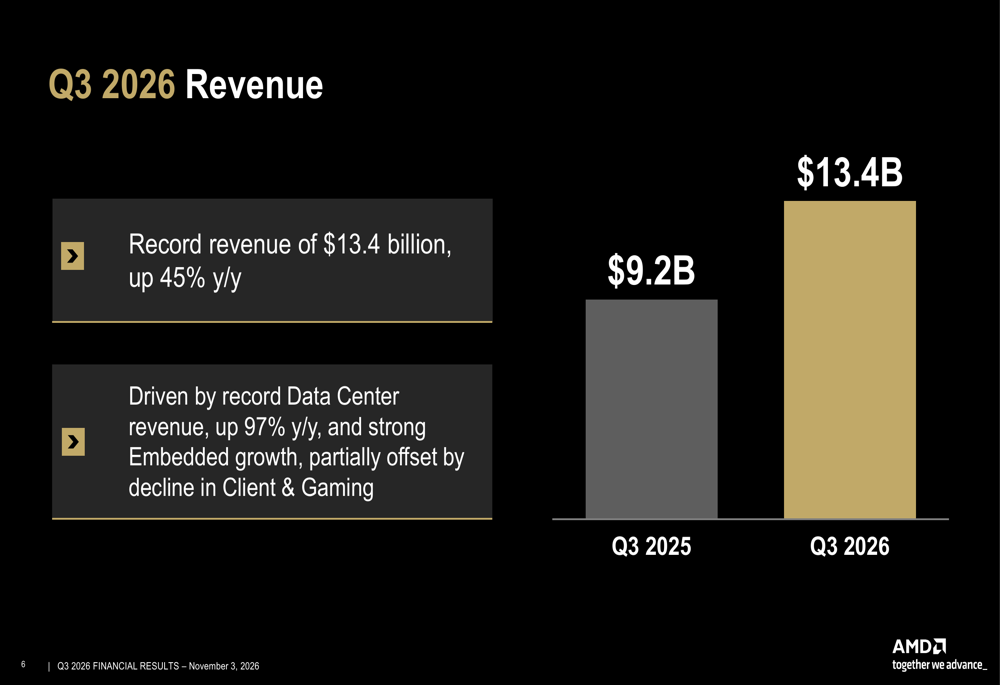
Advanced Micro Devices reported record third-quarter 2026 revenue of $13.377 billion, up 45% from a year earlier, as its data-centre business nearly doubled on demand for Instinct graphics processors and EPYC server CPUs. The results, released on November 3, showed that the company is gaining revenue from the expansion of artificial-intelligence infrastructure while some consumer-facing segments remain weaker. AMD reported GAAP diluted earnings per share of $1.46 and non-GAAP earnings per share of $2.09. Management forecast fourth-quarter revenue of about $17 billion, plus or minus $300 million.
The figures show how strongly the centre of gravity in the semiconductor business has shifted toward data-centre infrastructure. AMD’s record data-centre revenue was $8.5 billion, an increase of 97% year over year. The segment now represents roughly 63% of the company’s quarterly revenue. Demand for processors used in cloud servers and accelerators for AI workloads helped drive the increase, while the company said the launch of its Instinct MI450 series and continued EPYC sales supported the result.
AMD’s data-centre segment includes server CPUs and accelerators used in large-scale computing systems. EPYC processors compete in the server CPU market, while Instinct GPUs are designed for workloads such as training and running AI models. The company said customers including large cloud providers and AI developers were using its Helios rack-scale systems, which combine accelerators, CPUs and networking into larger computing platforms. The results therefore reflect more than the sale of a single chip: customers are buying complete systems and infrastructure that can be deployed in data centres.
The scale of the increase matters because AI workloads require substantial computing capacity, power, cooling and high-speed networking. A data-centre operator must consider the total cost of running a system, not just the purchase price of a processor. Performance per watt, software support, memory bandwidth, availability and the ability to scale across racks can influence which platform a customer chooses. AMD’s revenue growth indicates that its products are securing a larger role in this market, but it does not establish that the company has displaced its competitors or that every customer will adopt the same architecture.
The company’s software ecosystem is also important. AMD’s ROCm platform provides tools and libraries for developers building applications on its accelerators. A hardware platform can be competitive on paper but struggle to attract workloads if developers find it difficult to port software or optimise performance. AMD has been expanding ROCm support and working with cloud providers, software developers and system makers. The commercial effect of those efforts will depend on whether customers can run workloads reliably and at scale, not only on benchmark results.
The broader AI infrastructure market is being shaped by large capital-spending plans from cloud companies and other technology firms. Those investments can create demand for accelerators, CPUs, memory, networking equipment and power systems at the same time. The cycle also carries risks: if customers slow spending, if data-centre projects are delayed by power or permitting constraints, or if the economics of AI services disappoint, equipment orders can change quickly. AMD’s current results show demand at the time of the quarter, not a guarantee that the same growth rate will continue.
Also read: Global Markets Slide as AI Stocks Weaken and Oil Rebounds Ahead of US Midterms
AMD’s Client and Gaming segment generated $3.7 billion in the quarter, down 8% year over year. The client business, which includes PC processors, rose 7% to about $2.9 billion, supported by Ryzen mobile processor sales. Gaming revenue fell 40% to $773 million, reflecting lower semi-custom and graphics revenue. The split is important because it shows that the AI-driven expansion is not lifting every part of the company at the same pace.
The gaming decline reflects the timing of console-related revenue and weaker graphics demand, while the PC business faces a different set of conditions. Consumers and businesses weigh replacement cycles, device prices, memory costs and the availability of new systems. If AI data-centre demand absorbs more of the supply of memory and other components, PC makers may face higher costs or longer lead times. That can influence the price of a finished laptop or desktop even when the processor itself is competitive.
AMD’s Embedded segment delivered $1.1 billion in revenue, up 29% year over year, with growth across aerospace and defence, automotive, communications and industrial markets. Embedded chips are used in systems that require long product lifecycles and specialised reliability. The segment is smaller than data centre, but it gives AMD exposure to markets that do not depend entirely on consumer PC or gaming demand. The company has been expanding its adaptive and embedded portfolio as part of a broader push beyond traditional CPUs and graphics cards.
Also read: CrowdStrike to Acquire Fiddler AI and Dreadnode to Secure AI Agents
The quarter’s profitability also improved. GAAP gross margin was 54%, compared with 52% a year earlier, while operating income rose to $2.832 billion. Non-GAAP gross margin was 56%, and non-GAAP operating income reached $3.923 billion. These measures are not interchangeable: GAAP figures include expenses that AMD excludes from its non-GAAP presentation, so readers should compare like with like when assessing margins and earnings. The gap between the two sets of numbers reflects adjustments that investors should review in the company’s reconciliation.
AMD guided to fourth-quarter revenue of approximately $17 billion, with a range of plus or minus $300 million. That would represent a further increase from the third quarter if achieved. Management attributed the outlook to stronger demand across its data-centre portfolio and said it expected to scale Helios and Venice production. Guidance is a management estimate based on assumptions about supply, customer demand and execution; it is not a reported result and can change if conditions shift.
Investors and customers will be watching whether AMD can deliver the products it has announced in sufficient volume and whether its software and system partners can support large deployments. The MI450 accelerator series, EPYC processors and Helios rack-scale systems are part of the company’s attempt to sell more complete AI infrastructure. The pace of customer qualification, system availability and power efficiency will matter as much as headline chip performance. A delayed deployment can move revenue between quarters even when a customer remains committed to the platform.
Competition is another constraint. Nvidia has a large installed base in AI accelerators and a mature software ecosystem, while cloud companies are also developing their own chips for specific workloads. AMD’s opportunity is not simply to match a competitor’s product specification; it must offer customers a credible alternative in cost, performance, availability and software support. Large buyers may diversify suppliers, but they also face the engineering cost of validating and operating multiple platforms.
The results should therefore be read as a strong quarter for AMD’s data-centre business, not as proof that the semiconductor cycle has become risk-free. The company remains exposed to supply-chain bottlenecks, export controls, customer concentration, capital-spending cycles and changes in AI demand. The gaming segment’s decline is a reminder that consumer and semi-custom markets can move differently from enterprise infrastructure. The next few quarters will show whether the data-centre growth can translate into sustained margins and cash generation.
For readers following the semiconductor industry, the key indicators to watch are data-centre revenue, gross margin, operating cash flow, product availability and customer deployments. A headline revenue figure gives the scale of the quarter, but the segment mix explains where growth is coming from. AMD’s November 3 results show that AI infrastructure is now the dominant driver of its reported sales, while its other businesses face a more mixed environment.





Comments (0)
Be the first to comment. Comments are published after moderation.