


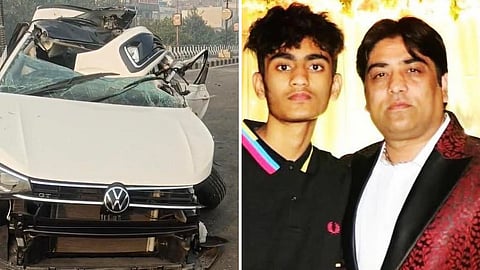
Two young men were killed and three others injured when a car collided with a municipal corporation tractor-trolley in Jalandhar district in the early hours of November 1, police said. The deceased were identified as Divit Auluck, 18, and Aarav Talwar, 19. The three injured occupants were taken for medical attention and were later discharged, according to reports citing police. The collision took place while the group was returning from a birthday gathering. Police said preliminary information indicated that the car struck a tractor-trolley being used for municipal garbage collection.
The incident was reported at about 3 am, when a control-room alert brought police teams to the site. The two young men were taken to a nearby hospital, where doctors declared them dead on arrival. The other occupants sustained minor injuries. The available reports do not provide a full medical account of the injuries or a complete reconstruction of the collision. They also do not establish the speed of the car, the precise position of the trolley or the visibility conditions at the time.
Baradari police station SHO Sahil Chaudhary told news outlets that the preliminary investigation indicated the car rammed into a municipal corporation tractor-trolley involved in road garbage collection. The vehicle was described in reports as being parked near a major roundabout or the Police Lines area. The municipal trolley’s role in the collision is part of the reported sequence, but the public information available so far does not establish whether it was positioned in a designated work zone, whether warning lamps or reflective markings were in use, or whether any traffic-control measures had been placed around it.
Those details matter because a preliminary police account is not the same as a completed investigation. Investigators may need to examine the vehicle damage, the road layout, lighting, CCTV footage, witness statements and any available electronic data from the car. A conclusion about speeding, negligence or the positioning of the municipal vehicle should not be drawn from the fact of the collision alone. Each factor has to be supported by evidence, and the available public reports do not provide a final police finding.
The families declined to file a formal legal complaint, according to a report by The Times of India. That statement should be reported carefully. It does not, by itself, establish whether police registered a separate case, whether any statutory process remains open or whether an inquiry has concluded. The sources consulted do not provide a final police closure report or a court finding. The status of any further action should therefore be confirmed with the investigating police station before it is described as settled.
The names of the two victims have been reported by police and news organisations. Divit Auluck was identified as the son of music-company founder Dinesh Auluck; singer Yo Yo Honey Singh later described him as his nephew in a public condolence message. Aarav Talwar was also identified by police reports. The family connection explains why the incident received wider public attention, but it does not change the central facts of the crash or provide evidence about how it occurred. The families’ privacy should be respected while the circumstances are examined.
Municipal tractor-trolleys and other maintenance vehicles often operate at night or in the early morning to collect waste, repair roads and clear public spaces while traffic is lighter. That work can reduce daytime congestion, but a vehicle stopped on or beside a carriageway can create a hazard if approaching drivers do not see it in time. The risk depends on the road geometry, speed, lighting, weather, visibility, the vehicle’s position and the use of warning devices. The fact that a municipal vehicle was involved does not prove that it was improperly parked; that question requires the investigation’s evidence.
For a road user, the safest response to a work vehicle ahead is to reduce speed, increase following distance and look for workers, cones, reflective signs or warning lamps. At night, headlights can make a stationary object appear closer or farther away than it is, particularly on a wide road with limited reference points. Drivers should avoid sudden lane changes and should not assume that a large vehicle will be visible merely because it is larger than a car. Two-wheelers and pedestrians face additional risks because they have less protection in a collision.
For agencies carrying out night work, a clear work zone helps separate the activity from moving traffic. Warning signs placed far enough in advance, reflective material, functioning lights, cones and a safe buffer around the work area can give approaching drivers time to react. The exact measures required depend on the road, traffic speed and local engineering standards. It would be wrong to claim that any one measure was absent in Jalandhar without an official inspection report. These are general road-safety principles, not findings about this specific crash.
The Ministry of Road Transport and Highways’ annual road-accident reporting provides a wider context for why investigators examine several factors rather than a single explanation. Road deaths in India involve a mix of driver behaviour, road design, vehicle condition, visibility and enforcement. A single collision can have more than one contributing factor, and a preliminary description of the event should not be turned into a definitive cause. The national data is useful for policy and prevention, but it cannot determine what happened at one junction in Jalandhar.
The reports reviewed do not provide a final reconstruction of the car’s movement, its speed, the exact placement of the tractor-trolley or the condition of the warning equipment at the site. They do not say whether CCTV footage has been secured or whether a technical inspection of the vehicles has been completed. There is also no public final statement from the investigating officer setting out the legal status of the case. These are important gaps, and any later update should be based on an official police statement or a document released by the authorities.
It is also important not to infer that the three injured occupants were unharmed simply because they were discharged. A hospital discharge indicates that doctors considered them fit to leave at that time; it does not provide a complete account of any later treatment or psychological impact. The families of the deceased and injured people should not be pressed for details while they are dealing with the aftermath. Public reporting should use information that has been confirmed by the authorities or voluntarily released by the families.
The crash is a reminder that late-night roads are not automatically safe because traffic is lighter. Drivers may be tired, visibility can be limited and road-maintenance work may be under way. The practical safeguards are familiar: avoid driving when fatigued, keep speed appropriate to the road and lighting, maintain distance, use seat belts and never assume that a stationary vehicle or work site will be visible at the last moment. These precautions cannot explain the Jalandhar collision, but they can reduce risk on other journeys.
For now, the confirmed public account is that two young men died, three others were injured and police described the preliminary collision as a car striking a municipal tractor-trolley used for garbage collection. The circumstances around speed, positioning, visibility and any further legal action remain matters for the authorities. The Fortune Post will update the report only if police release new findings or reliable documents clarify those points.

Comments (0)
Be the first to comment. Comments are published after moderation.