


LONDON, November 3, 2026 — Global markets fell on Tuesday, with shares and US stock futures lower as technology stocks extended a retreat across Asia and Europe, investors questioned whether heavy artificial-intelligence spending will deliver returns quickly enough, and oil prices rebounded after renewed military action near the Strait of Hormuz. The market moves came as Americans began voting in midterm elections that could reshape control of Congress and the policy outlook for the final two years of President Donald Trump’s term.
The decline was sharpest in several Asian technology markets. South Korea’s Kospi fell 4%, with memory-chip maker SK Hynix losing 5.7% and Samsung Electronics down about 4%, according to the Associated Press. Taiwan’s Taiex dropped 3.8%, while Taiwan Semiconductor Manufacturing Company and chip designer MediaTek also fell. The losses followed a period in which chipmakers and other AI-linked companies had attracted strong investor demand on expectations that data-centre construction and advanced computing would keep expanding.
European trading reflected the same caution. Reuters reported that the pan-European STOXX 600 was down 0.4% at 647.13 points by 0955 GMT, with the technology sector falling 1.6%. Shares in ASML and STMicroelectronics were among the notable decliners. The CAC 40 in Paris, Britain’s FTSE 100 and Germany’s DAX were also lower in the early session, while futures tied to the S&P 500 and Dow Jones Industrial Average pointed to a weaker start on Wall Street.
These are intraday snapshots rather than closing prices, and the direction of individual markets varied. Hong Kong’s Hang Seng rose 0.6% in the AP report, while the Shanghai Composite slipped 0.8%. India’s Sensex was up 1.3% in the same snapshot. Tokyo’s market was closed for a public holiday. The uneven performance suggests investors were not responding to a single global signal; technology exposure, local policy and currency conditions were shaping each market differently.
The technology sell-off has centred on the question of how much revenue and profit the current wave of AI investment can ultimately generate. Major US cloud and technology companies have committed enormous sums to data centres, accelerators, networking equipment and power capacity. Those investments are intended to support demand for model training and AI services, but investors are increasingly asking when the spending will translate into durable cash flow and whether the expected growth has already been priced into company valuations.
Reuters said Asian chip benchmarks came under pressure as investors reassessed the sustainability of the AI-driven rally after disappointing results from major US hyperscalers in the previous week. Apple’s outlook added to the cautious mood: the company’s forecast for a lower holiday-quarter gross margin, partly because of rising memory costs, raised questions about how the competition for components is affecting consumer-device makers. A stronger market for AI infrastructure can benefit chip suppliers while increasing costs for companies that buy memory and other components for phones, computers and other products.
Also read: Apple Q4 Earnings Beat Estimates as Memory Costs Pressure Holiday Outlook
The pressure is not limited to one chipmaker or one earnings report. Investors are comparing the scale of announced capital expenditure with the pace at which customers are adopting paid AI products. Data-centre projects can take years to secure land, electricity, cooling, permits and equipment. Even after a facility opens, its financial performance depends on utilisation, the price customers are willing to pay and the cost of keeping hardware current. A delay in any part of that chain can push expected returns further into the future.
That does not mean demand for AI computing has disappeared. Reuters reported that UK energy company Drax rose after announcing a data-centre project with Brookfield and Radiant that could attract more than £20 billion in investment. The contrast is important: some companies connected to new infrastructure continued to attract buyers even as semiconductor shares weakened. The market is trying to distinguish projects with credible customers, financing and power arrangements from investment plans whose economics are still uncertain.
Investors will also watch whether software companies can turn AI adoption into recurring revenue rather than relying mainly on pilot projects or one-off deployments. A strong quarterly revenue increase can be followed by a share-price decline if new contract growth slows or if the valuation assumes an even faster expansion. The reaction to recent technology results shows that earnings quality, customer retention and the cost of computing are being assessed alongside headline sales growth.
Also read: Palantir Q3 Earnings: Revenue Jumps 96% as US Commercial Sales Overtake Government
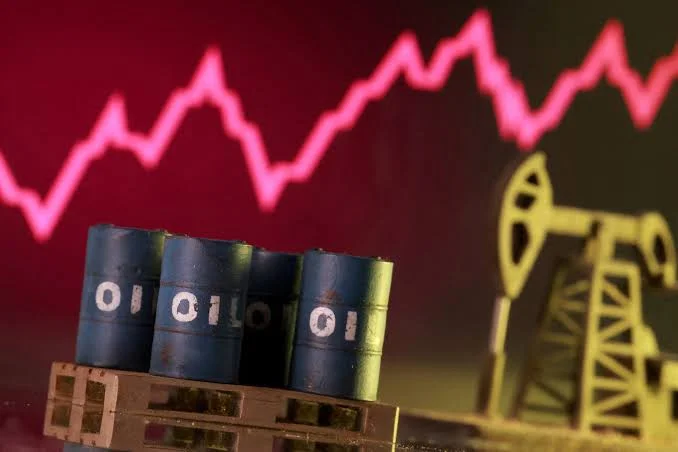
Energy prices moved in the opposite direction to equities. Brent crude rose more than 1% to above $100 a barrel in Reuters’ European market snapshot, recovering after a steep fall in the previous session. The Associated Press reported Brent at $106.58 a barrel and US benchmark crude at $97.88 in its Tuesday market update. The exact level changed during trading, but both reports pointed to a rebound as traders reassessed the risk of further disruption in the Gulf.
The move followed reports of US defensive strikes against Iranian targets near the Strait of Hormuz, including Qeshm Island. The Associated Press cited a US official describing the operation as defensive, while Reuters reported that the strikes and the wider regional tensions had weighed on investor risk appetite. The available public accounts did not establish a complete list of targets or a verified assessment of damage to commercial energy infrastructure. The price reaction therefore reflected concern about the possibility of escalation, not proof that a new interruption to oil exports had occurred.
Oil had fallen sharply on Monday as traders responded to signs that diplomatic contacts between Washington and Tehran might create a path towards reducing the conflict. The rebound shows how quickly the market can reverse when expectations change. A sustained easing in tensions could reduce the risk premium embedded in crude prices; further military action or threats to shipping could push that premium higher. Neither outcome can be inferred from one session’s futures movement.
Also read: US Strike Reported on Iran’s Qeshm Island as Oil Prices Edge Higher
Higher oil prices matter to import-dependent economies because they can raise the cost of fuel, transport, fertiliser and industrial inputs. The impact on consumers is not immediate or identical across countries: taxes, subsidies, currency movements, refinery margins and local distribution costs affect how global crude prices feed through to retail prices. For businesses, the uncertainty can be as difficult as the price itself because it complicates budgeting and decisions about inventory and investment.
The currency market was also responding to policy decisions in Asia. China’s central bank said it would raise the foreign-exchange reserve requirement for financial institutions from 4% to 6% from November 15, a move aimed at managing foreign-currency liquidity as the yuan strengthened. Reuters estimated that the change could withdraw about $24 billion from the financial system. The announcement was followed by a decline in the onshore yuan, although analysts cited by Reuters said the step was unlikely by itself to reverse the currency’s broader trend.
Australia’s Reserve Bank raised its cash rate by 25 basis points to 4.85%, the highest level in 18 years, in a split 6-3 decision. It was the fifth increase this year. The narrow vote and the bank’s softer guidance led markets to consider whether policymakers may pause, but the decision also showed that inflation pressures remain a concern even as higher borrowing costs weigh on households and businesses.
Those central-bank moves underline why investors are watching several variables at once. Higher interest rates can support currencies and make non-yielding assets less attractive, while energy-price shocks can complicate the fight against inflation. A stronger dollar, changing bond yields and geopolitical uncertainty can all affect the value of global shares and commodities. The direction of one market does not automatically determine the direction of another.
Election uncertainty keeps investors cautious
US midterm voting began on Tuesday, with all 435 seats in the House of Representatives and 35 Senate seats on the ballot, alongside gubernatorial, state legislative and local contests. Republicans are defending narrow congressional majorities, while Democrats are seeking the net gains needed to take control. The outcome could affect the administration’s ability to pass legislation, oversee federal agencies and advance tax, trade, energy and technology policies.
Markets do not have a single, predictable response to a change in congressional control. Investors will look at the likely implications for fiscal policy, regulation, tariffs, government spending and the technology sector, but the effects depend on which party wins, how narrow the margins are and whether lawmakers can agree on legislation. Even a clear result may take time to translate into policy because the presidency, House and Senate have different powers and political incentives.
The election is one source of uncertainty among several, rather than the sole explanation for the day’s market movements. The technology decline has a sector-specific driver in the reassessment of AI spending, while the oil rebound reflects the risk of renewed conflict. Interest-rate decisions in Australia and currency management in China add further context. Treating every move as an election reaction would obscure the different forces acting on each asset class.
For investors, the next indicators include the next round of technology earnings, evidence of customer demand for AI services, changes in data-centre spending plans, oil flows through the Gulf and the results of the US vote. A market rebound would require more than a change in sentiment if the underlying concerns about returns on AI investment remain. Likewise, a fall in crude prices would need to be supported by a sustained improvement in shipping and security conditions rather than a brief easing in headlines.
Tuesday’s trading showed a market trying to price two very different kinds of risk: whether the AI investment cycle can meet the expectations built into technology valuations, and whether geopolitical tensions will keep energy prices elevated. The US midterms add a political variable, but the immediate direction of markets will depend on how those business, energy and policy risks develop over the coming sessions.




Comments (0)
Be the first to comment. Comments are published after moderation.