


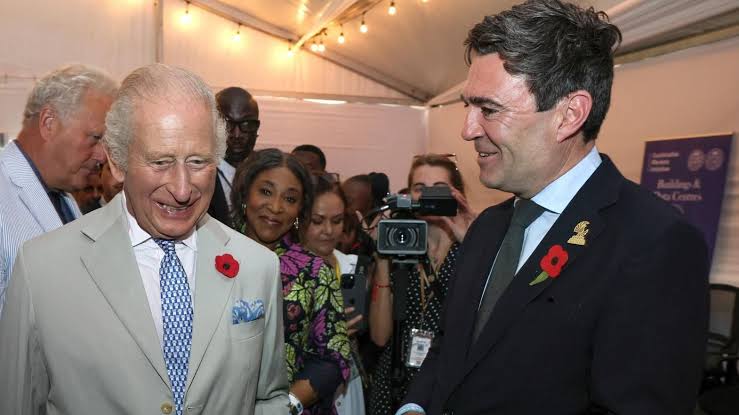
ST JOHN’S, Antigua and Barbuda, November 2, 2026 — The Commonwealth summit in Antigua and Barbuda is heading into its leaders’ sessions with two connected questions likely to test relations between Britain and Caribbean members: whether the United Kingdom can offer a meaningful process for addressing its role in the transatlantic slave trade, and whether a proposed debt-restructuring initiative can deliver practical relief to countries facing high borrowing costs. UK Prime Minister Andy Burnham is expected to press for longer repayment periods and better financing terms while opening structured talks with affected countries and communities about a possible formal apology.
The proposals are not a settled agreement, and Burnham has not announced a formal state apology or accepted demands for financial reparations. His government has ruled out compensation payments, a position that Caribbean leaders and reparations campaigners say leaves a central part of their demand unresolved. The talks are unfolding as the 56-member Commonwealth gathers in a small Caribbean host country, with trade, climate resilience, investment, youth opportunities and the financing needs of vulnerable states also on the agenda.
Reuters reported that Burnham plans to use the meeting to call for a reset of debt arrangements for developing countries, with creditors and donors beyond the Group of Seven economies and private-sector lenders involved. The approach would seek to give governments more time to repay loans and access better interest rates. Former UK prime minister Gordon Brown is expected to help lead the work, which the government presents as a way to ease pressure on public budgets without relying on a single, immediate cancellation of debt.
The scale of the problem is one reason the proposal has attracted attention. Reuters reported that about half of developing countries experiencing debt distress are Commonwealth members. When governments devote a large share of revenue to interest and repayments, they have less room to fund health services, schools, transport, climate adaptation and other public needs. The burden can be particularly difficult for small island states, which often face high costs for imported goods and infrastructure while also needing to invest in protection against storms, coastal erosion and rising seas.
Debt restructuring is not the same as a grant or a debt write-off. Extending maturities can reduce immediate repayment pressure, while lower interest rates can ease the cost of servicing a loan. But the eventual benefit depends on the terms offered, which creditors participate, whether private lenders accept comparable treatment and whether the savings are large enough to change a government’s fiscal position. A longer repayment schedule may improve cash flow without reducing the total amount owed. For countries already facing repeated shocks, the difference between temporary breathing space and a durable improvement matters.
Burnham is also expected to announce work on trade barriers and critical minerals, according to Reuters and the Financial Times. The proposed task forces would examine obstacles that make it harder for Commonwealth economies to trade with one another and attract investment into strategic supply chains. A separate UK commitment of £40 million for Caribbean infrastructure over three years has been reported as part of the package. Those measures would sit alongside, rather than replace, the debt initiative.
The trade agenda reflects the gap between the Commonwealth’s combined population and its ability to turn that scale into predictable economic gains. The group represents about 2.7 billion people, but its members have very different income levels, production capacities, transport links and access to finance. Common language and historical connections do not automatically remove customs costs, regulatory differences or logistical bottlenecks. Any attempt to expand trade will depend on the details of the proposed work and on whether governments follow through after the summit.
The Commonwealth Secretariat says 20 developing member countries have submitted investment-ready projects valued at about $34 billion, covering areas where external financing could support growth. The figure represents a pipeline of proposals rather than money already committed or projects already completed. Turning it into investment will require credible project preparation, transparent procurement, financing that governments can sustain and safeguards against leaving countries with new liabilities they cannot afford.
The second major issue is Britain’s response to calls for a formal acknowledgement of its role in the transatlantic slave trade. Burnham has said he is open to a state apology and wants a structured dialogue with countries and communities affected by the trade. The Guardian reported on Monday that the government intends to invite those affected to help shape the process, with the Foreign Office expected to lead discussions during the summit. That is a step towards a formal conversation, but it is not the same as an apology already issued on behalf of the state.
Britain has ruled out financial reparations. Burnham’s position is that people living today should not be held personally liable for historical wrongs committed in earlier eras. Caribbean governments and campaigners argue that the consequences did not end with abolition: they point to the enduring effects of enslavement, colonial extraction, racial inequality and uneven access to capital and public services. For them, an apology may be important, but it cannot by itself settle questions about the long-term economic damage and the responsibilities of institutions that benefited from the trade.
Historical scale is part of the debate. Reuters and the Guardian have reported that Britain transported an estimated 3.2 million enslaved Africans across the Atlantic. The trade was sustained through shipping, finance, plantations and imperial administration, while its consequences extended across generations and regions. The figures help explain why the issue remains central to the political conversation in parts of the Caribbean, although governments differ over which forms of acknowledgement, investment or redress should take priority.
Caribbean leaders have responded with a mix of cautious welcome and clear disagreement. Barbados Prime Minister Mia Mottley has welcomed movement towards dialogue while maintaining that the region’s views on reparatory justice differ from Britain’s position. Other leaders and advocates have argued that debt relief, investment in health and education, support for development and a formal apology should be considered as parts of a wider response, not as interchangeable substitutes for reparations. The demands are not identical across all member states, and the summit is unlikely to erase those differences in a single meeting.
The political challenge for Burnham is to persuade Caribbean partners that dialogue can lead to concrete outcomes, even though direct compensation is excluded. The challenge for Caribbean leaders is to decide whether the proposed process can advance priorities they have pursued for years without allowing the question of reparations to be pushed aside. A process that merely records opposing positions would have limited value; a process with agreed participants, a timetable and a clear scope could create a basis for further work, even if it does not resolve the dispute.
The issue also carries implications for the monarchy. King Charles III and Queen Camilla are attending the gathering, and the Commonwealth Secretariat has said the King is expected to address the opening ceremony on Tuesday. The King has acknowledged the suffering caused by slavery during his Caribbean visit, but he is not expected to issue a formal apology at the summit. The distinction between acknowledging suffering and making a formal state apology matters because the British government, the monarchy and Caribbean governments have different roles and responsibilities in the debate.
The meeting runs from November 1 to 4 under the theme “Accelerating Partnerships and Investment for a Prosperous Commonwealth”. It brings together leaders from 56 countries across Africa, Asia, the Caribbean, Europe and the Pacific. The official agenda includes trade, climate resilience, sustainable debt, democracy and opportunities for young people. The breadth of that agenda is deliberate: smaller and developing states often argue that the same pressures—high borrowing costs, limited fiscal space, climate exposure and dependence on a narrow range of exports—reinforce one another.
Climate finance is especially important for island and coastal members. The Associated Press has reported that 49 Commonwealth countries border oceans and face risks associated with rising seas and extreme weather. For those states, resilient ports, reliable power, safer housing, flood protection and early-warning systems are economic necessities as well as climate measures. A debt initiative that reduces near-term repayment pressure could create room for such investments, but only if the savings are meaningful and governments can access finance on terms that do not recreate the same problem later.
The summit is also expected to consider proposals related to digital skills and the transition from fossil fuels to renewable energy. The Associated Press has reported that discussions may include support for digital-skills training for up to 10 million young people and assistance for countries shifting towards cleaner energy. Those possibilities should be treated as proposals under discussion rather than confirmed programmes with approved funding, delivery dates or agreed eligibility rules. Their significance will depend on what leaders actually endorse and how implementation is financed.
For the Commonwealth itself, the summit is a test of whether a diverse political association can produce useful cooperation amid wider instability. Member governments do not share identical views on trade, migration, climate policy, historical responsibility or the relationship between large and small economies. The organisation has no single economic policy that can compel members to act. Progress therefore depends on voluntary commitments, practical coalitions and follow-up work that survives once leaders leave Antigua.
The UK proposal on debt could gain support if it offers a credible way to bring more creditors into restructuring talks and reduce financing costs for vulnerable states. It could face scepticism if the terms remain vague, if private lenders are not involved or if relief is too limited to change public spending choices. The same test applies to trade task forces: identifying barriers is useful, but governments and businesses will look for timelines, responsible institutions and measurable results rather than another list of ambitions.
The immediate question is whether Burnham’s proposed dialogue on a possible apology will produce an agreed process. Key details include which countries and community representatives will take part, how their views will be recorded, whether the British government will set a timetable and what form a potential apology could take. Without those details, the proposal remains an invitation to talk rather than a commitment to a specific outcome.
On debt, attention will turn to whether Gordon Brown’s role leads to a defined mechanism, which creditors and institutions will be invited, and whether the UK can persuade other donors and private lenders to participate. The £40 million Caribbean infrastructure commitment and the planned work on critical minerals and trade barriers will also need clear implementation plans. The value of the summit will be judged less by the number of announcements than by whether they create new options for countries whose budgets are already under strain.
Caribbean leaders have an incentive to keep the discussion focused on practical outcomes without allowing their disagreement with Britain to be mistaken for a rejection of cooperation in other areas. Health, education, climate resilience, trade and debt sustainability are not separate from the reparations debate; they are also areas in which governments say historical disadvantage continues to shape present-day choices. But whether they belong in the same negotiation, and whether progress in one can compensate for the absence of another, remains contested.
The summit’s opening will bring the debate into the formal leaders’ programme, but it will not settle it. A formal apology has not been issued, financial reparations remain off the table under Britain’s stated position, and the debt proposal still requires details on participation and terms. The most consequential result would be a process that identifies who will do what, by when, and how progress will be assessed. Until those commitments are made public, the announcements should be treated as plans under discussion, not completed agreements.



Comments (0)
Be the first to comment. Comments are published after moderation.