


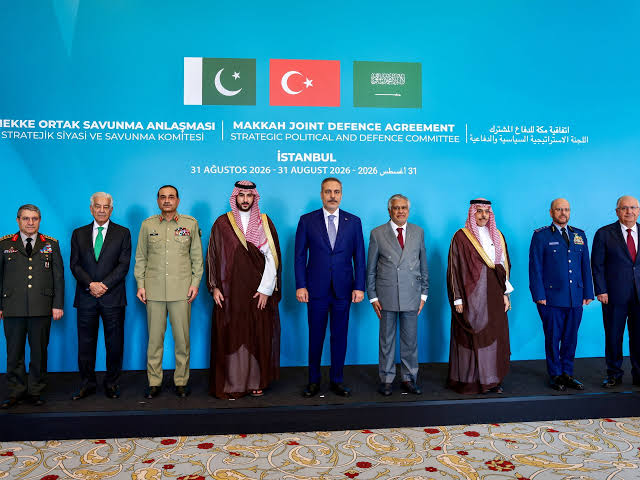
ANKARA, November 4, 2026: Turkey’s parliament is expected to move towards ratifying the Mecca Joint Defence Agreement with Saudi Arabia and Pakistan, bringing Ankara closer to a formal mutual-defence commitment with two regional powers as security tensions continue around the Gulf and the Red Sea.
The 16-article agreement, signed in Mecca on August 7, treats an armed attack on one signatory as an attack on all three. Reuters reported on Wednesday that Turkey’s parliament was set to ratify the pact. As of the time of drafting, a completed vote had not been confirmed. The current step is therefore a move towards formal approval, not evidence that the Turkish legislature has already completed ratification.
The agreement brings together Saudi Arabia’s financial and regional influence, Pakistan’s military capabilities and nuclear status, and Turkey’s large armed forces and defence industry. Its language is framed around collective defence, but the text leaves each country room to determine the scope and form of support after assessing the assistance required. That qualification is central to understanding what the pact does and does not oblige the signatories to do.
Article 1 commits the parties to use necessary means to address threats to one another’s territorial integrity, sovereignty and internationally recognised borders. Article 2 says that if one signatory suffers an armed attack or military aggression, the others will provide assistance using the range of mutual-support measures available to them. The agreement refers to the right of individual and collective self-defence under Article 51 of the United Nations Charter.
The wording has been compared with Article 5 of the North Atlantic Treaty, which treats an armed attack against one NATO member as an attack against all. The comparison is useful but should not be taken to mean that the Mecca agreement automatically requires every signatory to send troops whenever another is attacked. The text says each country will decide the scope and nature of support after assessing the assistance required and will act within its available resources and national legal arrangements.
The agreement covers more than a mutual-defence clause. It provides for cooperation in the defence industry, intelligence sharing, logistical support, joint training, counterterrorism and research and development in advanced technologies. The text also provides for a joint defence committee and a mechanism through which other countries may seek to join, subject to the approval of all three founding members.
The pact is designed to remain in force for 10 years, with withdrawal provisions after that period. The agreement therefore creates a long-term framework rather than a short-term arrangement tied to a single incident. Its practical effect will depend on the military, intelligence and industrial projects that the three countries choose to pursue.
Turkey’s parliament is the remaining formal step in Ankara’s approval process. The Turkish foreign affairs committee had previously approved the agreement and sent it to the full assembly for debate and a vote. The Associated Press reported that the committee’s approval advanced the 10-year pact to the legislature, while opposition lawmakers questioned whether the arrangement could draw Turkey into conflicts involving other regional powers.
The agreement has already moved beyond a signing ceremony. In a joint statement issued after an emergency meeting in Riyadh on October 5, the Turkish, Saudi and Pakistani governments said the committee had decided to begin practical implementation of the collective-defence commitments. The statement referred to agreed military forces and capabilities and to arrangements for their rapid deployment in Saudi Arabia, subject to the national legislation of the three countries.
That statement followed a series of attacks and security concerns affecting Saudi Arabia. The three governments condemned attempted attacks on Mecca and Medina and continuing strikes against cities and civilian and economic facilities in the kingdom. They said the security of each party was connected to the collective security of the others.
The Turkish foreign ministry’s statement is important because it shows that the pact’s members have begun building institutional mechanisms before the Turkish parliament has completed ratification. It does not, however, prove that Turkish troops have been deployed under the agreement. The statement says the agreed capabilities would be provided through approved arrangements and in accordance with national law.
A ruling-party lawmaker told Reuters that Turkey would also submit a separate parliamentary mandate allowing military personnel to be deployed to Saudi Arabia under the pact. Officials have said that the scope of any support would be determined through collective consultations and in response to requests from Riyadh. That is a further step beyond ratifying the agreement itself.
Turkey’s constitution requires parliamentary authorisation for sending troops abroad. The existence of a mutual-defence agreement does not remove that requirement. Turkish Foreign Minister Hakan Fidan has described the pact as defensive and said Ankara was not joining an offensive arrangement to attack another country. The distinction is relevant as the agreement is being discussed amid fighting involving Yemen’s Houthis and attacks on Saudi territory.
The pact also provides a structure for defence-industrial cooperation. Turkey has a growing arms industry, including drones, electronic-warfare systems, naval platforms and other military equipment. Pakistan has a large military establishment and experience in aircraft, missiles and defence production. Saudi Arabia has sought to expand domestic defence manufacturing and diversify its security partnerships. Joint development, technology transfer, maintenance and logistics could become as important as the mutual-assistance clause.
Intelligence-sharing and training are also likely to be central to the early stages of cooperation. The countries can coordinate information on threats, conduct joint exercises and improve the interoperability of their forces without necessarily committing to a permanent troop presence in another state. Such arrangements could strengthen deterrence, but their effectiveness will depend on how quickly the partners agree on procedures and command responsibilities.
The agreement is being developed against a backdrop of attacks on Saudi infrastructure and continuing instability in Yemen. The Houthis have used missiles and drones against Saudi targets, including oil facilities and transport infrastructure. Saudi Arabia has been seeking additional security support as the conflict affects energy routes and the safety of civilian and economic sites.
For Riyadh, the pact broadens the range of states with which it can coordinate defence. For Ankara, it offers a formal channel for closer military and political cooperation with Saudi Arabia and Pakistan. For Islamabad, it deepens a relationship with a major Gulf partner while adding Turkey’s defence industry and diplomatic weight to the arrangement.
The agreement could also affect the calculations of other regional governments. Iran has criticised the pact, while some analysts have questioned whether it could become a broader security grouping. The signatories have said it is defensive and not directed against a particular country. The agreement does not name Iran, Yemen or any other state as an enemy, and its text refers to threats against the signatories’ territorial integrity rather than a specific adversary.
India will watch the arrangement closely because Pakistan is one of the three signatories and because Saudi Arabia and Turkey are influential regional partners. The pact does not automatically create a military bloc against India, nor does it establish a direct commitment to intervene in a conflict involving Pakistan and India. The text is framed around mutual assistance after an armed attack on a member, and any support would be determined through the agreement’s procedures and each country’s national law.
The same caution applies to possible deployments in Yemen or elsewhere. The agreement’s collective-defence language does not by itself authorise a Turkish operation against the Houthis or a deployment into another conflict. A separate parliamentary mandate and specific decisions by the signatories would be required for any troop movement. Officials have indicated that Turkey’s contribution may initially focus on equipment, intelligence and weapons systems rather than a large ground-force deployment.
There are also limits to how quickly the agreement can be operationalised. Three countries have different military doctrines, procurement systems, command structures and political priorities. A joint exercise or a technology partnership can be organised through existing channels, but a collective response to an armed attack would require agreement on the threat, the type of assistance, the legal basis and the resources each state is prepared to commit.
The full parliamentary debate in Turkey will therefore matter. Opposition lawmakers have warned that the pact could expose Turkish forces to risks in conflicts involving Saudi Arabia, Pakistan, India, Afghanistan or Yemen. Supporters say it strengthens deterrence and gives Ankara a role in regional security without replacing its existing alliances. The final vote and any accompanying deployment mandate will show how far the Turkish government is prepared to take the commitment.
The next developments to watch are the outcome of the full assembly vote, the separate question of military deployment authority and the practical arrangements announced by the three governments. The October 5 joint statement shows that the alliance intends to move towards implementation, but the scale of any force deployment and the form of operational support remain matters for future decisions.
Turkey’s move towards ratification is a significant step in the institutionalisation of the pact, but it is not the same as an automatic military response to every regional crisis. The agreement sets a framework for mutual assistance and cooperation. Its real meaning will be determined by the decisions the three governments make when they are asked to put that framework into practice.

Comments (0)
Be the first to comment. Comments are published after moderation.