


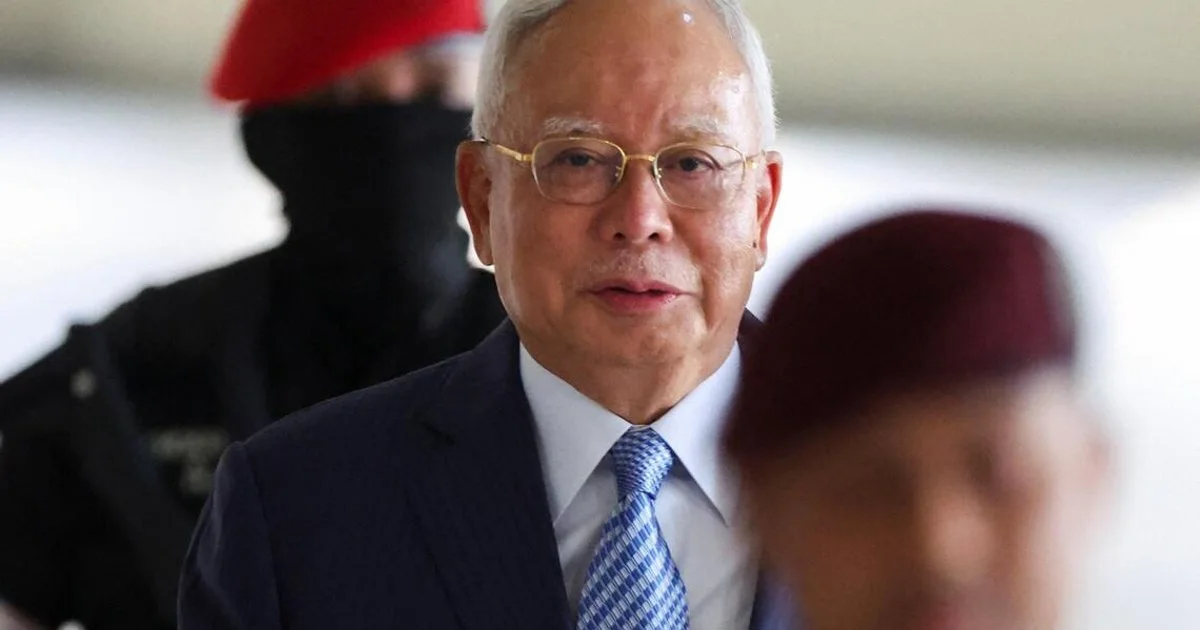
KUALA LUMPUR, November 7, 2026 — Malaysia’s King Sultan Ibrahim has warned that any attempt to challenge his order allowing former prime minister Najib Razak to serve the remainder of a reduced prison sentence under house arrest would amount to defying a royal decree, deepening a rare public dispute with the attorney-general’s office over how the order should be carried out.
The palace said on Saturday that the conditional pardon was “clear, explicit and without ambiguity” and that its requirements had been met. The Attorney-General’s Chambers, however, said it was not disputing or suspending the pardon but wanted the courts to clarify the effect of a High Court order issued after a fine was paid. The two statements have left Najib’s transfer from prison to house arrest on hold while the legal question is considered.
The dispute came after the United Malays National Organisation (UMNO), Najib’s political party, paid a 50 million ringgit fine required under the terms of the pardon. He was expected to move to house arrest on Friday. The Associated Press reported that he briefly left prison before being returned hours later after the Attorney-General’s Chambers intervened and sought clarification from the court. No final ruling on the transfer had been announced by Saturday.
The central question is not whether Najib received a conditional pardon, but how the payment of the fine and the High Court’s discharge order affect the time he still has to serve. The palace says the pardon order sets out the conditions and that they have been fulfilled. The Attorney-General’s Chambers says the court should determine how the discharge order applies to the remaining term and to a separate sentence in another 1MDB-related case.
In its statement, the Attorney-General’s Chambers said it had “never disputed, set aside or intended to suspend” the pardon. It said the application for clarification was intended to establish the legal effect of the High Court’s order, not to challenge the King’s constitutional power. The palace statement took a firmer tone, warning that any attempt to question the decree would be inconsistent with the order issued by the King.
The distinction matters because Najib has more than one sentence to serve. The current house-arrest arrangement relates to a reduced six-year sentence in the SRC International case, which involved the transfer of 42 million ringgit from a former unit of 1Malaysia Development Berhad, or 1MDB, into his accounts. He was convicted of abuse of power, criminal breach of trust and money laundering, and has maintained that he did not knowingly commit the offences.
Najib’s sentence in the SRC case was reduced from 12 years and the fine was cut from 210 million ringgit to 50 million ringgit under an earlier royal clemency process. The conditional order issued by Sultan Ibrahim in September allowed him to serve the remaining part of the reduced sentence under house arrest once the required payment was made. The party’s payment was intended to satisfy that condition.
A separate 15-year prison sentence was imposed on Najib in December 2025 in another major 1MDB case. He is appealing that conviction. The timing of the second sentence is now part of the dispute: if the first sentence is treated as completed once the fine is paid, the second term could begin earlier; if time remains to be served under house arrest, the start of the separate sentence may be affected. The court has not yet publicly resolved that question.
Malaysia’s Federal Constitution gives the King a formal role in the pardon process, exercised through the Pardons Board. The monarch is generally expected to act within the constitutional framework, but the power to grant pardons is one of the most consequential responsibilities attached to the office. The Attorney-General’s Chambers is responsible for public prosecutions and for advising the government on legal questions, while the courts determine the legal effect of judicial orders.
The public exchange is unusual because the palace and the government’s chief legal office have both issued statements about the same order, while describing their positions in different terms. The palace says the decree is unambiguous and should be implemented. The Attorney-General’s Chambers says it is seeking judicial clarity so that the order is carried out correctly and does not create uncertainty about Najib’s other sentence.
That distinction will matter to the court. A request for clarification is not the same as an appeal against the King’s pardon, and the Attorney-General’s Chambers has explicitly said it is not seeking to set the pardon aside. But the palace’s warning shows how sensitive the issue has become. The eventual ruling will need to address the legal status of the first sentence without appearing to reopen the constitutional decision to grant clemency.
The dispute also carries political weight. UMNO remains part of Prime Minister Anwar Ibrahim’s governing coalition, and Najib retains influence among parts of the party’s membership. The government has to balance respect for the constitutional process with the public interest in the enforcement of corruption convictions. The case is likely to renew scrutiny of how Malaysia handles high-profile political prosecutions and the consequences of royal clemency.
Najib’s supporters have argued that the house-arrest order should be implemented because the conditions have been met. Critics of the arrangement have raised concerns about equal treatment before the law, particularly because the former prime minister was convicted in cases tied to one of Malaysia’s largest financial scandals. Those arguments are political and public reactions; the immediate legal question remains the meaning of the High Court’s discharge order and the timing of the separate sentence.
The next step is a judicial determination of the effect of the High Court order. Until that happens, the transfer to house arrest remains unresolved. The palace has made clear that it considers the pardon terms settled, while the Attorney-General’s Chambers says it wants the court to remove uncertainty before the arrangement is implemented.
The court’s decision could clarify whether the fine payment completed the financial condition only or whether the discharge order also changes the date on which the first sentence is considered served. It will also need to explain how that decision interacts with the separate 15-year sentence. No hearing date or final timetable had been announced in the reports reviewed on Saturday.
For now, Najib remains in prison and the house-arrest transfer has not been completed. The case has moved beyond a question of logistics: it is testing the relationship between royal clemency, court orders and the prosecution of a former national leader. The legal clarification, rather than another political statement, will determine how the sentence is carried out.




Comments (0)
Be the first to comment. Comments are published after moderation.