


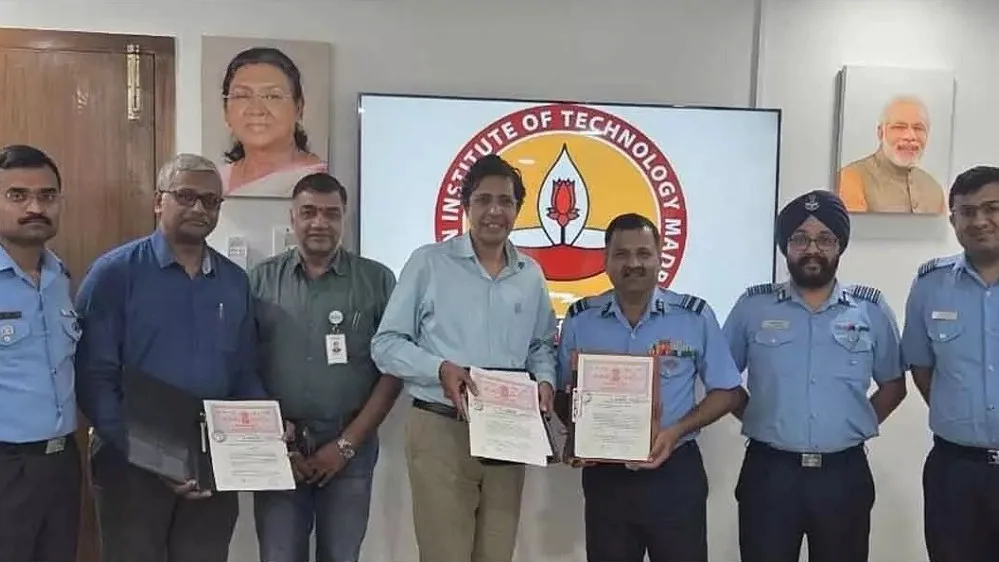
NEW DELHI, November 7, 2026 — The Indian Air Force’s Software Development Institute has signed an agreement with IIT Madras and IITM Pravartak Technologies Foundation to jointly design and develop an indigenous digital communications system for airborne applications. The collaboration is intended to build domestic capability in communication algorithms and networking, while reducing reliance on imported systems used in aviation-related defence operations.
The Memorandum of Agreement was signed on November 6 by Air Vice Marshal Sarabjit Singh, Commandant of the Software Development Institute, and Dr M. J. Shankar Raman, chief executive of IITM Pravartak Technologies Foundation. IIT Madras Director V. Kamakoti was present at the signing, according to the Ministry of Defence’s announcement.
The agreement sets out a joint development effort rather than the induction of a completed system. The ministry’s statement says the partners will work on advanced algorithms for communication systems and networking. It does not identify a particular aircraft, specify a deployment schedule, disclose technical performance figures or say when a prototype is expected to enter service.
Aircraft rely on communications to exchange information with ground stations, command structures and other platforms. In military operations, those links can support mission coordination, the transfer of operational information and communication between aircraft and the wider command network. The reliability and security of those links are therefore important to the effectiveness of air operations.
Digital communication systems can involve several connected elements, including radios, antennas, network protocols, encryption and the software that manages how information is routed. The specific architecture chosen for the IAF project has not been publicly disclosed. It would be inaccurate to assume that the agreement covers a particular encryption standard, radio frequency, aircraft type or network capability without technical details from the development partners.
The ministry has framed the project as a move towards indigenous development. Building domestic expertise can give the armed forces and Indian industry greater control over the design, maintenance and future modification of critical systems. It can also help develop specialised skills in signal processing, networking and embedded software. Those benefits depend on the project progressing from research and design to a tested system that meets operational requirements.
IIT Madras brings academic and engineering research capacity to the collaboration, while IITM Pravartak Technologies Foundation is a technology innovation hub associated with the institute. The Software Development Institute is the Indian Air Force organisation involved in software development. The agreement places the three partners in a joint design process, with the IAF bringing operational requirements and the academic partners contributing research and technology development.
Such collaborations can help translate research into systems designed for real operating conditions. For airborne use, those conditions can include vibration, temperature variation, electromagnetic interference, limited space, power constraints and the need to maintain reliable communication as aircraft move between locations. The ministry’s announcement does not set out which of these engineering requirements will be addressed in the first phase, so they should be understood as general considerations for airborne systems rather than confirmed specifications of this project.
Development work also needs to address security across the system lifecycle. A secure communication platform must be designed to resist unauthorised access, protect information in transit and allow controlled updates as threats change. It must also be tested with the equipment and networks with which it is expected to operate. The public announcement does not yet provide details about certification, interoperability testing or the process for selecting production partners.
The agreement is an early step in a development programme. The next information that would help assess its progress includes the project’s technical milestones, the aircraft or airborne platforms involved, the planned prototype stage, performance targets and the route through user trials and certification. The ministry has not announced a delivery date or a budget for the work in the statement reviewed for this report.
Indigenous development does not automatically mean that every component will be manufactured locally or that imported systems can be replaced immediately. The eventual level of domestic content will depend on the technology selected, the availability of components and the ability of suppliers to meet the required standards. The immediate significance of the MoA is that the IAF and IIT Madras have formalised a joint effort to design a system, not that an operational capability has already been deployed.
The project is part of a broader effort to strengthen domestic defence technology and reduce dependence on external suppliers for critical systems. Its value will be judged by whether it produces a secure, reliable and maintainable communications capability that meets the Air Force’s operational requirements. Until details of the prototype and testing programme are released, the agreement should be treated as a development initiative rather than a completed acquisition.






Comments (0)
Be the first to comment. Comments are published after moderation.