


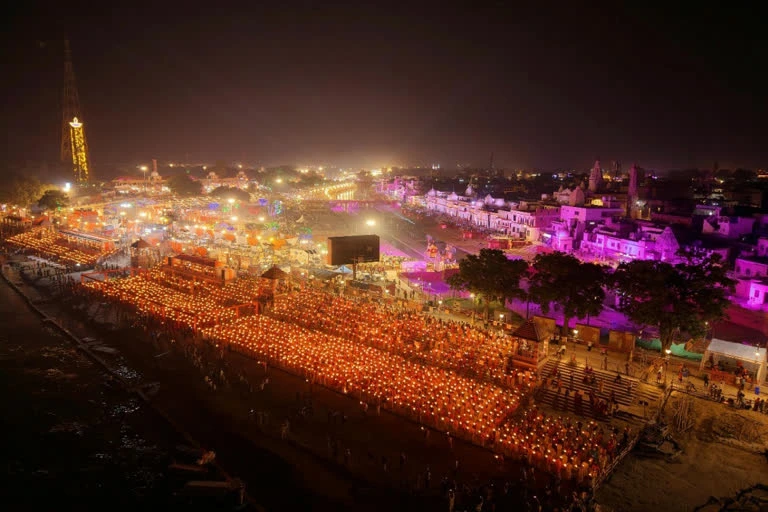
AYODHYA, November 7, 2026 — Ayodhya’s tenth Deepotsav illuminated more than 30 lakh earthen lamps across 56 ghats on the banks of the Saryu on Saturday, according to Akashvani News. Vice-President C. P. Radhakrishnan attended the main celebration with Uttar Pradesh Governor Anandiben Patel and Chief Minister Yogi Adityanath, as the temple town marked the festival with a riverfront aarti, cultural performances and a laser presentation.
The official broadcaster reported that the lamps were lit across the ghats, moving the event beyond the pre-festival target announced by organisers. The figure is an official report of the display, not a separately published Guinness World Records certification. The distinction matters because a large lamp count and a record verified under a specific measurement process are not the same thing.
Deepotsav has grown steadily since its first edition in 2017, when around 1.71 lakh lamps were used, according to The New Indian Express. The 2025 celebration set a Guinness record with 2,617,215 lamps, a total listed by Guinness World Records. The 2026 figure reported by Akashvani is higher, but no new Guinness certificate or independently verified record count had been announced in the coverage reviewed for this update.
Ram Ki Paidi remained the centre of the lamp display, with the wider event spread across 56 ghats. The main evening programme brought together the Saryu riverfront ceremony and performances linked to the Ramayana tradition. Radhakrishnan’s attendance gave the celebration a national profile, while the presence of the state governor and chief minister reflected the scale of the Uttar Pradesh government’s annual cultural event.
Before the celebrations, organisers had said that around 35,000 students from colleges in Ayodhya would help arrange and light the lamps. The programme also announced a Maha Aarti involving 2,147 participants, a procession of 22 tableaux based on the seven kandas of the Ramayana, and performances by around 2,500 artists across 12 stages. These were published as programme details ahead of the event; the post-event account confirms the lamp display and cultural programme but does not provide a complete audited count for every activity.
Ramlila troupes from South Africa, Sri Lanka, Nepal, Laos and Thailand were listed among the participants. The announced programme also included a 2,100-drone Ramayana presentation, a floating stage, projection mapping and musical fireworks. The New Indian Express and Hindustan Times reported those plans before the main evening. They should be treated as scheduled attractions unless organisers publish a separate confirmation of each element having taken place.
The event’s public footprint extended beyond the ghats. Organisers had planned 13 thematic gateways, 20 selfie points and installations along key routes, with tableaux and performances spread through the town. Such arrangements require coordination between the district administration, police, transport agencies, emergency services and local bodies. For residents, the practical impact is measured not only by the display but also by access to homes and businesses, road closures, crowd movement, sanitation and the ability of emergency vehicles to reach busy areas.
The preparations also created orders for rural pottery units. The New Indian Express reported that an order worth ₹12.8 lakh had been placed with 25 women from Gyaspur in Ayodhya and Kajiyapur and Bhaghar Jheel in Barabanki for 1.60 lakh diyas. The report said 197 potters had received electric pottery wheels by October 2026 to increase production capacity. Those figures offer a more concrete view of the festival’s local economic effects than the headline lamp count alone.
Large public celebrations can generate work for potters, performers, transport providers, food sellers and temporary workers, but the scale of an event does not automatically show how much income remains with local households. The reported diya order indicates a direct procurement link with women-led pottery groups, while the distribution of electric wheels suggests an effort to improve production capacity beyond a single festival. A fuller assessment would require information on how many artisans received repeat orders, the cost of materials and transport, and whether the equipment is being used throughout the year.
Deepotsav has also become a tourism showcase for Ayodhya. The five-day programme began on November 5 and was scheduled to continue through November 9, allowing visitors to attend events beyond the main lamp-lighting evening. The government has presented the celebration as part of a wider effort to improve visitor facilities and promote the city’s religious and cultural heritage. The effect on tourism will depend on visitor numbers, spending, accommodation capacity and the quality of services available to residents and travellers.
The reported 30-lakh-plus display is a major increase over the 2025 Guinness total of 2,617,215 lamps. Guinness World Records lists that 2025 figure as the largest display of oil lamps achieved in Ayodhya on October 19 last year. A new record would require the relevant counting and verification process to be completed and formally recognised. Until that happens, the 2026 event should be described as having illuminated more than 30 lakh lamps according to the official broadcaster, not as having secured a new Guinness title.
The size of the celebration also brings operational questions that are separate from the record. Millions of lamps require clay, oil, wicks, labour and a plan for collecting used materials after the event. The riverfront needs to be cleared and checked once crowds leave, while traffic and public-safety arrangements must be maintained during the busiest hours. The reporting reviewed for this article did not include a full public audit of waste management, oil use or the environmental footprint of the celebration, so those impacts should not be inferred from the lamp total alone.
For Ayodhya, the tenth Deepotsav was both a religious-cultural gathering and a large civic exercise. The more than 30 lakh lamps reported across 56 ghats provide a clear measure of the event’s scale. The longer-term test will be whether the attention and public investment translate into lasting benefits for local artisans, residents, tourism services and the city’s ability to host large gatherings safely.




Comments (0)
Be the first to comment. Comments are published after moderation.