


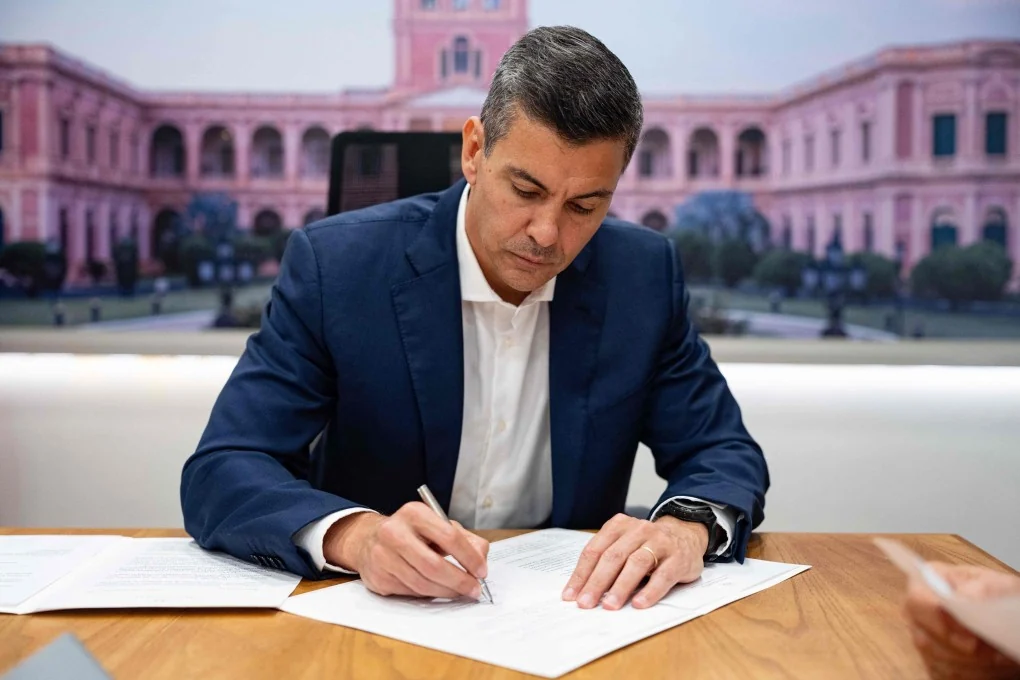
ASUNCIÓN, November 7, 2026 — Former Paraguayan president Santiago Peña appeared before prosecutors on Saturday, a day after the Senate removed him from office and authorities ordered him to remain at his home, as investigators pursue a criminal case linked to the collapse of digital lender Ueno Bank.
Reuters reported that Peña arrived at the Attorney General’s Office on Saturday to give a statement. The move followed a detention order issued by prosecutors on Friday in criminal case No. 92/2026, which concerns alleged breach of trust and other offences connected to the bank. In its public notice, Paraguay’s Public Ministry said the order was made through Resolution No. 7 and directed police to keep Peña at his residence until he could be placed at the disposal of the specialised Economic Crimes and Anti-Corruption Unit.
The location of the hearing was changed before the appearance. ABC Color reported that the Public Ministry moved the questioning from the specialised unit to the Attorney General’s headquarters for security reasons. Local newspaper La Nación had reported that Peña was scheduled to appear on Saturday morning, with former central bank chief Carlos Carvallo due later in the day. Reuters subsequently reported Peña’s arrival at the prosecutor’s office.
The criminal investigation is separate from the Senate’s impeachment decision. Reuters reported that prosecutors were still determining the charges that could be brought against Peña, with influence peddling among the possible offences under consideration. The Public Ministry’s detention notice cited suspected breach of trust and other alleged crimes. The Associated Press reported that the accusations also included possible use of public office for personal gain. No court has found Peña guilty, and he has denied wrongdoing.
Lawmakers who backed his removal accused him of conflicts of interest, interference with regulatory oversight and participation in an institutional cover-up involving the central bank. Reuters reported that Peña held a stake in Ueno’s holding company until March 2025, when he sold it. That business connection is part of the scrutiny surrounding the bank’s collapse, but it does not by itself establish that he directed lending decisions or ordered regulators to overlook problems.
The Public Ministry’s Friday notice also named former central bank president Carlos Carvallo Spalding, who was ordered detained in the same case. Carvallo had previously led the financial company that became Ueno before Peña appointed him to head the central bank. The prosecutors’ order directed police to detain him as well, although the Associated Press said it was not immediately clear whether he had been taken into custody at the time of its report.
The investigation is examining the decisions that preceded the bank’s failure, including the supervision of Ueno, lending to companies linked to its controlling group and the placement of public funds at the lender. The collapse left millions of customers temporarily unable to access savings and raised questions about the independence of financial oversight. Those issues now sit within a wider inquiry involving bank executives, regulators and political figures.
The Senate’s vote on Friday brought Peña’s presidency to an abrupt end. The Associated Press reported that all 44 senators present voted to remove him for misconduct in office. It was the second time a Paraguayan president had been ousted by impeachment since the end of Alfredo Stroessner’s dictatorship in 1989. Vice-President Pedro Alliana was sworn in the same day to serve the remainder of the term, which runs through August 2028, Reuters reported.
The vote followed days of political turmoil after the central bank intervened in Ueno. Peña had announced that he intended to resign, but the resignation did not complete the transfer of power. The Senate instead proceeded with impeachment, leaving him without the protection he might have retained had Congress accepted a resignation. The legal consequences of that sequence are now being tested through the separate criminal proceedings.
Alliana inherits the government at a moment when depositors are still waiting for the return of funds and the financial regulator is managing the bank’s resolution. The Associated Press reported that Alliana is also under investigation in connection with the bank, although no finding of wrongdoing has been announced against him. His administration will have to demonstrate that the deposit-guarantee process, the investigation and the central bank’s supervisory work can proceed independently.
The political allegations against Peña are not identical to the criminal case. Impeachment is a constitutional process through which Congress removed him from office; prosecutors must separately determine whether evidence supports criminal charges and, if so, present them through the courts. The distinction is important because a Senate vote does not establish criminal guilt, just as a detention order does not amount to a conviction.
The central bank placed Ueno under resolution after its solvency ratio fell below half the legal minimum, according to reporting by EFE and the Associated Press. The intervention disrupted a lender that had built a customer base of nearly three million people. Depositors reported being unable to withdraw cash, use cards or access balances, while public institutions and pension-related funds also had money at the bank.
The scale of the disruption made the crisis a national issue rather than a dispute confined to investors or bank executives. The Associated Press reported that Ueno had attracted more than three million customers and held substantial public funds. The failure prompted protests in Asunción and forced authorities to set up an accelerated deposit-guarantee process. The central bank said on Saturday that about 1.196 million customers had benefited from payments totalling 996 billion guaranies over two days, according to EFE and El Nacional.
Those payments are part of the financial response and should not be confused with the criminal investigation. The central bank must determine the assets and liabilities of the failed institution, process eligible claims and explain how larger or institutional deposits will be treated. Prosecutors, meanwhile, are examining whether officials or bank executives committed offences. The two processes may rely on some of the same records, but they have different purposes and legal standards.
The authorities will also face questions about how Ueno’s financial condition deteriorated, what warnings were available to supervisors and whether the bank received preferential treatment. The fact that Peña once held shares in the parent group and appointed a former Ueno executive to lead the central bank has intensified scrutiny. It remains for investigators to establish whether those relationships influenced specific regulatory decisions or caused a breach of law.
For now, the next steps are the completion of Peña’s questioning, any decision by prosecutors on formal charges, and further action in the case involving Carvallo and Ueno’s executives. The courts will determine whether the evidence supports the allegations. The new administration, meanwhile, must manage the depositor repayment programme and restore confidence in financial supervision without interfering in the investigation.


Comments (0)
Be the first to comment. Comments are published after moderation.