


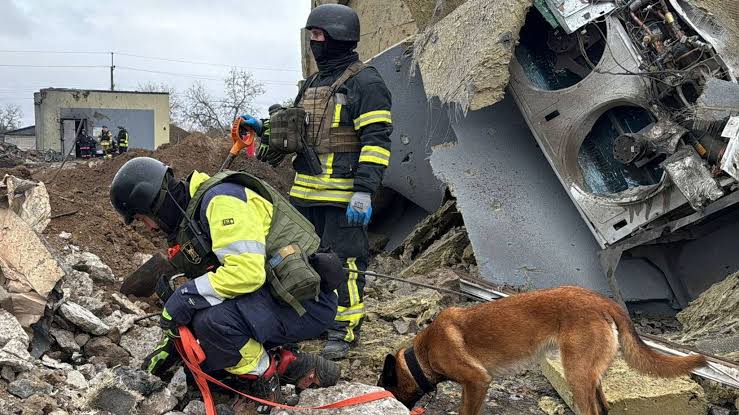
KOMYSHUVAKHA, Ukraine, November 8, 2026 — The Komyshuvakha drone attack, which Ukrainian officials attributed to Russian forces, struck emergency workers searching the wreckage of a humanitarian aid site in Ukraine’s Zaporizhzhia region on Sunday, damaging specialist rescue equipment but causing no reported injuries among the personnel. Ukrainian officials said the strike hit the village of Komyshuvakha while teams were still looking for people after a November 2 bombing that has killed at least 55.
The State Emergency Service of Ukraine said its personnel were carrying out search-and-rescue work at the site of an earlier airstrike on a shelter when a drone targeted the operation on the morning of November 8. The service said no rescuers were hurt, but specialist equipment was damaged. It did not publish a full inventory of the equipment affected or say how long the damage would interrupt the work.
President Volodymyr Zelenskyy said the drone was an FPV, or first-person-view, aircraft and identified Komyshuvakha as the location. In a statement carried by Ukrainian media, he said rescue operations had been under way for seven days and warned that more people could still be beneath the rubble. He condemned the attack, but the precise flight path, launch point and circumstances of the strike have not been independently established in the reporting reviewed.
The incident took place at the same site where Russian guided bombs hit a former school and an underground shelter on November 2. The building had been used to distribute humanitarian assistance to residents of Komyshuvakha and nearby communities. The village lies in the Zaporizhzhia region, close to the front line, where access for emergency crews and the movement of civilians are complicated by continuing military activity.
The Komyshuvakha drone attack was a separate incident from the bombing six days earlier. It did not add to the reported death toll from November 2, and Ukrainian officials said no rescue workers were injured in the latest attack. The distinction matters because casualty figures from the original bombing have continued to change as teams recover remains and authorities identify victims.
Also read: Zaporizhzhia Bombing of Ukraine Aid Site Leaves Conflicting Death Toll Reports
Ukraine’s State Emergency Service said on November 7 that the number of people confirmed dead in the November 2 bombing had risen to 55 after rescuers recovered the bodies and remains of nine more victims during the preceding day. The agency said search teams and canine units were continuing to clear the damaged structures and examine the area despite difficult conditions and the threat of further attacks.
The acting head of the Zaporizhzhia regional military administration, Mykhailo Semikin, told The Associated Press that 45 people were still listed as missing as of Sunday afternoon. Ukraine’s military intelligence agency gave a figure of about 50 missing in a separate account. The numbers were reported at different points and by different authorities; they should not be combined into a single confirmed total. Many recovered remains had not yet been identified, and DNA testing was continuing.
The search has therefore involved more than removing debris. Authorities must establish who has been found, match remains to missing-person reports and notify families. That process can take time when buildings have collapsed, bodies have been badly damaged and relatives are waiting for reliable confirmation. The figures may change as forensic work progresses, but the latest official death toll reported by the emergency service was 55.
Emergency personnel have remained at the site for nearly a week, working among unstable structures and the remains of a building that had served as a community relief point. The State Emergency Service has described the work as difficult and said the possibility of further attacks has forced responders to operate under continuing security risks. The latest drone strike adds another hazard to a task that already requires heavy equipment, trained search teams and access to the damaged shelter.
Damage to specialist vehicles or tools can have consequences beyond the cost of replacing equipment. Search teams may rely on lifting gear, cutting tools, lighting, communications equipment and machinery to move debris safely. If a piece of equipment is damaged, crews may need to bring a replacement from another location or change the order in which they examine the site. The Ukrainian service has not said whether any particular part of the operation was suspended after Sunday’s strike, so the extent of any delay remains unknown.
The incident also affects the people waiting for news. Families of those still missing depend on rescue teams to reach parts of the site that may not yet have been cleared. A disruption can prolong uncertainty even when no additional casualties are reported. For residents who used the school and shelter to obtain food or protection, the destruction of the facility and the danger around the search area may also weaken access to local assistance.
Ukrainian officials have repeatedly accused Russian forces of striking locations where emergency personnel are working. The State Emergency Service characterised Sunday’s drone attack as a deliberate targeting of rescuers, while Zelenskyy said the aircraft hit the area during the ongoing operation. Those are the Ukrainian authorities’ accounts. The reports reviewed did not include a Russian response to the November 8 incident, and there has been no independent reconstruction of the drone’s route or the decision-making behind the strike.
The distinction between a reported attack and a legally established violation is important. International humanitarian law provides protections for civilian rescue personnel and civilian objects, subject to the circumstances set out in the law. Determining whether a particular strike breached those protections requires evidence about the target, the presence of any military objective, the information available to the attacking force and the precautions taken. The information currently available is not sufficient to make a definitive legal finding about Sunday’s incident.
The earlier bombing has also raised questions about the safety of humanitarian distribution points in frontline communities. A site used to hand out aid can bring residents together at a predictable time, particularly when transport is limited and alternative services are scarce. That makes the security of such locations a practical concern for local authorities and relief organisations. The available reporting establishes that the school was being used for aid distribution and shelter; it does not provide a complete account of who controlled the site or whether any military activity was present when it was hit.
For emergency services, the immediate priority remains the search, recovery and identification process. The service has not announced a final end to operations, and the number of people still missing means the work cannot be treated as complete. Investigators may also need to document damage to the rescue equipment and collect evidence about the latest drone strike, although no public timetable for such an inquiry has been announced.
Several important details remain unresolved. Ukrainian officials have identified the weapon as an FPV drone and attributed the attack to Russia, but the available reports do not establish where it was launched from, who operated it or whether the damaged equipment can be repaired quickly. The State Emergency Service has not published a detailed damage assessment. Nor has it said whether the rescue teams changed their procedures or moved equipment after the strike.
The final toll from the November 2 bombing is also not settled. Fifty-five deaths had been confirmed by the emergency service’s November 7 update, while dozens remained missing in accounts published the following day. DNA identification may clarify the status of some people, but it does not guarantee that every missing person will be located. Until the regional authorities provide a consolidated update, reports should preserve the date and source of each figure.
The latest attack underscores how a strike on an emergency operation can compound the effects of an earlier attack. It can damage equipment, put personnel at risk and make it harder for families to receive answers, even when no additional injuries are reported. The practical impact will depend on whether replacement equipment can reach the site, whether teams can continue safely and how quickly the remaining debris can be examined.
The next meaningful updates are likely to come from the State Emergency Service, the regional administration and investigators examining the November 8 strike. Readers should look for a confirmed account of equipment damage, any change in the search operation, updated missing-person figures and evidence that clarifies the circumstances of the drone attack. Until those details are available, the confirmed facts are that a drone struck the rescue site, specialist equipment was damaged, no rescuers were reported injured and the search after the November 2 bombing remains unfinished.
Also read: Russian Strikes Hit Kyiv Energy Facilities Ahead of New US-Brokered Talks



Comments (0)
Be the first to comment. Comments are published after moderation.