


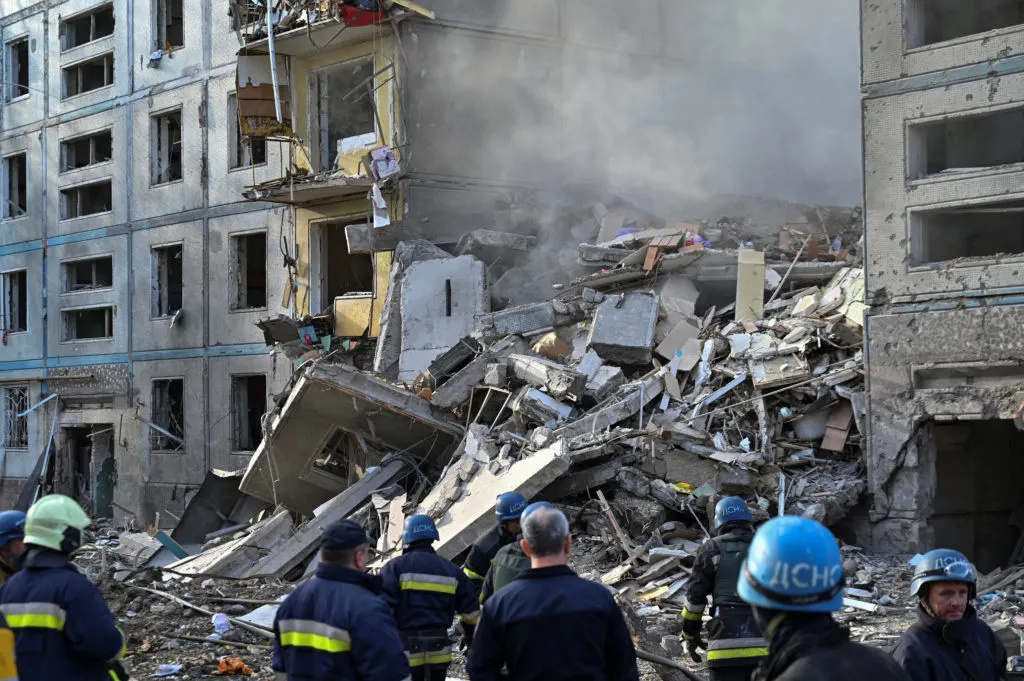
ZAPORIZHZHIA REGION, Ukraine, November 2, 2026 — A Russian bombing struck a school being used to distribute humanitarian aid and a nearby shelter in the village of Komyshuvakha, killing civilians, according to Ukrainian authorities. The reported death toll differed between initial accounts: the Associated Press, citing Ukraine’s emergency services agency, reported 24 people killed, while Reuters, citing President Volodymyr Zelenskyy, reported 18 dead and five injured. The figures had not been reconciled in the reports available by late Monday.
The attack hit a location used to provide assistance to residents in a frontline area of the southern Zaporizhzhia region. Zelenskyy said the first strike hit the school building and that additional guided bombs struck the shelter where people had gathered. The emergency-services account carried by AP said the aid distribution centre and neighbouring shelter were hit. The accounts agree that the strike hit civilian sites used for humanitarian purposes, but the exact sequence and final casualty count require further confirmation.
The difference between 18 and 24 deaths is significant and should not be treated as a settled total. Casualty figures can change as emergency crews search damaged buildings, hospitals report injuries and authorities reconcile names. The two reports may reflect different updates or different official statements; the material reviewed did not explain the discrepancy. The higher figure should therefore remain attributed to the emergency services account reported by AP, while the earlier figure remains attributed to the president’s statement reported by Reuters.
Also read: Public Alert App Hacks Hit Russia and Ukraine, Trigger False Warnings
Komyshuvakha is in the Zaporizhzhia region, an area affected by Russia’s full-scale invasion and continuing attacks. The village’s use as a place where residents could collect assistance makes the reported strike especially consequential for people who depend on local relief arrangements. The available reporting did not provide a verified breakdown of the victims by age, nor did it establish how many people were present in the buildings when they were hit.
Ukrainian officials said guided bombs struck the area on Monday. Zelenskyy described a first strike on a school used for humanitarian distribution and a second attack involving more bombs directed at the shelter. Reuters reported his account that 18 people were killed and five wounded. AP separately reported that Ukraine’s emergency services agency gave a toll of 24 dead. Neither report provided independent forensic confirmation of the weapon type or a complete assessment of the damage.
The location was not described as a military installation in the reporting reviewed. It was identified as a school building being used to distribute humanitarian aid and a neighbouring shelter. That distinction matters when assessing the civilian impact, but the available reports do not provide enough evidence to make a legal determination about the attack. Such an assessment would require more detail about the intended target, the information available to those who planned the strike, the weapons used and the precautions taken.
Russia had not provided a detailed public response to the specific attack in the reports reviewed. The absence of a response in those reports does not establish what information Russian authorities may have, and it does not resolve the competing casualty figures. The account of the strike and the reported deaths should remain attributed to Ukrainian officials until more evidence becomes available.
The bombing came as a limited humanitarian ceasefire in the Kherson region expired on Monday. That arrangement had allowed aid and evacuation missions in a different part of southern Ukraine. The ceasefire was local rather than a nationwide halt to fighting, and its end did not automatically determine the status of military operations in Zaporizhzhia. Ukraine’s general staff said Russian forces used the pause to strengthen defences and replenish ammunition, according to AP.
The attack was part of a wider day of violence. Ukrainian authorities also reported Russian drone strikes that injured at least 17 people in other locations, including Kharkiv and Odesa, according to AP. Those injuries were reported separately and should not be added to the toll from Komyshuvakha. The available information does not establish that the attacks were coordinated or that they were part of a single operation.
Russia’s Defence Ministry said it had shot down 212 Ukrainian drones overnight, AP reported. That figure is Moscow’s official account and has not been independently verified in the reporting reviewed. It concerns a separate set of military claims and does not establish the cause or circumstances of the attack on the aid site.
In wartime reporting, official statements are often the first source of information about casualties and damage, particularly when access to the affected area is limited. Those statements can be essential, but early figures may change as the situation develops. A responsible account should distinguish between the number announced by one authority, the number reported by another and any independently confirmed total. At the time of writing, the sources reviewed did not provide a final, jointly reconciled figure for Komyshuvakha.
Schools, community buildings and shelters can take on additional roles during conflict, including serving as distribution points for food, medicine and other assistance. That does not make every such building immune from attack under every circumstance, but civilian protection obligations remain central. The facts needed to assess a particular strike include the status and use of the site, whether a military objective was present, the expected civilian harm and the precautions taken to reduce that harm.
Humanitarian distribution points can also draw people who have limited alternatives for obtaining supplies. Residents may travel to a familiar building because local shops are closed, transport is disrupted or aid organisations have concentrated services at a known location. When an attack strikes such a site, the consequences can extend beyond the immediate casualties: people may be reluctant to attend later distributions, relief workers may have to change routes and the remaining shelters may face greater pressure.
The reports reviewed do not establish whether the aid distribution operation had been suspended before the strike, whether the shelter was officially designated or how many relief workers were present. Those details should not be inferred from the description of the buildings. They will matter to a fuller reconstruction of the incident and to any investigation of the circumstances surrounding it.
For families in frontline communities, the loss of a school or shelter can remove an important local resource even if the building can eventually be repaired. A damaged school may no longer be safe for classes, while a shelter that has been struck may need structural assessment before people can return. The duration of any disruption in Komyshuvakha was not clear in the initial reports.
International humanitarian law requires parties to a conflict to distinguish civilians and civilian objects from military objectives and to take precautions to limit civilian harm. Whether a particular attack violated those rules depends on evidence about the circumstances, not simply the number of people killed. The reported use of the buildings for aid distribution and shelter is an important part of the context, but the information available at the time of writing is not sufficient to make a definitive legal finding.
Investigators would need to establish the sequence of strikes, the types of weapons used, the points of impact, the presence or absence of military targets and the information available to the attacking force. Interviews with survivors and emergency workers, medical records, photographs, satellite imagery and physical evidence could help reconstruct what happened. Access to the site and the safety of investigators may affect how quickly those questions can be answered.
Also read: Russian Attacks Hit Ukraine’s Energy Infrastructure, Disrupting Power and Heating
The conflicting casualty reports also show why transparent updates from emergency services are important. A single consolidated count, with a clear time stamp and explanation of whether it includes people still missing, would help avoid confusion. Until such a statement is available, reporting should preserve the attribution and not combine figures from separate accounts as if they were independent totals.
The incident comes amid continued strain on civilians across southern and eastern Ukraine. Attacks and the threat of further strikes can disrupt electricity, transport, healthcare and access to basic goods. Local services may continue operating under difficult conditions, but each new incident can force officials and aid organisations to reassess where people can safely gather and how supplies can be delivered.
The next developments to watch are an updated casualty statement from Ukraine’s emergency services, further details from regional authorities, and any response from Russia concerning the specific strike. Independent reporting from the site, if access becomes possible, could clarify the damage and help establish the sequence of events. A final toll should be used only once the responsible authorities provide a consistent update or multiple credible reports converge on the same figure.
For now, the confirmed outline is that a Russian bombing hit a school building used for humanitarian aid distribution and a nearby shelter in Komyshuvakha, in Ukraine’s Zaporizhzhia region. Ukrainian officials reported civilian deaths, but the toll differed between the emergency services account carried by AP and the presidential account reported by Reuters. The scale of the loss is clear; the final number of people killed, the full circumstances of the attack and any legal assessment remain subject to further evidence.






Comments (0)
Be the first to comment. Comments are published after moderation.