


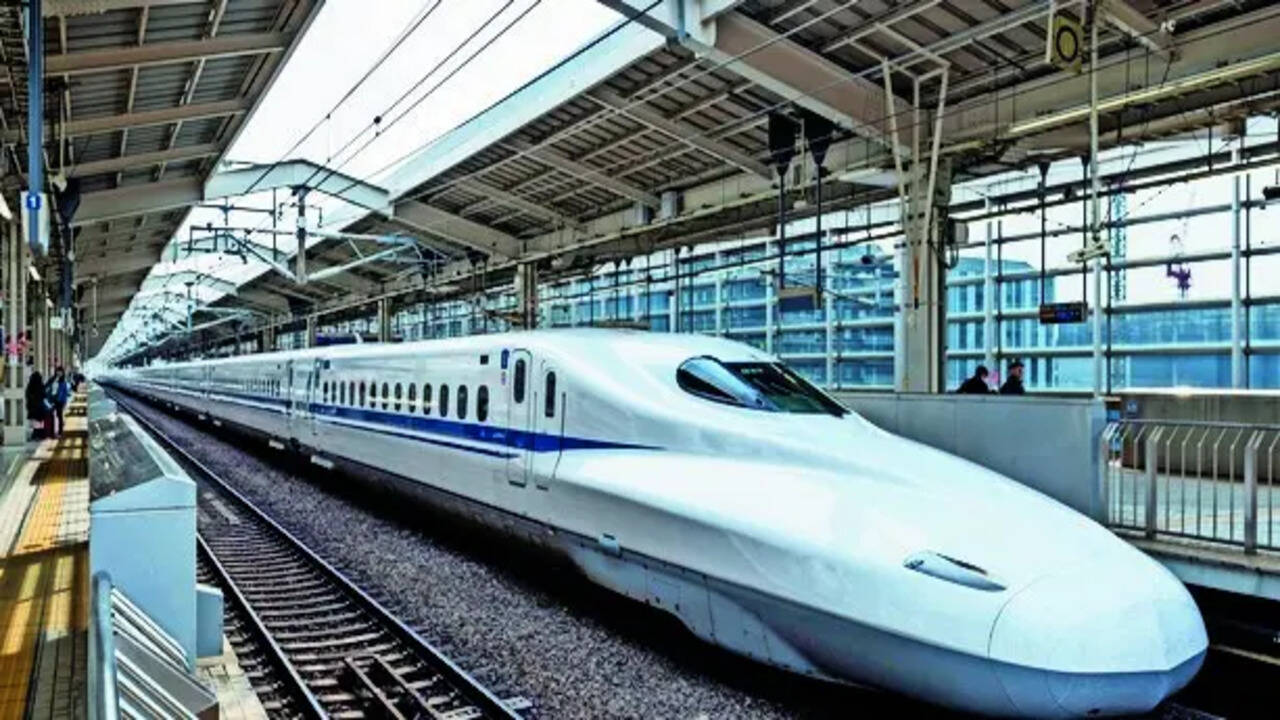
BENGALURU, November 3, 2026 — India’s first indigenously designed high-speed trainset, known as B-28 or Bharat Bullet Train, is undergoing structural validation at BEML’s manufacturing facility in Bengaluru as the Mumbai–Ahmedabad corridor moves through a new phase of rolling-stock development. Railway Minister Ashwini Vaishnaw inspected the work on November 1, including a car-body “squeeze test” intended to assess how the structure responds to controlled external forces.
The test is a safety and engineering check, not a demonstration that the train is ready to carry passengers at its planned speed. A vehicle body must retain its structural integrity under specified loads before it can proceed through the wider sequence of static testing, dynamic trials and certification. The ministry has said major components are being manufactured, integrated and tested, but the public inspection alone does not establish a commercial launch date.
The B-28 project is significant because India is developing its own high-speed trainset rather than relying entirely on imported rolling stock. It also highlights a distinction that is easy to miss in headlines: the trainset, the high-speed railway corridor and the eventual passenger service are separate pieces of the programme. A prototype can progress at the factory while civil works, track systems, signalling, power supply and operational approvals continue elsewhere.
What the squeeze test is designed to establish
A squeeze test applies controlled compressive forces to a vehicle body to measure how the structure deforms and whether it returns to an acceptable shape after the load is removed. Reports on the B-28 test describe forces of up to 1,500 kilonewtons. The precise test procedure, acceptance limits and results should be understood from engineering documentation rather than from a photograph of equipment or a minister’s visit.
High-speed trains face loads that differ from those experienced by ordinary passenger coaches. Their bodies must withstand the stresses associated with acceleration, braking, track irregularities, aerodynamic pressure and changes in pressure when trains pass one another or enter tunnels. The train must also protect passengers in abnormal events while keeping doors, windows, fittings and internal systems within their design tolerances.
At high speed, air pressure changes around the train and can create forces on the body and equipment. A design must balance stiffness, strength, weight and fatigue resistance. Excess weight can increase energy use and place greater demands on traction and braking, while insufficient structural performance can compromise safety and service life. Engineers therefore use several tests, computer models and inspections rather than relying on one headline figure.
A squeeze test is not the same as a crash test, nor does it replicate every load a train may encounter in service. It is one element in a larger validation programme. The trainset still needs appropriate checks on bogies, braking, traction, doors, HVAC, electrical systems, control equipment and interfaces with the infrastructure. Dynamic trials examine behaviour under motion; signalling and communications tests verify that the train can operate safely within the system designed for it.
The B-28 is being developed for the Mumbai–Ahmedabad High-Speed Rail corridor. Published specifications describe an eight-coach train of about 202 metres, with seating for approximately 557 passengers. Seven standard-class coaches use a 3×2 seating arrangement, while an executive coach has a 2×2 layout. Two compatible eight-coach sets can be coupled to form a longer formation with capacity for roughly 1,114 passengers, subject to the final operating configuration.
Published reports give different test-speed figures—275 km/h in a BEML tender document cited by The Times of India and up to 280 km/h in other reporting—while the planned operating speed is 249 km/h. The final approved specification should be checked against official railway and manufacturer documentation. These figures serve different purposes. Test speed is part of the engineering programme, while operating speed is the speed planned for passenger service under the system’s certified conditions. Neither figure means that the train will travel at that speed on every section of track or throughout every journey.
The train is reported to include wheelchair-accessible provisions, dedicated seating, accessible toilets and Braille signage, along with passenger information screens, announcements, charging points and onboard infotainment. These features matter because high-speed rail is not only a question of top speed. The passenger experience also depends on boarding, luggage storage, accessibility, station connections, ticketing and how reliably the service fits into a wider journey.
Published design information also describes 25-kilovolt alternating-current traction and regenerative braking. Regenerative braking allows a train to recover some kinetic energy during deceleration and return it to the electrical system where the infrastructure supports that function. Actual energy savings depend on operating patterns, gradient, speed, braking behaviour and the ability of the network to accept recovered power.
Technical specifications can change during testing. The final passenger configuration, accessibility arrangements, onboard systems and operating performance should therefore be taken from the certified train and official service information once available. A prototype’s published design data is not a substitute for the operating manual or final approval.
BEML, a state-owned engineering company, was awarded an earlier contract by Integral Coach Factory to design, manufacture and commission two high-speed trainsets. The contract announced in October 2024 was valued at approximately ₹866.87 crore and covered design, development, tooling and testing facilities. That contract established the initial prototype programme.
Separately, BEML disclosed a later order worth about ₹5,400 crore for 16 additional trainsets, together with maintenance and associated work for the Mumbai–Ahmedabad project. The two numbers should not be added or described as one contract for a single prototype: they refer to different phases and quantities. The additional order indicates a broader production requirement, but the delivery schedule and readiness of each trainset remain tied to contractual milestones and testing.
The manufacturing work involves more than assembling the visible car body. High-speed rolling stock requires precise alignment, welding quality, control of materials, vibration management, aerodynamic design and the integration of systems from multiple suppliers. Each component must be compatible with the final design and traceable through inspection and testing. If a component or interface fails a test, engineering changes can affect the schedule even when the train looks nearly complete from the outside.
Domestic manufacturing can build skills and supplier capacity in high-speed rail, but it does not remove the need for rigorous certification. A locally manufactured train still needs to meet the applicable safety and performance requirements. It must also work with the corridor’s track geometry, power system, signalling, communications and maintenance arrangements.
Also read: Mumbai-Ahmedabad Bullet Train Gets Maharashtra’s First Steel Bridge
The train’s development is only one part of a high-speed rail programme. The Mumbai–Ahmedabad corridor requires completed civil structures, track, stations, power supply, signalling, communications, train-control systems, depots and emergency arrangements. The interfaces between those systems need to be tested together. A train that passes factory tests cannot enter passenger service until the infrastructure and operating system are ready and the relevant authorities have issued the necessary approvals.
Testing normally progresses from component and static checks to controlled dynamic trials. Engineers examine braking performance, acceleration, ride quality, stability, noise, vibration, energy use, door interlocks and how onboard equipment responds under different conditions. Tests may be repeated after software changes, component replacements or design modifications. Safety validation must account for ordinary operation as well as failures and emergency procedures.
High-speed rail also requires maintenance systems that differ from those used for conventional trains. Inspection intervals, diagnostic tools, spare parts, wheel and rail monitoring, specialist training and depot procedures must be in place. Staff need to know how to identify defects and respond to alarms before a train is released. Passenger operations depend on this routine work as much as on the visible launch event.
The Mumbai–Ahmedabad corridor has experienced schedule changes over its development, and individual milestone announcements should not be treated as a final opening commitment. Officials have discussed prototype roll-out and trial phases, while the wider corridor has its own civil and systems schedule. The reliable indicators to watch are formal commissioning milestones, test results, safety clearances and an official passenger-service timetable.
For passengers, the practical questions will eventually be journey time, station locations, ticket pricing, frequency, accessibility, luggage rules and connections with existing transport. Those details are not established by the squeeze test. They will become meaningful when the railway publishes the operating plan and ticketing information.
For now, the B-28 test is a measurable engineering step. It shows that structural validation is underway at BEML, but it should not be confused with final certification or the start of commercial service. The next useful updates will explain which tests have been completed, whether any corrective work was required and when the train can begin the full set of trials on suitable infrastructure.





Comments (0)
Be the first to comment. Comments are published after moderation.