


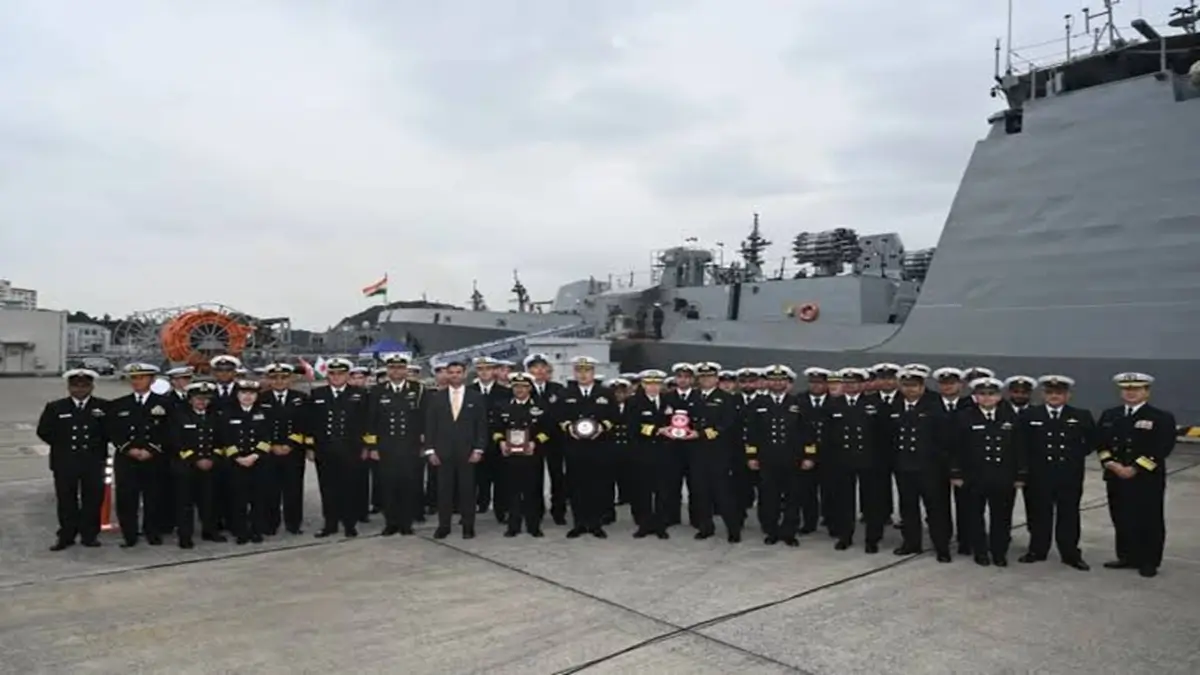
Yokosuka, Japan | 7 November 2026: Naval forces from India, the United States, Japan and Australia are taking part in Exercise Malabar 2026 in waters south of Japan’s Kanto region, with the Japanese Maritime Self-Defense Force hosting the multilateral exercise from 5 to 12 November. India’s guided-missile frigate INS Sahyadri arrived at Yokosuka ahead of the exercise, while commanders from the four navies held an opening ceremony and flag meeting on 6 November.
The Japanese Maritime Self-Defense Force’s announcement lists a mix of surface ships, a submarine and maritime patrol aircraft among the participating units. The exercise is designed to improve tactical capabilities and strengthen cooperation among the participating forces. Its published activity list includes anti-submarine warfare, anti-surface warfare and a photographic exercise, or PHOTOEX. The programme is a scheduled military exercise, not a public announcement of a new alliance or a statement that the participating countries have adopted a common operational plan for a specific conflict.
The Japan Maritime Self-Defense Force announced that Malabar 2026 would be conducted from 5 to 12 November in the sea area south of Kanto. The Japanese force listed the destroyer JS Ise, the frigate JS Mogami, a submarine and a P-1 maritime patrol aircraft among its participating units. The United States is contributing an amphibious transport dock and a P-8A maritime patrol aircraft. India is represented by INS Sahyadri, while the Royal Australian Navy is sending HMAS Stuart and the Royal Australian Air Force is contributing a P-8A aircraft.
The list is useful because it shows that the exercise is not limited to surface ships. A submarine and maritime patrol aircraft add an undersea and surveillance dimension to the training, while the participating surface vessels provide the platform for coordinated operations at sea. The published announcement does not provide every tactical detail, the full daily schedule or the precise scenario for each activity. Those limits matter: the presence of a particular platform does not establish exactly how it will be employed in every drill.
The opening ceremony on 6 November brought together senior officers from the four navies. Japan’s Vice-Admiral Omachi Katsushi, commander of the Self Defense Fleet, met Rear Admiral Anita Williams of the Royal Australian Navy, Vice-Admiral A. N. Pramod of the Indian Navy and Vice-Admiral Patrick J. Hannifin of the US Seventh Fleet. The Japanese statement said the commanders held a flag meeting and bilateral discussions with each participating nation.
Japan’s announcement described the objectives as improving tactical capability and strengthening cooperation with the United States, India and Australia. During the flag meeting, the commanders discussed maritime security in the Indo-Pacific and the future development of the exercise. The statement used the language of readiness, cooperation and a free and open Indo-Pacific. It did not identify a specific country as the target of the drills.
Malabar began in 1992 as a bilateral naval exercise between the United States and India. Japan joined the exercise in 2007, and Australia became a regular participant in 2020. The sequence reflects a gradual expansion of maritime cooperation among four countries that have shared interests in the security of sea lanes, the freedom of navigation and the ability to coordinate during complex operations.
The exercise’s growth has not been a straight line. Participation has varied across editions, and the political environment surrounding the Indo-Pacific has changed over the decades. The addition of more navies has increased the range of ships, aircraft, communications systems and operating procedures that must work together. That is why interoperability is a central purpose of the exercise. A ship may be capable of operating independently, but combined operations require crews to understand one another’s communication procedures, tactical signals and safety rules.
Malabar is often discussed alongside the Quad because India, Japan, Australia and the United States are also members of the four-country diplomatic grouping. The two are related in the sense that the same countries participate and share concerns about regional maritime security, but they are not the same institution. The Quad is a diplomatic partnership with working groups and summit-level engagement; Malabar is a naval exercise organised by the participating maritime forces. The exercise does not, by itself, create a collective-defence treaty or an automatic obligation to enter a conflict.
That distinction is important for understanding India’s strategic approach. New Delhi has expanded maritime cooperation with partners while retaining its own defence decision-making and its policy of strategic autonomy. Participation in Malabar allows Indian ships and crews to practise with other navies, exchange operational experience and improve the ability to communicate during joint activities. It does not mean that India has surrendered control over its deployments or agreed to a standing military command under another country.
Anti-submarine warfare is a major element of modern maritime security because submarines can threaten surface ships, ports and commercial routes while remaining difficult to detect. Exercises can test how ships, aircraft and sensors share information, classify contacts and coordinate search patterns. The exact tactical scenarios used in Malabar 2026 have not been published in the public announcement, so it would be inaccurate to claim that a particular submarine-hunting sequence or weapon release has taken place.
Anti-surface warfare training addresses a different problem: identifying and responding to threats posed by surface vessels. It can involve communication between ships, surveillance, manoeuvring and coordinated responses under agreed exercise rules. When several navies take part, the challenge is not simply to demonstrate the capability of each individual ship. Crews must understand how the other force operates and how a combined group can share information without creating confusion or unsafe movements.
The presence of P-8A maritime patrol aircraft from the United States and Australia, together with Japan’s P-1, adds an air component to the published list. Maritime patrol aircraft can contribute to surveillance over wide areas and support the search for surface and subsurface contacts. Their participation can improve the ability of ships to build a shared picture of activity in the exercise area. The public announcement does not specify the sensor data that will be exchanged or the level of access each country will receive.
A PHOTOEX is a coordinated photographic exercise in which participating ships and aircraft arrange themselves for images that document the event and demonstrate their ability to manoeuvre together. It is not a combat engagement. Such activities can have a communication purpose as well: they make the participation of the forces visible and provide a record of the exercise, while also testing formation discipline and coordination.
INS Sahyadri is an Indian Navy stealth frigate of the Shivalik class. Its participation gives India a surface combatant that can operate alongside the ships of the other three navies. The Ministry of Defence said the ship arrived at Yokosuka on 5 November for the exercise. The visit also provides an opportunity for port-level engagement and interaction between personnel, although the precise schedule of those activities should be taken from official announcements rather than assumed.
For the Indian Navy, exercises such as Malabar are a way to maintain practical familiarity with partners in a region where maritime traffic is strategically important. The Indian Ocean and the wider Indo-Pacific contain major trade routes, energy flows, undersea cables and critical port infrastructure. A disruption to shipping can affect fuel prices, supply chains and the delivery of goods far beyond the immediate area of an incident. Cooperation at sea is therefore relevant not only to defence planners but also to the economic security of countries that depend on maritime trade.
India’s participation also demonstrates the value of operating with different naval platforms and procedures. A ship that has trained with another navy may be better prepared to communicate during a humanitarian response, an evacuation, an anti-piracy operation or a maritime-security mission. Exercises do not guarantee that every real-world operation will proceed smoothly, but they provide a controlled environment in which crews can identify gaps and improve their working relationships.
Malabar 2026 takes place amid continuing competition in the Indo-Pacific, but the exercise should not be presented as a direct response to one incident unless the participating governments say so. The official Japanese statement refers to maritime security, tactical proficiency and cooperation. Analysts may connect the exercise to broader regional tensions, but that interpretation should be distinguished from the stated objectives of the organisers.
There are also practical limits to what can be concluded from the participating-unit list. The public release identifies the major platforms and the general types of drills, but it does not disclose classified operating procedures, sensor performance or rules of engagement. It does not say that the forces will conduct live weapons firing. The exercise is therefore best understood as a structured opportunity to practise maritime operations rather than as evidence that a new combat arrangement has been formed.
The next developments to watch are the conclusion of the exercise on 12 November, any official account of the activities completed and the level of participation reported by the four navies. The closing statements may explain which skills were tested and what lessons the forces intend to carry into future editions. Any announcement of additional port visits or bilateral meetings should be treated separately from the sea-phase drills.
For India, the immediate value is practical: INS Sahyadri is operating with three partner navies in a defined exercise area, and senior commanders have discussed the maritime-security environment. For the wider region, the event is another sign that the four countries are investing in the ability to work together at sea. Its significance lies in repeated professional cooperation, not in an automatic military commitment.



Comments (0)
Be the first to comment. Comments are published after moderation.