


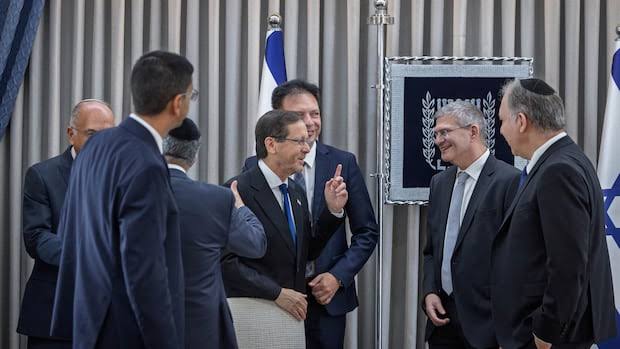
JERUSALEM, November 4, 2026: Israel’s Central Elections Committee has certified the results of last week’s general election after finding no irregularities capable of changing the outcome, rejecting claims of widespread fraud made by Prime Minister Benjamin Netanyahu’s allies and moving the country into a difficult phase of coalition negotiations.
The official results were submitted to President Isaac Herzog on Wednesday. The Netanyahu-led bloc secured 53 seats in the 120-member Knesset, while the opposition bloc led by Gadi Eisenkot won 48. The Arab-led Ra’am and Joint List parties together secured 19 seats, a record result for the two groupings. None of the blocs has the 61 seats required for a parliamentary majority.
The certification is important because the fraud allegations had threatened to turn an already fragmented election into a dispute over the legitimacy of the vote. The committee said it had reviewed 9,069 polling stations and found no irregularities that compromised the election’s integrity or changed the result. Its findings were reported by Al Jazeera, which drew on Associated Press and Agence France-Presse coverage, and by The Guardian.
The election was held on October 27. Netanyahu and allies subsequently questioned the result, focusing in particular on the performance of Arab-led parties and suggesting that the vote had been affected by fraud or foreign influence. The committee’s review did not support those claims. Its acting director general, Dean Livne, said complaints had been examined individually and that the certified figures reflected voters’ choices.
Justice Noam Sohlberg, a Supreme Court justice who chairs the Central Elections Committee, said attempts to cast doubt on the result posed a danger to democratic institutions. The committee’s five-member presidium voted to ratify the results, with representatives of Yesh Atid and Blue and White supporting certification. Likud and Shas abstained, leaving Sohlberg’s vote decisive.
The certification does not mean that every allegation connected to the election has disappeared. Authorities may continue investigating specific complaints or suspected misconduct. But the committee has made clear that the available evidence does not justify withholding or changing the overall result. That distinction matters: an investigation into an individual allegation is not the same as evidence that the national vote count is invalid.
The political rhetoric surrounding the Arab vote has added to the tension. The Ra’am and Joint List parties represent a large share of Palestinian citizens of Israel, who make up about one-fifth of the country’s population. Their combined 19 seats give them a stronger parliamentary position than in previous elections and make them central to the coalition arithmetic.
Netanyahu’s allies have alleged that Arab-led parties benefited from improper voting or outside interference. The committee’s review found no result-changing irregularities in the polling stations examined. The claims should therefore remain attributed to the politicians who made them rather than presented as established evidence of fraud.
The dispute has also raised questions about the role of security agencies in domestic politics. Israeli media have reported that the Shin Bet is examining allegations of foreign influence and that some Arab politicians may be questioned. The available reporting does not establish that any such inquiry has uncovered evidence capable of overturning the election result. The election committee’s certification remains the formal basis for the next stage of government formation.
The 53 seats won by Netanyahu’s bloc fall short of a majority by eight. Eisenkot’s opposition bloc has 48, leaving it 13 short of the threshold. The 19 seats held by Ra’am and the Joint List could therefore determine whether an opposition-led coalition can be assembled, whether a broader unity arrangement is attempted or whether negotiations fail and another election becomes necessary.
Eisenkot has received the backing of the Jewish opposition parties, according to The Guardian. The Arab-led parties have said their priority is to remove Netanyahu from office, making them potential partners in an arrangement that could prevent his bloc from returning to power. But support for replacing the prime minister does not automatically settle disagreements over policy, security, budgets or the terms of coalition participation.
Herzog’s role is now central. After receiving the certified results, the president is beginning consultations with the leaders of the political blocs. Those meetings are intended to establish which candidate has the best chance of forming a government. The president does not choose a prime minister by personal preference; the process is guided by the recommendations and parliamentary support available from the parties.
Under the Israeli system, the candidate selected by the president receives 28 days to form a government, with the possibility of a 14-day extension. If that effort fails, the mandate can pass to another candidate or the process can move towards a new election, depending on the constitutional timetable. Al Jazeera reported that a failure to assemble a coalition could lead to another vote early next year.
The consultations are expected to take two days. The Times of Israel has reported that Herzog will meet smaller parties first, followed by the larger blocs. The order of meetings does not by itself determine who will receive the mandate, but it will give the president an opportunity to assess the political commitments each party is prepared to make.
Coalition talks could take weeks because the seat totals leave little room for error. A government built around Eisenkot would need to reconcile the positions of parties with different political and ideological priorities. An arrangement involving Arab-led parties would be historically significant, but it would also face opposition from parties that have made their participation unacceptable. A unity government could avoid some of those problems, although it would require a compromise between rivals who campaigned on sharply different visions for the country.
Netanyahu remains a powerful political actor even after his bloc failed to reach a majority. The election has not immediately removed him from office. Until a successor is sworn in, the existing government continues to perform its functions, and the prime minister’s position in the security and diplomatic system remains consequential. The immediate question is whether his allies can recruit enough support to remain in power or whether the opposition can turn its combined numbers into a functioning coalition.
The election result also carries implications for Israel’s relations with Arab citizens and the political legitimacy of minority representation. The rise in support for Arab-led lists has been accompanied by intense rhetoric about their role in the state. The certification process has therefore become more than a technical exercise in counting ballots: it has tested whether the political system will accept a result that gives Arab parties a potentially decisive voice.
That does not mean the Arab parties will necessarily join an opposition government. They may support a candidate for the initial mandate, negotiate confidence-and-supply arrangements or remain outside the coalition while voting on selected measures. Each option carries different political costs. Their leaders will have to decide how much influence they can secure without compromising positions that matter to their voters.
In a 120-member parliament, the 61-seat threshold is more than a numerical target. It determines whether a prime minister can secure confidence for a government and pass budgets and legislation. A candidate who receives the president’s mandate still needs a coalition agreement and enough support in the Knesset to govern. Parties can offer outside support without joining the cabinet, but such arrangements may be less stable when the partners disagree on security, religion, budgets or the status of Arab citizens. The negotiations will test whether the opposition can maintain a common position after campaigning as a bloc and whether the Arab-led parties are prepared to support a government without taking ministerial responsibility.
Netanyahu’s cabinet remains in office until a new government is formed and sworn in. The election result therefore does not immediately change the administration of security, foreign policy or public services. A prolonged caretaker period can nevertheless make major appointments, long-term spending decisions and new policy initiatives more difficult. The parties will have to decide whether to seek a narrow coalition that can pass confidence votes or a broader unity arrangement that offers greater numerical stability but requires compromise on issues that divided the campaign.
The broader background is a period of repeated electoral deadlock. Israel held five elections between 2019 and 2022 before Netanyahu returned to office in late 2022. The latest result again shows how difficult it can be to translate a plurality of seats into a stable governing majority when party blocs are divided and no side can cross the threshold alone.
The committee’s certification removes one major uncertainty but does not resolve the political crisis. The next developments to watch are the recommendations made during Herzog’s consultations, the candidate who receives the first mandate, the conditions attached to support from Arab-led parties and whether any unity arrangement gains traction. If no candidate can assemble a government within the prescribed period, Israel could face another election only months after the last one.
For now, the official count stands. The election authority has found no evidence that changes the outcome, and the burden has shifted from disputing the ballot to negotiating a government capable of commanding the Knesset.


Comments (0)
Be the first to comment. Comments are published after moderation.