


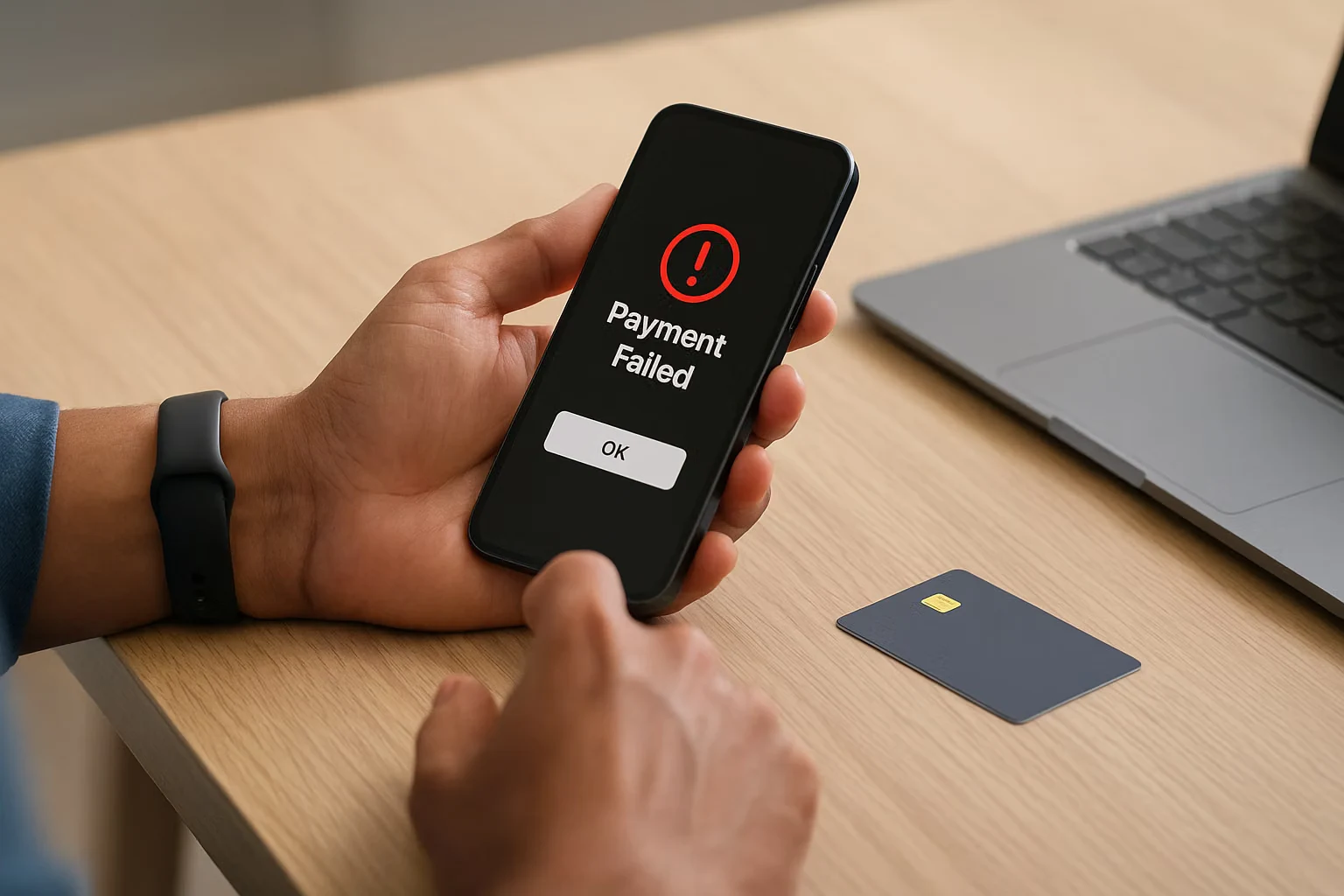
A failed UPI payment does not always mean the money has been lost. In some cases the payer’s bank debits the account while the beneficiary or merchant does not receive confirmation; the payment system then has to reconcile the transaction and reverse the debit where required. The correct next step depends on whether the transfer was person-to-person, a merchant payment, a pending transaction or a completed payment sent to the wrong recipient.
The Reserve Bank of India’s framework for failed transactions sets different automatic-reversal timelines for different payment situations. For a UPI funds transfer in which the payer is debited but the beneficiary account is not credited, the framework specifies reversal by the beneficiary bank no later than T+1 day. For a merchant payment where the account is debited but confirmation is not received at the merchant location, the framework specifies auto-reversal within T+5 days. The same circular provides compensation of ₹100 per day for delays beyond the applicable timeline in the listed cases.
Those timelines are not a promise that every payment dispute will be settled in one day or five days. A mistaken transfer, a refund requested after a purchase, a suspected fraud and a transaction that remains pending can follow different processes. Consumers should record the transaction reference and follow the complaint route in the UPI app or bank before escalating.
First, identify what actually happened
A transfer to another person shows failed
If the app says failed but the payer’s account was debited, check the transaction status in the app and in the bank statement. Do not immediately send the same amount again unless the status is clear; a delayed success notification can create a duplicate payment. Save the UPI transaction ID or reference number, date, time, amount, payer bank, beneficiary details and any status message.
For a funds transfer where the beneficiary account was not credited, the RBI framework uses the T+1 reversal timeline. T is the transaction date, and the framework’s table defines the turnaround time for that specific failure scenario. If the amount has not been reversed within the applicable period, raise a complaint with the UPI app and the bank, quoting the transaction reference. The bank can trace whether the transaction settled, failed or remains unresolved.
A merchant says the payment did not arrive
A merchant payment is a different situation. The customer may see a debit, while the shop, website or payment terminal does not receive a successful confirmation. The RBI framework specifies auto-reversal within T+5 days for the listed case in which an account is debited but confirmation is not received at the merchant location. Keep the receipt, order number or merchant reference and ask the merchant to check its payment record before paying again.
If the merchant’s system later confirms a successful payment, the issue may be a delayed status update rather than a failed transaction. In that case, the merchant should not be asked to issue a duplicate refund simply because the app initially displayed a pending message. The customer should preserve evidence of both the bank debit and the merchant’s confirmation and ask the payment app or bank to reconcile the status.
A purchase was cancelled or returned
A refund after a cancelled order or returned product is not necessarily the same as an automatic reversal of a failed UPI payment. The seller may have to initiate a refund through its payment system, and the timeline can depend on the merchant’s policy and the payment route. Keep the cancellation confirmation, return tracking, invoice and merchant’s refund reference. Ask the seller whether the refund has actually been initiated rather than relying only on a bank debit entry.
Money went to the wrong recipient
A completed transfer to the wrong UPI ID or mobile-linked account is not the same as a failed transaction. The payment may have been processed correctly according to the instruction entered by the payer. Contact the UPI app and bank immediately, provide the transaction reference and request assistance. Do not assume the failed-transaction auto-reversal rules apply, and never share a PIN or one-time password with someone claiming they can recover the money.
The step-by-step complaint process
- Open the UPI app used for the payment and select the specific transaction. Save the status, transaction ID and any complaint or ticket number.
- Use the app’s help or dispute option to raise a complaint for the relevant transaction type. Describe whether the payer was debited, whether the beneficiary or merchant received funds, and whether the app shows pending, failed or successful.
- Contact the payer’s bank through its official app, website, branch or customer-care channel if the app complaint does not resolve the issue. Give the transaction reference, amount, date and evidence of debit.
- Ask for a complaint acknowledgement and expected resolution date. Keep the ticket number, emails and screenshots so the issue can be escalated without repeating the full history.
- If the complaint remains unresolved, use the National Payments Corporation of India’s dispute-redressal guidance to identify the relevant participant and escalation route.
- If the regulated entity does not respond within the applicable period, or its response is unsatisfactory, check eligibility to lodge a complaint through the RBI’s Complaint Management System under the applicable ombudsman framework.
Use only official app and bank channels. Search results and social-media comments can direct users to fake customer-care numbers. A legitimate bank or payment app should not ask for the UPI PIN, screen-sharing access or an OTP to reverse a transaction. Do not install a remote-access app at the request of someone claiming to be a bank employee.
What the RBI reversal timelines mean
The RBI circular distinguishes the failure mode and the party responsible for the reversal. For the UPI funds-transfer case where the payer is debited but the beneficiary is not credited, the beneficiary bank must reverse the transaction no later than T+1 day if the funds cannot be credited. The framework lists ₹100 per day of delay beyond that timeline. For the merchant-confirmation case, the auto-reversal timeline is T+5 days, with ₹100 per day for delay beyond the specified period.
Also read: UPI Lite vs Regular UPI: Limits, Payments and Safety
These are regulatory turnaround times for the scenarios described in the circular, not a universal five-day rule for every refund. A completed payment sent to the wrong person, a merchant refund, a chargeback, a suspected fraud and a payment whose final status is still being reconciled may require different handling. The bank or payment provider should explain which category applies and what evidence is required.
The distinction between a transfer and a merchant payment is important because a user may see the same word—‘pending’—in different contexts. A person-to-person transfer depends on whether the beneficiary account was credited. A merchant payment may depend on whether the merchant’s system received confirmation. A refund after a returned item depends on the merchant initiating the refund. Asking the bank to identify the transaction category helps avoid a generic answer that does not address the actual problem.
When to escalate beyond the app
If the UPI app’s help section does not resolve the problem, the bank that holds the payer’s account is a useful next contact. Depending on the transaction, the payment service provider, beneficiary bank or merchant’s acquiring bank may also be involved. The consumer should not have to guess which institution failed, but providing the transaction reference and a clear timeline makes investigation easier.
NPCI’s dispute-redressal information explains the route for UPI transaction complaints and directs users to the relevant participant. If a complaint remains unresolved, the RBI Complaint Management System is the official channel for eligible complaints against regulated entities. Users should check the current eligibility and escalation conditions on RBI’s site, including whether they have first complained to the regulated entity and whether the required response period has elapsed.
A complaint is easier to investigate when it is specific. State the amount, date and time; say whether the payer was debited; identify whether the beneficiary or merchant received the money; quote the UPI reference; and list the complaint numbers already raised. Avoid sending a full bank statement or identity documents to an unverified email address or a social-media account.
Avoid common mistakes while waiting
Do not pay a second time until the first transaction’s status is understood, especially when buying tickets, paying bills or placing online orders. If a second payment is unavoidable to complete an urgent purchase, record both references and tell the merchant that the first is under investigation. Do not treat an SMS alert as the only proof of settlement; check the account statement and the transaction status.
Do not share your UPI PIN to receive a refund. A PIN authorises a debit; it is not a code that releases money into an account. Banks and payment apps should not ask for it to reverse a failed payment. Treat unexpected calls, QR codes and links that promise immediate refunds as potential fraud, and independently open the official app or website.
Finally, retain the record until the credit appears in the bank statement, not just until the app changes status. If a reversal is partial or the merchant’s refund differs from the original amount, ask the responsible institution to explain the difference in writing. Clear records make it easier to identify whether the issue is a technical failure, a merchant refund or a separate dispute.
A practical checklist
- Save the UPI transaction ID, amount, date, time and bank debit evidence.
- Identify whether the case is a person-to-person transfer, merchant payment, cancelled order, wrong recipient or suspected fraud.
- Raise a complaint in the UPI app and retain its ticket number.
- Check the relevant RBI turnaround time rather than assuming every case follows T+1 or T+5.
- Escalate through the bank, NPCI’s dispute guidance and, where eligible, RBI’s Complaint Management System.
- Never share a UPI PIN, OTP or remote-access permission with anyone offering to recover the money.
Most importantly, a debit entry is not by itself proof that the beneficiary received the money, and a pending status is not proof that the transaction has failed permanently. Identify the failure type, preserve the evidence and use the formal complaint route. That gives the bank and payment provider the information needed to trace the transaction and apply the correct reversal or dispute process.
Frequently asked questions
How long does a failed UPI transfer take to reverse?
For the RBI framework’s specific case where the payer is debited but the beneficiary is not credited, the stated auto-reversal timeline is no later than T+1 day. Other payment situations can have different timelines.
What if a UPI merchant payment is debited but the shop says it failed?
Save the transaction reference and receipt, check the app status, and raise a complaint. The RBI framework specifies auto-reversal within T+5 days for the listed merchant-confirmation failure scenario.
Can I share my UPI PIN to get a refund?
No. A UPI PIN authorises a debit and should never be shared with a caller, merchant or support agent to receive a refund.
Sources: RBI — Harmonisation of turnaround time and compensation for failed transactions; NPCI — UPI dispute-redressal mechanism; RBI — Complaint Management System





Comments (0)
Be the first to comment. Comments are published after moderation.