


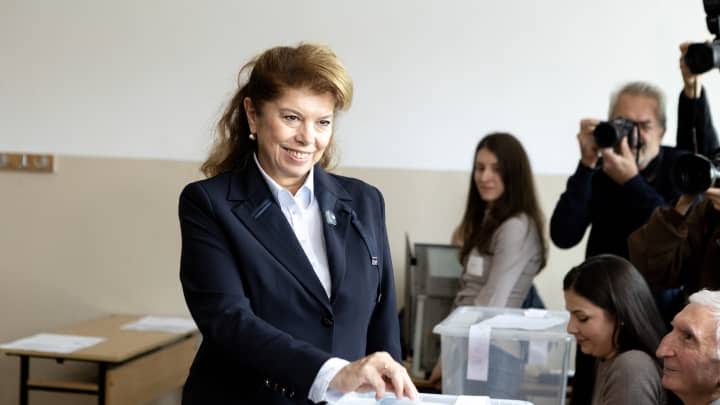
Iliana Iotova has won Bulgaria’s presidential runoff, becoming the first woman elected to the country’s presidency after defeating pro-Western candidate Andrey Gyurov by a wide margin, according to near-complete results reported on Monday, November 2. The result gives Iotova a five-year mandate at a time when Bulgaria is still grappling with political fragmentation, public distrust of institutions and difficult choices over its position on Russia’s war against Ukraine.
With 99.95% of polling-station protocols processed, figures from Bulgaria’s Central Election Commission cited by national broadcaster Radio Bulgaria put Iotova’s ticket at 57.58% and Gyurov’s at 39.46%. The remaining ballots included a smaller share of voters who selected the option indicating that they did not support any candidate. The Associated Press and Reuters reported the result at approximately 57.6% to 39.5%, respectively. Final certification remains a matter for the election authorities.
Gyurov conceded defeat after the result became clear. Iotova called for national consensus and a stronger state, framing the vote as an opportunity to restore public confidence in institutions. Her victory was backed by the political camp associated with Rumen Radev and his Progressive Bulgaria movement. That support gives the result importance beyond the largely ceremonial character of the presidency: it reflects the strength of a political current that has argued for a more cautious approach to Bulgaria’s involvement in the Ukraine conflict.
Iotova is due to take office on January 22, 2027, for a five-year term. Her election is historic for representation, but the practical reach of the presidency is more limited than that of the prime minister and cabinet. Bulgaria’s president represents the state, serves as commander-in-chief, can return legislation to parliament for reconsideration and has an important role when political parties fail to form a government. Those constitutional responsibilities can become consequential during periods of prolonged parliamentary deadlock.
The election unfolded against a background of repeated political instability. Bulgaria has experienced a succession of elections and fragile governing arrangements in recent years, with disputes over corruption, judicial accountability and the functioning of state institutions remaining central to public debate. That instability has made the presidency a prominent platform for political argument even when the office does not directly manage day-to-day government policy.
Iotova’s message about institutional repair and dialogue is likely to be tested by the divisions that marked the campaign. A president can encourage negotiations and use public influence to press parties towards compromise, but cannot by herself resolve disputes inside parliament or impose a governing programme on elected representatives. The test will be whether she can use the authority of the office to help produce more durable political arrangements without becoming an extension of one party’s strategy.
The near-final results showed a clear lead for Iotova, but the turnout figure and the vote for the blank or protest option point to a wider question about voter engagement. An election can produce a decisive winner without settling the dissatisfaction that has driven political churn. Bulgaria’s institutions will continue to face pressure to show that they can deliver stable administration, transparent decisions and accountability for misuse of public power.
Her political alignment will also be watched closely in Brussels and other European capitals. Bulgaria is a member of the European Union and NATO, and decisions on sanctions, defence cooperation and support for Ukraine are made through a mix of national government policy and commitments within those organisations. The president does not set those policies alone, but can shape the public debate and influence the tone of the country’s foreign-policy discussion.
During the campaign, Iotova favoured diplomacy in dealing with Russia’s war against Ukraine and opposed additional Bulgarian military assistance to Kyiv. That position differs from the approach of governments that have argued that military support is necessary to help Ukraine defend itself. It also reflects concerns among some Bulgarian voters about escalation, economic costs and the country’s historical and cultural ties with Russia. Those positions are politically significant, but they do not automatically translate into a change in Bulgaria’s official commitments as an EU and NATO member.
Any shift in policy will depend on the government, parliamentary arithmetic and the legal framework governing defence and foreign affairs. The president may express views, convene consultations and use constitutional powers, but military assistance and budget decisions require action by the relevant elected institutions. Iotova’s influence is therefore likely to be greatest in setting priorities, pressing for debate and shaping how Bulgaria explains its choices to domestic and international audiences.
The presidency can matter most when parliamentary politics breaks down. Under Bulgaria’s constitutional system, the head of state has a role in appointing caretaker administrations and setting the process for fresh elections when parties cannot form a stable government. That makes the office especially relevant in a country where coalition negotiations have repeatedly failed or produced short-lived arrangements. Iotova may be called upon to act as an institutional intermediary even if she is unable to dictate the outcome.
Her relationship with Radev’s political movement will be another factor. Support from a powerful political camp can give a president a clearer base of public backing, but it can also raise questions about independence. The presidency is expected to represent the state as a whole, not simply the interests of the forces that helped elect its occupant. Iotova will need to demonstrate that she can engage with parties that opposed her and defend the constitutional role of the office when political interests conflict.
For Bulgaria’s European partners, the immediate focus will be continuity and clarity. The country’s position on Ukraine, defence spending, energy security and EU policy will be assessed through official government decisions rather than campaign language alone. A president who calls for diplomacy may still operate within existing alliance commitments; a president who criticises those commitments can influence debate without necessarily changing them. The distinction will be important as Iotova prepares to assume office.
The result also carries a symbolic significance in a region where women have held senior public roles but have not always reached the presidency through a direct national election. Iotova’s election will be noted as a milestone, although the significance of that achievement will ultimately be judged alongside her performance in office. Voters will expect the incoming president to address institutional distrust and political instability rather than rely on the symbolism of the result alone.
The next stage is the formal completion of the count and the preparations for the January transfer of office. Between now and then, the outgoing administration and parliament will continue to make the decisions that shape Bulgaria’s immediate policy. Iotova’s first months as president will show whether her call for consensus can bridge the country’s political divides, and how she balances her campaign positions with the responsibilities of a state that is firmly embedded in European and transatlantic institutions.
SOURCE
Reuters; Associated Press; Bulgarian Central Election Commission; Radio Bulgaria (BNR)



Comments (0)
Be the first to comment. Comments are published after moderation.