


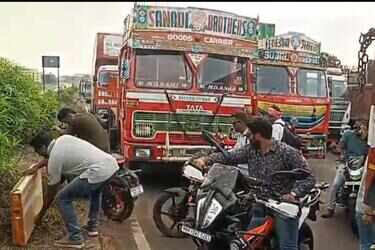
KOLHAPUR, November 6, 2026 — The Kolhapur sugarcane protest led by the Swabhimani Shetkari Sanghatana has ended after farmers called off their blockade of the Pune–Bengaluru National Highway under a revised payment arrangement worth up to ₹4,200 per tonne. The settlement, reached during talks at the Kolhapur district collector’s office on Thursday evening, ended more than two days of disruption around the Kini toll plaza and led organisers to withdraw a proposed Kolhapur bandh for Saturday.
Former MP and organisation leader Raju Shetti announced the suspension of the agitation after addressing farmers at the protest site. Regional reports said the road blockade was lifted late Thursday or in the early hours of Friday. The duration was described as about 61 hours by eSakal and Agrowon, while The Times of India used a figure of roughly 72 hours. The reports agree on the central outcome: the blockade ended after the mills improved their offer and the farmers’ organisation accepted a staged payment formula.
The proposal provides for an initial payment of ₹3,900 per tonne, another ₹100 when the crushing season ends, and a further ₹200 before the next season begins if the specified sugar-price condition is met. The final instalment is linked in regional reporting to sugar prices holding at or above ₹45 per kilogram. That makes ₹4,200 the effective total under the agreed formula, not an unconditional upfront payment of that amount. The distinction matters to growers deciding how much money they can count on immediately and how much depends on conditions later in the season.
The agreement followed a negotiation involving district officials, sugar mill representatives and farmer leaders. Reports from the meeting identified Maharashtra medical education minister Hasan Mushrif, former minister Prakash Awade, the district collector and the sugar joint director among those involved. The precise commitments of individual mills and the mechanism for monitoring deferred payments will matter as the arrangement moves from a meeting-room proposal to payments made to growers.
The protest had centred on the amount growers would receive for cane supplied to factories during the new crushing season. Shetti’s organisation had sought a higher initial return, with reports describing an earlier demand of ₹4,500 per tonne. The mills’ revised offer brought the effective value to ₹4,200, but spread across three stages rather than paying the full amount at the time of delivery. The farmers’ decision to accept the formula ended the immediate road confrontation; it does not mean every payment has already reached growers.
Under the reported arrangement, the first ₹3,900 is the amount farmers can expect as the initial payment. The ₹100 due when a mill closes for the season comes later, while the remaining ₹200 is tied to the sugar-price condition before the next crushing season. Farmers will therefore need clear documentation showing the amount paid for each delivery, the dates on which later instalments become due and the benchmark used to decide whether the final amount is payable.
The formula also leaves a question about enforcement. A collective agreement can resolve a protest, but the practical test is whether participating factories apply it consistently and settle the deferred amounts on time. The district administration and the sugar department may be asked to clarify the terms in writing, including how the price condition will be measured and what happens if the market price moves below the agreed level. The available reports describe the settlement, but they do not establish that all mills have signed identical written undertakings or that a payment-monitoring mechanism has already been notified.
For growers, the timing of payments can be as important as the final rate. Cane cultivation involves costs that accumulate before harvest, including seed material, fertiliser, irrigation, labour, harvesting and transport. Farmers who rely on crop receipts to repay seasonal credit or meet household expenses may place greater value on a larger first instalment than on a higher total spread over several months. Mills, meanwhile, have to account for the prices at which they can sell sugar and by-products, the cost of cane, working capital and their obligations to farmers. The settlement reflects a negotiated balance between those competing pressures; it should not be confused with a change to the national statutory fair and remunerative price.
The fair and remunerative price, or FRP, is the minimum cane price set under the central government’s sugarcane pricing framework. The ₹4,200 arrangement reported in Kolhapur is a negotiated local payment formula between the organisation and sugar factories. It is not, by itself, a nationwide revision of FRP or a government order changing the price for every mill in Maharashtra. Farmers in other districts will need separate agreements or administrative action before the same formula can be treated as applicable there.
The protest was centred on the Kini toll plaza on the Pune–Bengaluru highway, a major route connecting western Maharashtra with Karnataka and carrying passenger, freight and intercity traffic. Earlier reports described disruption across a stretch extending between Nagthane in Satara district and the Sangli Phata area of Kolhapur district. The road closure affected more than farmers and mill operators: truck drivers, bus passengers, traders, transport companies and people travelling during the festive period were also caught in the disruption.
Hindustan Times reported that more than 1,500 trucks had been stranded and that the Maharashtra State Road Transport Corporation had cancelled around 100 bus trips a day while the agitation continued. Agrowon reported a larger cumulative figure of 166 cancelled ST bus services. These figures refer to reporting at different points during the blockade and should not be treated as a single final tally. They nevertheless show how a dispute over a crop price can quickly affect a transport corridor well beyond the villages and factories directly involved.
Perishable goods and time-sensitive cargo are particularly exposed when trucks cannot move. A delayed consignment can raise costs for traders and carriers even if the goods are not lost. Bus cancellations also impose costs on passengers who must find alternative transport, change travel plans or miss work and appointments. Those effects explain why the end of the blockade and the withdrawal of the planned district bandh were significant for the wider public, not merely a procedural detail in a farm-price negotiation.
Reports following the agreement said traffic began returning to normal after the blockade was lifted. Operators and travellers should still rely on local traffic and police updates for the status of individual stretches, since the reopening of the main protest point does not automatically establish that every diversion, queue or restriction elsewhere has cleared. The immediate relief is that organisers have suspended the action and withdrawn the announced bandh, removing the stated reason for the continued blockade.
The dispute also illustrates the different interests connected to the sugar economy in western Maharashtra. Growers seek a price that covers cultivation costs and provides a predictable return. Mills must purchase cane, process it and sell sugar in a market where prices can change during the season. The sector is also linked to ethanol production and other revenue streams, but those factors do not remove the need for transparent payment terms between mills and farmers. A price that is stated as a headline figure can mean something different if part of it is delayed or conditional.
Shetti’s organisation has indicated that the Kolhapur formula should be considered in neighbouring districts, including Sangli and Satara. The settlement therefore may not end the wider regional debate over cane prices. If growers in those districts do not receive a similar offer, the organisation could press for separate negotiations or renewed action. That possibility is distinct from the Kolhapur blockade, which has been called off; no new highway shutdown should be described as confirmed unless organisers announce it and local authorities verify the situation.
The next test will be implementation. Farmers will be watching whether the initial ₹3,900 is paid as cane is supplied, whether the ₹100 end-of-season instalment is honoured and whether the ₹200 conditional amount is calculated against a clearly defined sugar-price measure. Mill-level records, written agreements and confirmation from the district administration will be more useful indicators than the headline settlement number alone.
For transport operators, the priority is the restoration of predictable movement along NH-48. For the agricultural sector, the important question is whether the settlement can reduce uncertainty for growers without creating payment obligations that mills later dispute. For public authorities, the episode is a reminder that negotiations over farm prices can quickly become a matter of public infrastructure and essential transport when a protest is staged on a national highway.
The immediate standoff has ended, but the agreement will be judged over the months in which its instalments fall due. The blockade’s suspension has reopened the route and removed the planned Kolhapur bandh from the calendar. Whether the settlement provides lasting relief will depend on transparent mill-wise implementation and on whether farmers in neighbouring sugar-producing districts accept the same terms.

Comments (0)
Be the first to comment. Comments are published after moderation.