


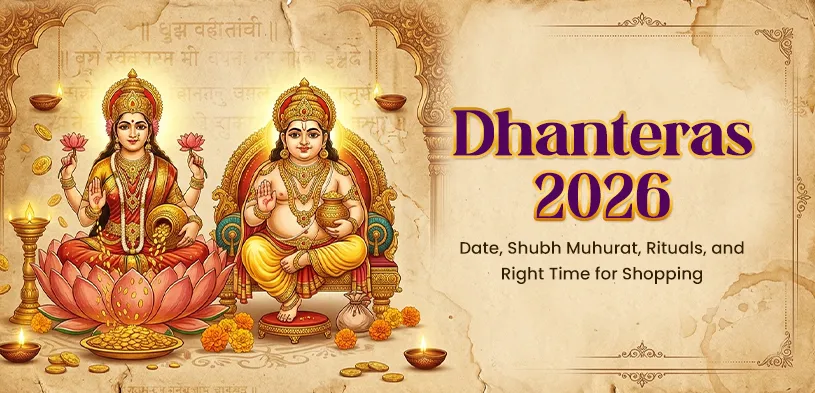
NEW DELHI, November 6, 2026 — Dhanteras, also known as Dhantrayodashi, is being observed across India on Friday as the opening day of the Diwali festival period. In the New Delhi Panchang, the Trayodashi tithi begins at about 10:30 am on November 6 and ends at about 10:47 am on November 7. Drik Panchang lists the evening puja muhurat in the capital from 6:02 pm to 7:57 pm IST. The timings are location-specific: families in other cities should follow their local Panchang rather than assume that the Delhi clock window applies nationwide.
The overlap between two calendar dates is not unusual in the Hindu lunar calendar. A tithi is determined by the angular relationship between the Sun and Moon, not by the civil day beginning at midnight. It can therefore start during one date and end during the next. Dhanteras is associated with the Trayodashi of Kartika Krishna Paksha, and the observance is generally placed on the day when that tithi is present during the evening Pradosh period. That is why the festival is listed on November 6 even though the tithi continues into the following morning.
The exact minute of a muhurat can differ slightly between almanacs because calculations use location, sunrise and sunset, and the method used to define the relevant period. Some published calendars show a one- or two-minute variation at the beginning or end of the Delhi window. Such differences should not be turned into a claim that one calendar is universally correct. A household following a temple, family priest or regional Panchang may use the timing traditionally observed in that community.
The name Dhanteras combines the idea of wealth with the thirteenth lunar day. The festival is also called Dhantrayodashi and is linked in Hindu tradition with Dhanvantari, who is associated with Ayurveda and healing. Many households offer prayers to Lakshmi and Kubera, figures associated with prosperity, while some also mark Dhanvantari Jayanti. The emphasis on health alongside wealth is one reason the day is not limited to shopping: prayer, family gatherings, cleaning and preparation for the wider Diwali observances are also part of the occasion.
Another custom is Yamadeepdaan, the lighting of a lamp in connection with Yama. In many traditions, a diya is placed outside the home in the evening as a prayer for protection from untimely death. The details vary by region and family. Some households prepare a specific lamp and place it near the entrance; others follow the practice prescribed by their local temple or family custom. It is best understood as a religious observance rather than a uniform national ritual with one compulsory procedure.
Dhanteras is commonly described as the first day of the five-day Diwali sequence. The days that follow have their own regional names and observances, including Narak Chaturdashi, Lakshmi Puja, Govardhan Puja and Bhai Dooj. The order and local calendar details can differ where a tithi overlaps or a regional tradition assigns an observance differently. For households planning travel, temple visits or family events, the practical step is to check the local festival calendar for each day rather than rely on a single generic list.
Gold, silver, utensils and other durable household items are traditionally bought by many families on Dhanteras. The purchase is often treated as a symbolic beginning to the festive season, with the object representing prosperity or a useful addition to the home. The custom has also become an important date for jewellers, bullion dealers and retailers, who prepare for seasonal footfall and advance bookings. The tradition does not mean every family must buy an expensive item, and it does not guarantee that a purchase will rise in value.
For a household working within a fixed budget, a small utensil, a modest silver item or a purchase already planned for the year can carry the same personal meaning as a larger transaction. The financial decision should remain separate from the religious symbolism. Gold jewellery includes the value of the metal as well as workmanship and tax, and resale terms can differ from the original purchase price. Buyers comparing jewellery offers should examine the complete bill, not only the rate displayed outside a shop.
Also read: Gold Jewellery Bill in India: Making Charges, GST, and HUID Explained
Gold and silver prices can also move independently of the festival calendar. International bullion prices, the rupee, import costs, domestic premiums and trading conditions all influence the rates quoted in India. A festival promotion or a popular shopping day does not remove those market factors. Anyone comparing a shop quotation with a market headline should first establish whether the figure refers to global spot bullion, an exchange futures contract, a domestic benchmark or a retail price for a particular purity.
Also read: Gold and Silver Prices: Why Indian Rates Differ From Global Bullion
Consumers should keep the purchase decision practical. Set a spending limit before entering a crowded market, ask for an itemised quotation and retain the invoice and payment record. If buying jewellery, check the stated purity and hallmark details and understand the seller’s exchange or buyback terms. If paying digitally, use the payment method shown by the merchant and confirm that the transaction is complete before leaving. Avoid making a rushed purchase because a salesperson says a particular offer or auspicious window will disappear immediately.
The wider retail impact is visible beyond precious metals. Dhanteras is also used by households to buy kitchen utensils, small appliances, tools, vehicles and other durable goods. For retailers, the day can concentrate demand into a short period, while online sellers may spread offers across several days. A discount is useful only if the final price, delivery terms, warranty and return conditions are clear. A product that is not needed or cannot be comfortably paid for is not made financially sound by the festival date.
Families observing the evening puja in New Delhi can use the 6:02 pm to 7:57 pm window listed by Drik Panchang as a local reference. Those outside the capital should check a city-specific Panchang because sunset and the relevant lunar calculations change with location. People travelling between cities should also remember that the local time of a ritual is tied to the place where it is performed, not necessarily the place where a calendar was first consulted.
Those visiting temples or markets should plan for heavier traffic and queues, especially near jewellery districts and shopping centres. Keep children close in crowded areas, use well-lit routes after evening prayers and avoid carrying more cash or valuables than necessary. Retailers and market associations may issue local traffic or opening-hour advisories, which can change from one city to another. These practical arrangements are separate from the religious timing and should be checked through local authorities or the venue itself.
For people who do not make a purchase, the day can still be observed through prayer, lighting a lamp, cleaning the home, preparing for Diwali or spending time with family. The idea that Dhanteras requires a gold purchase is a modern commercial simplification of a broader set of religious and household practices. The festival’s meaning is not measured by the weight or price of an item bought on one day.
The next part of the festival period brings its own puja and family customs. Lakshmi Puja, which is the central Diwali evening for many households, has a separate muhurat and should not be confused with the Dhanteras window. People should check the calendar for their city and tradition as the dates approach. The immediate confirmed point for this year is that Dhanteras is observed on Friday, November 6, with the Trayodashi tithi extending into Saturday morning in the New Delhi calculation.
When is Dhanteras in 2026?
Dhanteras is observed on Friday, 6 November 2026. The Trayodashi tithi begins on the morning of 6 November and continues into 7 November in the New Delhi Panchang calculation.
What is the Dhanteras puja time in New Delhi?
Drik Panchang lists the New Delhi puja muhurat as 6:02 pm to 7:57 pm IST on 6 November 2026. Timings vary by location, so households should check the Panchang for their own city.
Why does the Trayodashi tithi continue into 7 November?
Hindu lunar tithis do not begin at midnight. The Trayodashi period starts on 6 November and ends on the morning of 7 November, while the Dhanteras observance is assigned to the evening when Trayodashi prevails during Pradosh.
Is buying gold compulsory on Dhanteras?
No. Buying gold or silver is a customary practice in many households, but it is not compulsory. Families may mark the day through prayer, lighting a lamp, buying utensils or other traditions.



Comments (0)
Be the first to comment. Comments are published after moderation.