


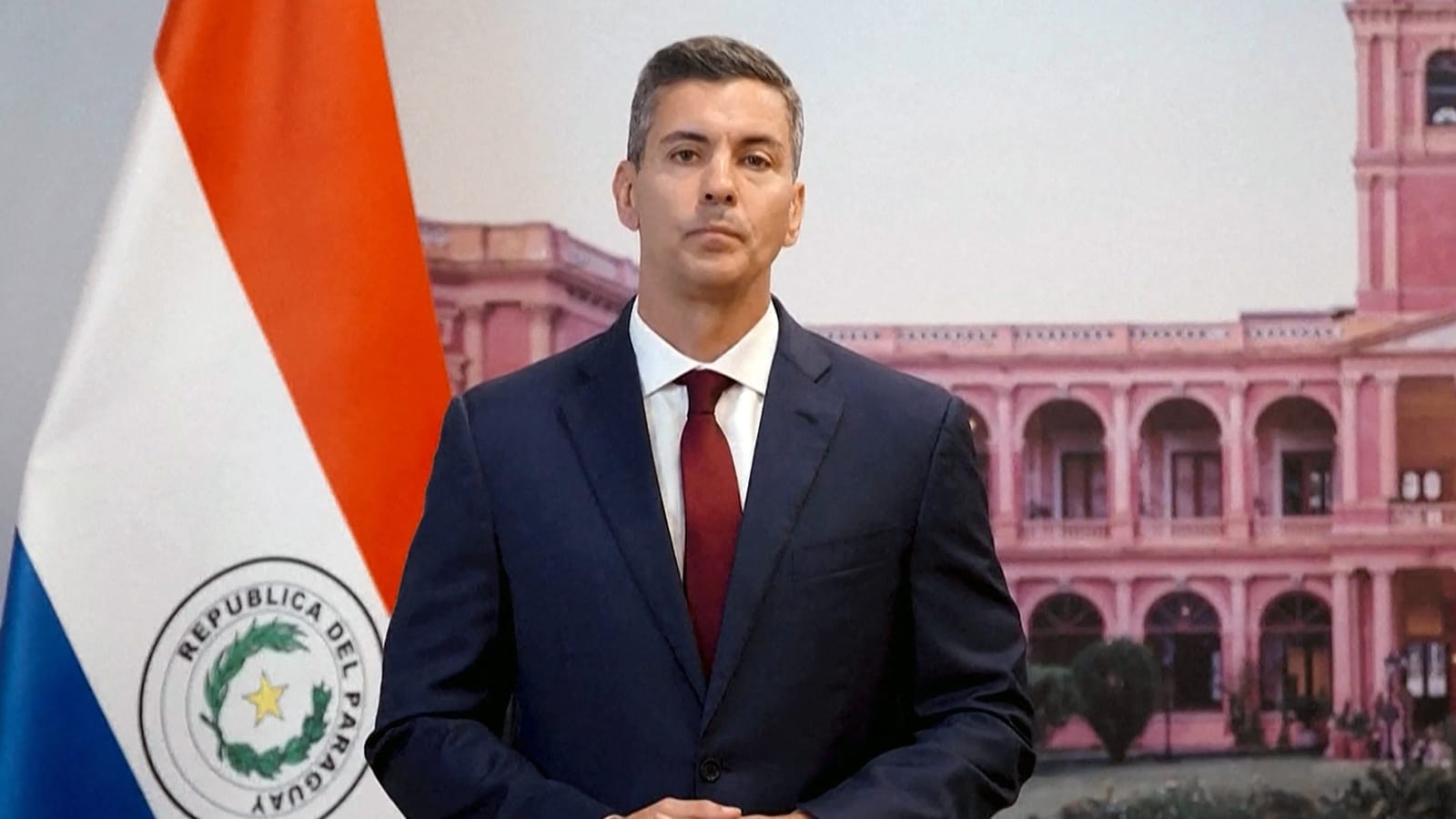
Paraguay’s President Santiago Peña announced on Thursday that he was stepping down, in a dramatic escalation of the political crisis triggered by the collapse of digital lender Ueno Bank. In a recorded address, Peña said he was resigning to protect national stability, social peace and democratic institutions. The announcement came as lawmakers were preparing to advance impeachment proceedings over allegations of conflicts of interest, misuse of pension funds and institutional failures linked to the bank’s collapse.
Reuters and the Associated Press reported the resignation on Thursday. Peña apologised to the public in his address and said his priority was to ensure that depositors recovered their money, but he did not accept responsibility for the crisis. His statement followed protests by customers and pensioners who had been unable to access accounts after the central bank intervened in Ueno, as well as public anger over the lender’s connections to people close to the governing political establishment.
The announcement changes the immediate political question in Asunción. Earlier on Thursday, Congress had convened an extraordinary session to consider impeachment articles submitted by 35 lawmakers in the 80-seat Chamber of Deputies. The effort gathered momentum after senior figures in the ruling Colorado Party, including Congress President Basilio Nuñez and party leader Horacio Cartes, withdrew their backing for Peña. Reports from Paraguay said support for the accusation had spread across party factions and that a large majority of deputies appeared ready to advance the motion.
But an announced resignation and a completed constitutional transfer are not necessarily the same event. Paraguay’s Constitution gives Congress the power to accept or reject the resignation of the president and vice-president. Article 202 sets out that responsibility. Article 234 provides that the elected vice-president assumes the presidency when the office becomes vacant and serves for the remainder of the constitutional term. The formal status of Peña’s departure, and the point at which the succession takes effect, therefore depend on the constitutional steps that follow his announcement.
Vice-President Pedro Alliana is the constitutional successor if the presidency becomes definitively vacant. The Constitution says the vice-president replaces the president in cases of impediment or absence and assumes the office if it falls vacant. Alliana would not need to win a fresh presidential election to complete the current term. The separate question of how to fill a resulting vacancy in the vice-presidency would be governed by the timing of the vacancy and the procedure in Article 234. As of the latest reports, the formal parliamentary acceptance of Peña’s resignation and the completion of the transfer had not been independently confirmed.
The impeachment process had been launched because lawmakers blamed Peña for decisions and institutional failures surrounding Ueno’s collapse. The accusations included alleged conflicts of interest, the handling of pension funds and an alleged cover-up of regulatory failures. These are political allegations contained in the impeachment articles, not findings of criminal guilt. The resignation announcement does not by itself determine whether the allegations are substantiated or whether any separate criminal investigation should proceed.
The political crisis began after Paraguay’s central bank took control of Ueno Bank, a major digital lender, following a severe shortfall in the capital required by law. The intervention disrupted customers’ access to banking services and triggered long queues and protests outside branches. Ueno had presented itself as a fast-growing digital institution with a large customer base; the Associated Press reported that it claimed more than three million customers and served over 60% of adults in the country. The sudden interruption affected depositors, businesses, pensioners and people who relied on the bank for routine payments.
Regulators identified problems in the bank’s financial position, including risky insider lending, loans with inadequate documentation and assets that had been recorded in a way that overstated the institution’s available capital. After corrections, the bank’s capital was reported to be less than half the legal minimum. Those findings prompted the central bank to place the lender under official management and begin a process to protect depositors and preserve wider financial stability. The authorities have not suggested that every customer’s deposit is at risk, but the disruption has left people waiting for clear information about access to funds and repayment arrangements.
The crisis also drew scrutiny because of Peña’s past business relationship with the group that controlled Ueno. Reuters reported that Peña held a stake in the parent group until March 2025, when he sold it. That history does not establish that the president directed lending decisions or intervened in regulatory oversight. It does, however, explain why lawmakers and demonstrators have questioned whether the government’s response was sufficiently independent and whether potential conflicts of interest were properly managed.
Ueno’s collapse has also become a test of the institutions responsible for supervising banks and protecting public money. The bank had held substantial deposits from public entities and pension-related funds, raising the stakes beyond private customers. The failure has forced authorities to explain how exposures were monitored, what warnings were available, how the bank’s financial position deteriorated and why intervention came when it did. The resignation of central bank chief Carlos Carvallo earlier in the week, at Peña’s request, had already intensified questions about the regulator’s past relationship with Ueno; Carvallo had previously chaired the lender.
Investigators are pursuing a separate track involving the bank’s executives and associates. The Associated Press reported that eight senior executives had been detained and 27 bank officials and associates had been charged in connection with alleged financial irregularities. Those proceedings are distinct from the political process concerning Peña. Detention and charges do not amount to convictions, and the allegations must be tested through the justice system. The central bank’s resolution process, criminal investigation and constitutional succession are related in their consequences but have separate legal standards and decision-makers.
The government and regulators face immediate pressure to make the return of depositors’ money workable. Authorities have begun arrangements to transfer accounts and organise repayments, while customers need clarity on deadlines, eligibility, limits and the treatment of public-sector deposits. Employees have also protested over unpaid wages and uncertainty about their jobs. The longer those questions remain unresolved, the greater the risk that people will lose confidence not only in Ueno but in the wider banking system.
For Paraguay’s economy, the crisis arrives at a time when the country has sought to attract investment by presenting itself as a stable market within South America. A high-profile bank failure, the resignation of a president and uncertainty about the financial regulator can complicate that message. International investors will be watching whether the authorities can keep the resolution of Ueno separate from political interference, publish credible information about the bank’s assets and liabilities, and protect depositors without exposing public finances to unbounded losses.
The next constitutional steps are now central. Congress must deal with the resignation under Article 202, while the executive succession rules in Article 234 determine who assumes the presidency if the vacancy is accepted and becomes definitive. The impeachment motion had reached the stage of an extraordinary session, but the resignation may alter the immediate route lawmakers take. A formal parliamentary decision and an official announcement of the transfer are needed before the succession can be described as complete. The status of the separate allegations against Peña and other officials may continue to be examined through the appropriate institutions.
Alliana’s likely assumption of the presidency would not end the Ueno crisis. The incoming administration would inherit the task of supporting the central bank’s resolution process, communicating with depositors, ensuring that the criminal investigation is allowed to proceed and restoring confidence in financial supervision. It would also face demands to explain the relationship between public funds and the bank, and to demonstrate that the regulatory process is being handled on evidence rather than political convenience.
Thursday’s announcement is therefore both a turning point in Paraguay’s political crisis and the beginning of another period of institutional uncertainty. Peña has said he is stepping down to protect stability, while the opposition and dissident members of his own party had been seeking his removal over the bank’s collapse. The Constitution sets out how Congress must handle a presidential resignation and how the vice-president assumes office after a definitive vacancy. Until those steps are confirmed, the distinction between Peña’s announcement and the formal transfer of power remains important. The financial questions that brought the government to this point—depositors’ access to money, the bank’s losses, public funds and accountability for regulatory failures—remain unresolved.



Comments (0)
Be the first to comment. Comments are published after moderation.