


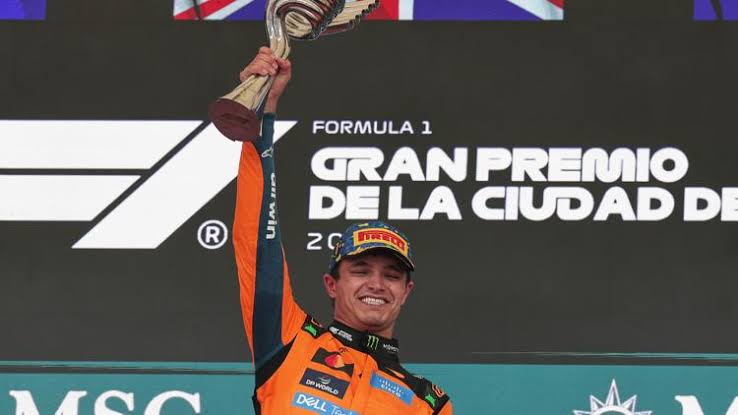
SAO PAULO, November 8, 2026 — Lando Norris won a rain-affected São Paulo Grand Prix from pole position on Sunday, beating Max Verstappen by 14.602 seconds as Mercedes secured its ninth Formula One constructors’ championship. The result gave McLaren its third victory of the season and ended Mercedes’ wait for the teams’ title, which had last been won by the Brackley-based outfit in 2021.
The 71-lap race at the Autódromo José Carlos Pace moved between wet and dry conditions before rain returned late in the afternoon. Norris managed the changing grip, tyre decisions and pressure from behind to take the chequered flag in 1:35:23.504. Verstappen, who started 21st after an engine-related grid penalty, recovered to second, while Red Bull team-mate Isack Hadjar completed the podium.
Mercedes had needed to score at least three more points than Ferrari to clinch the constructors’ title. George Russell finished fourth and Kimi Antonelli fifth, giving the team enough points to make the championship secure. Ferrari’s Charles Leclerc was seventh and Lewis Hamilton ninth, leaving the Italian team unable to keep the contest open.
Also read: Lando Norris Takes São Paulo Grand Prix Pole as Rain Disrupts Qualifying
Also read: Kimi Antonelli Becomes Youngest Formula 1 World Champion After Mexico City Podium
Antonelli made the strongest start from the front row and moved ahead of Norris when the lights went out. The Mercedes driver had already spun during his reconnaissance lap before the race, but he recovered to reach the grid and then led the opening phase. Norris stayed close, while Hadjar and Liam Lawson also ran near the front as the field negotiated a damp surface that was beginning to dry.
The first major strategic decision came when teams judged that the track had enough grip for slick tyres. Hamilton was among the early drivers to stop, briefly dropping down the order before others followed. The switch changed the shape of the race: the fastest line was no longer the same as it had been at the start, and drivers had to balance the risk of sliding on damp patches against the time lost by remaining on intermediate tyres.
Antonelli’s race became more difficult after his first stop. He reported an unusual feeling from the car and spun at the first corner as Norris moved into the lead. The Italian went off again several laps later, losing the position he had held at the front. Russell also lost time after spinning in the pit lane while switching to slicks, although he avoided serious damage and continued.
Norris took advantage of the changing order and built a lead, but the race was not settled. Hadjar moved into contention and briefly led when Norris made another stop for intermediate tyres around lap 50. McLaren’s decision was based on the forecast and the rain returning more strongly. As other front-runners came in for wet-weather rubber, Norris regained the lead and had enough pace to pull clear.
The final laps demanded restraint as well as speed. Rain swept across the circuit again, reducing grip and making the braking zones difficult. Norris did not need to take unnecessary risks once he had a margin over Verstappen. He kept the car on the road and crossed the line more than 14 seconds ahead, securing his third win of the season and his second consecutive victory at the Brazilian venue.
Verstappen’s second place was one of the race’s strongest individual performances. He started 21st after taking an engine-related penalty, which forced him to work through traffic on a circuit where passing opportunities depend heavily on tyre condition and track position. The Red Bull driver made steady progress as the race unfolded, taking advantage of the changing conditions and the mistakes of rivals ahead.
His recovery did not put him in a position to challenge Norris for the win, but it limited the damage to his championship campaign and gave Red Bull a strong result. Hadjar added further value by finishing third. The French driver had been near the front during the opening laps and was able to remain competitive as the leaders cycled through their pit stops. His podium gave Red Bull two cars in the top three.
Russell’s fourth place helped deliver Mercedes the title, while Antonelli’s fifth was enough to complete the team’s points requirement. The result was not a clean afternoon for either driver: Antonelli lost the lead after his stop and spun twice, while Russell’s pit-lane mistake cost him time. Their combined points, however, mattered more than the order between the two Mercedes cars.
Hamilton finished ninth in his 400th Formula One start. The Ferrari driver had begun from 20th after a grid penalty and made early progress, reaching the points before tyre wear and the changing conditions limited his recovery. Leclerc took seventh, but Ferrari did not score enough to delay Mercedes’ celebration. McLaren’s Oscar Piastri finished sixth, while Liam Lawson placed eighth for Racing Bulls. Nico Hulkenberg took the final point for Audi.
The constructors’ championship is Mercedes’ ninth, drawing the team level with Williams on that total. Only Ferrari and McLaren have won more. The title is its first since 2021, a period in which the team struggled to match the pace of rivals under the previous technical regulations before rebuilding its competitiveness for the current season.
Mercedes had done much of the work earlier in the year. The team began the campaign with a strong car and converted that advantage into a points cushion that remained large enough to survive a difficult afternoon in Brazil. Reuters reported that the team had taken 12 wins from 20 races before the São Paulo round, underlining how consistently it had been near the front even as reliability and race execution created occasional problems.
The result also completes a drivers’ and constructors’ double for Mercedes. Antonelli had already secured the drivers’ championship in Mexico City, becoming the youngest champion in Formula One history. His title was a major achievement for a driver in only his second season, while the constructors’ crown confirms that the team’s strength was not dependent on a single car or one exceptional weekend.
For team principal Toto Wolff and the engineers in Brackley, the championship is evidence that the organisation has recovered from several seasons in which it could not consistently challenge for the top prize. The team still has work to do. Its spins in Brazil and Antonelli’s tyre-temperature problems showed that the car can be vulnerable when conditions change quickly. The final rounds will provide more information about whether those weaknesses are isolated or part of a wider pattern.
McLaren also leaves Brazil with reasons to be encouraged. Norris’ win was the team’s first since August, and the latest upgrades appeared to help the car perform in the mixed conditions. Piastri’s sixth place added points, although McLaren did not have enough to turn the weekend into a larger team result. The team will be looking at whether the changes can carry into the final races and provide a platform for the next season.
Verstappen’s drive showed that Red Bull can still be a threat even when it starts outside the leading group. The team’s ability to recover from an engine penalty and secure two podium places will matter as it assesses its development direction. Hadjar’s third place was also a useful result for a driver who has been building experience in a competitive car.
The São Paulo race did not change the fact that Antonelli has already won the drivers’ championship, but it reshaped the contest behind him. Verstappen strengthened his position in the fight for second, while Russell moved ahead of Hamilton in the standings. Ferrari’s failure to threaten Mercedes in Brazil also ended the constructors’ title battle before the season’s final races.
The remaining events will still matter for team positions, individual race wins and the evaluation of car upgrades. Mercedes can now approach the final rounds with the constructors’ championship secured, but the team will want to avoid reliability problems and finish the year with the strongest possible results. McLaren and Red Bull have incentives to test their latest developments, while Ferrari will be looking to close the season with a more competitive performance.
For Norris, the victory was a reminder that he can manage a race in which the fastest car is not always the one with the clearest path to the finish. The conditions changed repeatedly, and the leading group was reshaped by pit stops, spins and the return of rain. Norris kept his pace without forcing an unnecessary move and converted pole position into a controlled win.
The official classification puts Verstappen 14.602 seconds behind, Hadjar 24.485 seconds back, Russell 33.991 seconds behind and Antonelli 36.017 seconds behind. Those gaps show that the top five were separated by more than half a minute, but the race was far from straightforward for the drivers who finished behind Norris. The wet-dry transitions created several opportunities for mistakes, and the final order reflected both pace and the ability to keep the car on the circuit.
Mercedes’ ninth constructors’ championship is the lasting team result from the weekend. Norris took the race win, Verstappen produced a striking recovery and Hadjar added a podium, but the points scored by Russell and Antonelli gave Mercedes the title it had been pursuing since 2021. The final rounds will determine how each team finishes the year; the central championship question, however, has been answered.

Comments (0)
Be the first to comment. Comments are published after moderation.