


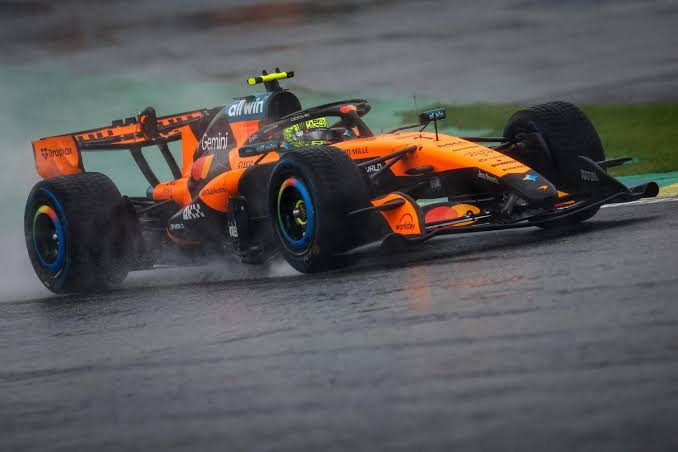
Lando Norris secured pole position for the São Paulo Grand Prix on Saturday, mastering a rain-soaked Interlagos circuit in a qualifying session that stretched over roughly two and a half hours. The McLaren driver set a fastest lap of 1 minute 27.470 seconds, beating Mercedes’ George Russell by 0.204 seconds. Russell initially qualified second, but a five-place grid penalty for a power-unit change moves him to seventh, promoting newly crowned world champion Kimi Antonelli to the front row for Sunday’s race.
Also read: Kimi Antonelli Becomes Youngest Formula 1 World Champion After Mexico City Podium
The result gives Norris his third consecutive pole at Interlagos and strengthens McLaren’s position for a race in which weather and grid penalties could be as important as outright pace. Antonelli, who clinched the drivers’ title in Mexico, will start alongside Norris after qualifying third. Racing Bulls’ Liam Lawson moves up to third, while Audi’s Nico Hülkenberg is promoted to fourth. The final grid is shaped by several power-unit penalties, so the qualifying order alone does not tell the full story of the starting positions.
The session was repeatedly disrupted by heavy rain and standing water. Race control stopped Q1 only a few minutes after the start when drivers reported aquaplaning and visibility problems. The stoppage lasted more than 80 minutes as conditions were assessed and the track was allowed to improve. When the cars returned, lap times fell quickly as the surface changed, leaving teams with a narrow window to judge tyre choice, traffic and the risk of another interruption.
Rafael Câmara, the Brazilian rookie driving for Haas, crashed during Q2, bringing out another red flag. The interruption further compressed the session and left drivers with limited time to prepare for the final segment. Rain intensified again in Q3, reducing the opportunity to improve. Norris made the most of the conditions, while Russell was left frustrated after abandoning his final flying lap when he encountered traffic and was told to back off. The timing left the Mercedes driver second on the sheet but unable to challenge for pole.
Russell’s five-place penalty was known before qualifying and came after Mercedes fitted another internal-combustion engine. The penalty means his second-fastest qualifying time will not translate into a front-row start. Antonelli, who was third in the session, moves up to second. Leclerc qualified fourth for Ferrari but faces a 10-place drop after power-unit changes, allowing Lawson to take third and Hülkenberg fourth. The reshuffle gives the front four a different mix of teams from the qualifying classification.
Other penalties will send several high-profile drivers towards the back of the grid. Max Verstappen faces a 30-place penalty after Red Bull changed multiple power-unit components, while Lewis Hamilton has a 65-place penalty after Ferrari exceeded the allocation for several components. Reuters reported that Verstappen is set to start 21st and Hamilton 20th, with Sergio Pérez also facing a penalty. Those positions are important because Interlagos can offer overtaking opportunities, but a wet race may make recovery more difficult and increase the cost of a mistake.
Norris’s pole is a timely result for McLaren, which has been seeking to convert its pace into a strong finish in the closing rounds of the season. The driver said the car was competitive in the conditions, and the margin over Russell was small enough to underline how quickly the order could have changed if the final laps had unfolded differently. His three consecutive poles at São Paulo also give him a strong starting point at a circuit where weather can alter strategy from one session to the next.
## The constructors’ fight and the Sunday forecast
Mercedes can secure the constructors’ championship in São Paulo if it outscores Ferrari by three points in Sunday’s race, according to The Guardian. The drivers’ title is already decided, but the team competition remains open. Antonelli’s front-row position gives Mercedes a strong opportunity, while Russell will need to recover from seventh. Ferrari’s prospects are complicated by Leclerc’s penalty and Hamilton’s drop to 20th, leaving the team with a difficult task if it is to keep the constructors’ contest alive.
The race is scheduled for Sunday, November 8, at Interlagos. Formula 1’s official schedule lists the start for 5 pm local time. More rain is forecast, which could make tyre selection, visibility and safety-car timing central to the result. Wet conditions can narrow the performance gap between cars, but they also increase the risk of aquaplaning and crashes, as qualifying demonstrated. Teams will have to balance the chance to gain positions against the danger of losing points through an avoidable incident.
Several drivers will be looking for a recovery. Oscar Piastri qualified 10th after another difficult weekend, while Brazilian home favourite Gabriel Bortoleto ended the session near the back after hitting the barriers. Câmara’s Q2 crash also ended a promising run for the rookie. With penalties reshaping the order, drivers who qualified outside the top five may find opportunities if the track remains wet, but overtaking will depend on visibility, tyre performance and whether the race can run without repeated interruptions.
The session also showed how much the 2026 field can be affected by power-unit allocation rules. Teams sometimes accept penalties at a circuit where overtaking is considered more achievable, but the decision carries risk when rain is expected. Russell’s five-place drop was planned, while the larger penalties for Hamilton and Verstappen reflect additional component changes. The regulations are intended to limit the number of power-unit elements used during a season, but late-season penalties can create a grid that looks very different from the raw qualifying times.
For Norris, the immediate task is to protect the advantage he earned in qualifying. The McLaren driver has a clear track ahead at the start, but Antonelli’s Mercedes will be close and the weather may quickly change the balance. A clean opening lap could be decisive if rain reduces visibility or forces teams to react to a safety car. The pole does not guarantee a win, but it gives Norris the best available starting position in a race where several title and team objectives remain in play.
Interlagos has produced unpredictable races before, and the 2026 qualifying session has already shown how quickly conditions can shift. Norris starts first, Antonelli second, Lawson third and Hülkenberg fourth after the penalties are applied, while Russell faces a recovery drive from seventh. The championship fight among drivers is over, but the constructors’ contest and the battle for race positions remain open. Sunday’s weather may decide whether the grid advantage holds or whether the field is reshuffled again.





Comments (0)
Be the first to comment. Comments are published after moderation.