


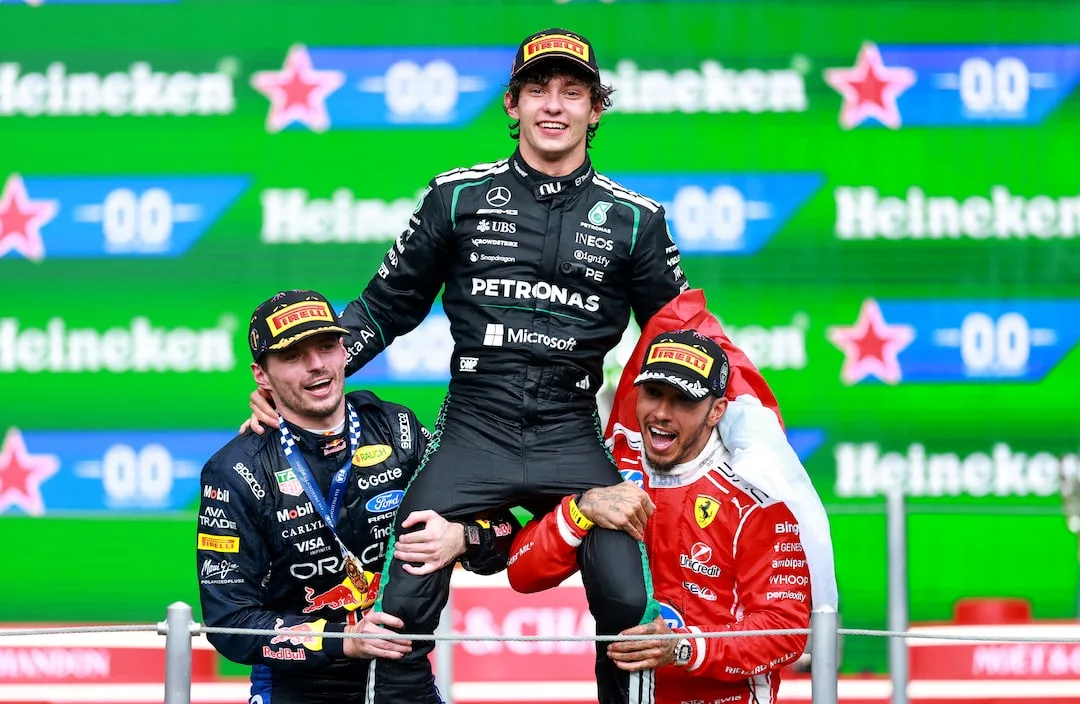
MEXICO CITY, November 2, 2026: Kimi Antonelli became the youngest Formula 1 world champion in history on Sunday after finishing third in the Mexico City Grand Prix, securing the drivers’ title with four rounds remaining in the season. Max Verstappen won the race for Red Bull, holding off Lewis Hamilton, but the championship was decided by Antonelli’s controlled drive to the podium.
Antonelli, 20 years and 68 days old, broke the record set by Sebastian Vettel in 2010. He is also the first Italian to win Formula 1’s drivers’ championship since Alberto Ascari in 1953. The title is the first for Mercedes since Hamilton’s 2020 championship and the team’s 10th drivers’ crown, according to The Guardian’s race report.
The result came in a race interrupted by a heavy crash, a red flag and a late safety-car period. Antonelli had started fourth and needed only to finish ninth or higher to secure the championship, whatever his closest rivals did. He finished third behind Verstappen and Hamilton, avoiding the incidents that reshaped the contest at the front.
Also read: India Finish Asian Para Games Opening Day With 11 Medals
Antonelli arrived at the Autódromo Hermanos Rodríguez with a substantial advantage in the championship. The Mercedes driver did not need to win in Mexico. A ninth-place finish would have been enough to make the title mathematically secure, even if Hamilton or Mercedes team-mate George Russell won the race.
That margin allowed Antonelli to concentrate on completing the race rather than forcing a move that might have jeopardised his position. He started from fourth on the grid and moved into the leading group as the race unfolded. The final order placed Verstappen first, Hamilton second and Antonelli third. The Formula 1 race report recorded Verstappen’s winning time as 2:20:28.772, with Hamilton 0.799 seconds behind and Antonelli a further 4.006 seconds back.
At 20 years and 68 days, Antonelli became the youngest driver to win the championship. Vettel had previously held the record, taking his first title at 23 years and 134 days in 2010. The gap between the two marks is more than three years, making Antonelli’s achievement a substantial change to a record that had stood for 16 seasons.
The title also ends a long wait for Italy. Ascari’s championships came in 1952 and 1953, and no Italian driver had won the modern Formula 1 world championship since the latter triumph. Antonelli’s success therefore carries significance beyond Mercedes: it returns an Italian driver to the top of the sport after more than seven decades.
The championship was not decided by a single late-season surge. The Guardian reported that Antonelli took the lead in the standings after the third round in Japan and won five of the first six races. Mercedes had a strong start under the season’s technical regulations, and Antonelli converted the car’s early competitiveness into a lead that his rivals struggled to close.
He went on to record nine victories during the campaign, according to The Guardian. The report said he failed to score points only twice, on both occasions because of mechanical failures. Those retirements or non-scoring results did not erase the advantage he had established in the opening stretch of the year.
One of the season’s defining results came at Antonelli’s home race at Monza. He won after starting 19th on the grid, a recovery that demonstrated his ability to make progress even when qualifying did not place him among the front runners. The Monza result also gave the championship campaign a high-profile moment in front of Italian fans.
George Russell had been regarded as a leading contender before the season, while Hamilton remained a major rival after moving to Ferrari. Neither was able to reduce Antonelli’s lead sufficiently. By the time the championship reached Mexico, the younger Mercedes driver needed a points finish rather than another victory.
Verstappen’s victory came after a difficult start to the race for the Ferrari pair and a series of interruptions. Hamilton, who started on pole, was involved in an opening-lap fight with team-mate Charles Leclerc. Formula 1’s official race report said Leclerc received a time penalty after cutting the track while battling for the lead. Verstappen took advantage of the contest between the Ferraris and moved towards the front.
The race was then interrupted when Cadillac’s Valtteri Bottas suffered a heavy accident after a suspension failure. The red flag required a standing restart, resetting the immediate contest and giving drivers another opportunity to fight for track position. Hamilton moved into second, while Antonelli remained in a position that would secure the title.
A later collision involving Arvid Lindblad and Oscar Piastri brought out the safety car. Verstappen had to defend his lead again after the restart, with Hamilton close enough to apply pressure. The Red Bull driver kept the Ferrari behind him to take the chequered flag. Leclerc finished fourth, Lando Norris fifth and Russell sixth, according to the official classification.
The race’s incidents mattered to the contest for victory but did not change the basic championship calculation. Antonelli was not required to win a battle with Hamilton or Verstappen. His task was to avoid a major mistake and finish high enough to protect the points advantage accumulated during the season. The third-place finish did exactly that.
For Mercedes, the championship is a return to the top of the drivers’ standings after a period without that prize. The Guardian described it as the team’s first drivers’ title since Hamilton won in 2020 and its 10th overall. Antonelli took the title in only his second Formula 1 season, having been promoted to the race seat for the previous year.
The decision to place a young driver in a high-profile seat carried obvious pressure. Hamilton’s departure left Mercedes with a major vacancy, and Antonelli had to move from the junior programme into a team expected to compete for championships. The Guardian reported that Mercedes had brought him into its young-driver programme when he was 12.
His first season at the top level was difficult, but the 2026 campaign showed a marked change in results. The title suggests that Mercedes’ decision to trust him with the seat has delivered a championship sooner than many observers might have expected. That does not remove the challenge of maintaining performance: the team still has races to contest, development decisions to make and a constructors’ campaign to complete.
Hamilton’s second place in Mexico added a separate storyline to the result. He had been one of Antonelli’s closest title rivals, but could not keep the championship open. The Ferrari driver’s late pursuit of Verstappen also meant he finished the race without a victory, despite starting from pole and remaining competitive after the restart.
Antonelli’s title does not bring the season to an immediate close. Four rounds remain, leaving time for further race victories, changes in the constructors’ standings and battles for positions behind the champion. Verstappen’s Mexico win gave Red Bull another result to build on, while Hamilton and the Ferrari drivers will have their own reasons to seek strong finishes in the remaining events.
For Antonelli, the final races will be an opportunity to compete without the pressure of a live title fight. The challenge will be to maintain the discipline that brought him the championship while continuing to race at the front. A title won early can create room to experiment with strategy, but it also places more attention on every performance that follows.
The next race is the São Paulo Grand Prix in Brazil, scheduled for November 6–8, according to Sky Sports. The remaining calendar gives Antonelli and Mercedes a short turnaround before returning to the track. The immediate focus will be on how the team approaches the final rounds now that the drivers’ championship is settled.
Antonelli’s Mexico podium was not a victory in the race, but it was the result that completed his season-long objective. At 20, he has taken a record that belonged to Vettel, ended Italy’s long wait for a Formula 1 champion and delivered Mercedes its first drivers’ title in six years. The record will now be measured against the next generation, while Antonelli begins the more difficult task of defending a championship.


Comments (0)
Be the first to comment. Comments are published after moderation.