


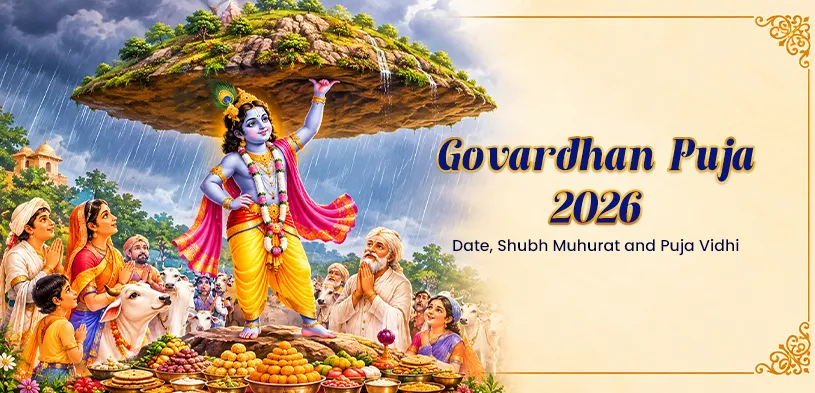
Govardhan Puja 2026 will be observed on Tuesday, 10 November, the day after Diwali, on Kartika Shukla Pratipada. The observance is associated with the story of Krishna lifting Govardhan Hill to protect the people and cattle of Braj from torrential rain. Families and temples mark the day through prayer, food offerings known as Annakut, and rituals that express gratitude for land, cattle and the harvest.
The date can cause confusion because the Hindu lunar day, or tithi, does not begin at midnight like a civil calendar date. In the New Delhi calculation published by Panchangya, Pratipada begins at 12:32 pm on 9 November and ends at 2:00 pm on 10 November. The tithi therefore remains in force at sunrise on Tuesday, which is why the principal observance is assigned to 10 November in the capital. A separate calendar calculation lists the morning puja period in New Delhi from about 6:40 am to 8:50 am, with Abhijit Muhurat from 11:43 am to 12:26 pm.
These timings are location-specific rather than a single national schedule. Sunrise, sunset and the tithi’s relationship to the local day differ from city to city. Panchangya lists 10 November for New Delhi, Mumbai and Bengaluru, but the muhurat minutes vary. A household following a temple calendar, family priest or regional almanac should use the timing calculated for the place where the puja will take place. A time copied from a Delhi calendar should not automatically be treated as the correct window for a ceremony in another city.
Govardhan Puja 2026: Date and Significance
In the best-known Braj tradition, the festival recalls the episode in which Krishna persuaded the residents of Gokul and Vrindavan to honour Govardhan Hill and the natural resources that sustained their lives. The story says that the community had traditionally offered worship to Indra, the deity associated with rain, but Krishna urged the people to recognise the hill, forests, pastures and cattle that supported their everyday work. Indra responded with severe rain, and Krishna lifted Govardhan Hill to shelter the community until the storm passed.
The account is a religious narrative, not a meteorological record. Its meaning in devotional practice is connected with protection, humility and gratitude. Govardhan is understood as more than a geographical hill: it represents the relationship between people, animals, food, water and the land. The festival therefore places food offerings and care for cattle at the centre of the observance. The story is especially important in Braj, where Govardhan Parikrama remains a major pilgrimage practice.
For many families, the day also follows a sequence of Diwali observances. The festival calendar includes Dhanteras, Narak Chaturdashi, Lakshmi Puja, Govardhan Puja and Bhai Dooj, although regional calendars can place some observances differently when a tithi overlaps two civil dates. Govardhan Puja is often called Annakut in temple settings because a large variety of cooked food is arranged as an offering. In Gujarat, the day is also associated with the beginning of the Gujarati New Year, known as Bestu Varas, while other regions emphasise different household customs.
Annakut, Govardhan worship and the day’s rituals
Annakut literally refers to a mountain or heap of food. Temples and households prepare many dishes, arrange them before the deity and offer them as prasad. The menu varies by region and temple tradition. It may include cooked grains, vegetables, sweets, savoury dishes, fruit and milk-based preparations. The number of dishes is not a universal religious requirement; the central idea is the collective offering of food and gratitude for nourishment.
Some temples arrange the dishes in a mound that symbolises Govardhan Hill. Devotees offer prayers, perform aarti and receive prasad after the offering has been made. The scale of Annakut displays can be large in major temples, but a household does not need to reproduce a temple-sized arrangement. A modest offering prepared with care is consistent with the spirit of the observance. Families should follow the custom of their temple or community rather than treating a particular number of dishes as compulsory.
Govardhan Puja is also linked with the worship of cows and other cattle. In agrarian communities, cattle have historically provided milk, dung for fuel and manure, and labour for farming. The ritual recognises that relationship. Some households decorate cattle with flowers, coloured markings or cloth, offer fodder and perform aarti. Animal welfare should remain central: decorations must not restrict movement, irritate the skin or frighten the animal, and food offered should be suitable for it.
In Braj, pilgrims may undertake Govardhan Parikrama, a circumambulation of the hill and its sacred sites. The route is traditionally around 21 kilometres, although the distance and sequence can vary according to the route taken. Visitors should plan for crowds, footwear rules at particular sites, drinking water, heat or cold, and local traffic arrangements. A person unable to complete the full walk can follow a shorter devotional visit; the pilgrimage should not be treated as a test of physical endurance.
How families can plan the observance
Households planning a morning puja should first confirm the local Panchang and the opening hours of the temple they intend to visit. Prepare the food offering in advance, keep the prayer area clean and ensure that any ingredients required by a family tradition are available. People observing the day at home may use a small symbolic representation of Govardhan, such as a mound made from food or another customary material, if that is part of their practice. There is no single arrangement followed by every Hindu community.
Food safety matters when a large Annakut is prepared. Cooked food should not be left at room temperature for extended periods, particularly dairy-based dishes. Temples and community kitchens should plan safe storage, clean serving areas and orderly distribution. Prasad should be shared in a way that avoids waste and does not leave food in unsafe conditions. These practical steps do not diminish the religious meaning of the offering; they help ensure that the food can be consumed safely.
Visitors to Govardhan and other pilgrimage centres should check local administration advisories before travelling. Large gatherings can affect parking, public transport, road access and the availability of accommodation. People with mobility limitations should confirm whether a temple or route has accessible entry points. Families travelling with older people or children should agree on a meeting point and keep essential medicines and drinking water available.
It is also useful to distinguish the date of the festival from the time chosen for a particular ritual. The date is determined through the tithi and local sunrise rules; the muhurat is a narrower auspicious window calculated for a place. Different almanacs may show small minute-level differences because they use different calculation conventions or location settings. Such differences should be explained, not presented as evidence that one calendar is necessarily wrong.
Govardhan Puja follows the main Diwali evening but is not a continuation of the Lakshmi Puja muhurat. Each observance has its own tithi and local timing. Families should not reuse the previous evening’s puja window for the next day. The most useful planning step is to check the calendar for the city of observance and then confirm any temple-specific schedule directly with the organisers.
For urban families, the story of Govardhan can be a reminder of the systems that make daily life possible. Food depends on soil, water, farmers, transport and markets; livestock and biodiversity remain part of many rural livelihoods. The festival’s emphasis on gratitude can be observed without turning religious symbolism into an unsupported claim about modern environmental policy. Its practical message is that prosperity is connected to the health of the natural and social systems that sustain communities.
The observance also provides a point of connection for families who live far from Braj. People may attend a local temple, prepare a small Annakut, read or hear the Govardhan episode, or share a meal with relatives. Regional customs differ, and families may follow a tradition that is specific to their language, temple or community. That diversity is part of the festival’s practice rather than a reason to impose one uniform ritual on everyone.
For 2026, the key date for New Delhi and several other Indian cities is Tuesday, 10 November. The New Delhi Panchang calculation places Pratipada from 12:32 pm on 9 November until 2:00 pm on 10 November. The morning puja window and Abhijit period are local references, not universal timings. The safest approach is to confirm the city-specific calendar, follow the family or temple tradition and observe the day with attention to food safety, animal welfare and the meaning of gratitude.
Frequently asked questions
When is Govardhan Puja in 2026?
Govardhan Puja is observed on Tuesday, 10 November 2026 in the New Delhi calendar, on Kartika Shukla Pratipada.
What is the New Delhi tithi timing?
Panchangya lists Pratipada from 12:32 pm on 9 November until 2:00 pm on 10 November. The local sunrise and the tithi’s presence at sunrise help determine the observance date.
What is Annakut?
Annakut is an offering of many prepared foods made in temples and homes. The dishes are offered in worship and later distributed as prasad. The menu and scale vary by tradition.
Is Govardhan Puja observed at the same time in every city?
No. The date and muhurat are calculated using local sunrise, sunset and tithi details. Families should check the Panchang for the city where the puja will be performed.
Also read: Ayodhya Lights More Than 30 Lakh Diyas at 10th Deepotsav Across 56 Ghats






Comments (0)
Be the first to comment. Comments are published after moderation.