


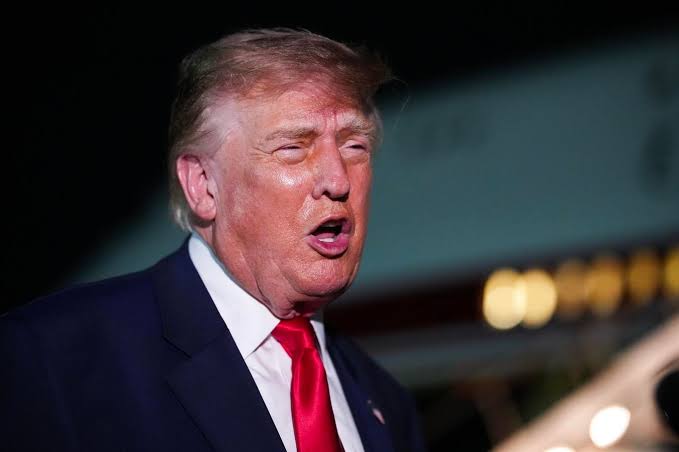
WASHINGTON, November 9, 2026 — US President Donald Trump has signalled that he is willing to consider AI guardrails and work with Democrats on the issue, while warning that regulation must not slow the United States in its competition with China. The remarks, made in a CBS 60 Minutes interview broadcast on Sunday, offer a possible opening for bipartisan talks but stop well short of a new policy commitment.
Asked whether he would cooperate with Democrats on AI safety, Trump said he did not object to “guardrails” but did not want the United States placed in “a deep second position”. He also described the risks of advanced AI as manageable and argued that the country could not afford to fall behind China. The interview did not identify a bill, regulatory standard, enforcement mechanism or timetable that the administration intends to support.
The distinction matters. A president’s willingness to discuss safeguards can change the tone of a policy debate, particularly when lawmakers from both parties have been pressing for stronger protections. It does not, by itself, establish what the safeguards would cover, who would enforce them or how much oversight technology companies would face before releasing powerful systems.
Also read: 2028 AI Leadership: Will the US or China Win the Critical Race?
Also read: Project Glasswing: Anthropic’s AI Cybersecurity Initiative Explained
The exchange came during Trump’s first sit-down television interview since the midterm elections. CBS correspondent Ross Douthat asked whether the United States should accept the risks associated with advanced AI in order to remain ahead of China. Trump answered that the danger was not as severe as critics suggested and said it could be managed. When Douthat asked whether he would work with Democrats on AI safety, Trump replied that he did not mind guardrails, provided they did not undermine America’s competitive position.
Trump’s emphasis was on the strategic race rather than on a specific safety problem. He described AI as a technology with major implications for national power and said the United States could not afford to allow China to take the lead. The president also referred to his recent meeting with Chinese President Xi Jinping and said the contest would shape the balance of power between the two countries.
The interviewer challenged Trump’s assertion that China had no guardrails, pointing to the controls exercised by the Chinese state. That distinction is important. China’s approach to technology regulation is not the same as the system debated in Washington, but it is not an absence of rules. The country’s 2023 Interim Measures for Generative AI Services impose obligations on providers offering public-facing generative AI services, including requirements related to lawful content and security. Some services with public-opinion or social-mobilisation capabilities are subject to security-assessment requirements.
Those rules do not amount to an independent, transparent safety regime of the kind some US researchers and lawmakers advocate. They operate within China’s broader system of state control over online information and technology companies. But they show why a simple comparison between a regulated United States and an unregulated China would be misleading. The two countries are debating different forms of control, with different institutional checks and different expectations of private companies.
Trump’s comments also leave open a basic question: what does he mean by a guardrail? In public policy, the term can cover a wide range of measures, from voluntary testing before a model is released to mandatory reporting of serious incidents, restrictions on high-risk uses, privacy protections or government review of systems with advanced cyber capabilities. The interview did not indicate which of these options he would accept.
The administration’s current approach has placed a strong emphasis on innovation, national security and cooperation with the private sector. A June 2 executive order, Promoting Advanced Artificial Intelligence Innovation and Security, directed federal agencies to strengthen cyber defences and develop a classified process for assessing the advanced cyber capabilities of frontier models. It also called for a voluntary framework through which developers could provide the government with limited early access to certain models before release to selected partners.
The order set an important boundary around that proposal: it said the framework should not create a mandatory government licensing, preclearance or permitting requirement for the development or release of AI models. That language is consistent with the administration’s repeated argument that broad regulatory hurdles could weaken American companies against foreign competitors. It also leaves room for targeted cooperation between developers and national-security agencies, particularly where models could be used to discover software vulnerabilities or assist cyberattacks.
The same order directed federal authorities to prioritise enforcement against people who use AI to break into computer systems, steal information or facilitate other crimes. In other words, the administration has already accepted that some AI-related risks require government action, even as it resists a general licensing system for model developers.
Trump’s latest remarks could make it easier for the White House to discuss narrower safeguards with Democrats without abandoning that framework. A voluntary testing arrangement, stronger reporting rules for major incidents or shared standards for evaluating dangerous capabilities might attract support from lawmakers who disagree about the role of federal regulation. But those are possible areas for negotiation, not measures Trump announced in the interview.
For developers, the difference between voluntary and mandatory safeguards is substantial. A voluntary system can allow companies to decide how to test models, which findings to disclose and when to involve government agencies. Binding requirements can create legal duties, independent oversight and penalties for failing to meet standards. They can also impose compliance costs, particularly on smaller firms that do not have the resources of the largest AI laboratories.
One area of potential agreement is testing before deployment. Developers can assess whether a model can assist with cyber intrusions, produce dangerous instructions, generate convincing impersonations or bypass restrictions designed to prevent misuse. Independent red-team exercises can test systems under adversarial conditions. The policy question is whether such evaluations should remain industry practice, become a condition for certain high-risk releases or be overseen by a public authority.
Another issue is the reporting of serious failures. A model that causes a major data exposure, enables a large-scale fraud operation or behaves in an unexpected way when connected to critical infrastructure may create risks beyond the company that developed it. Governments could require notification of specified incidents, while companies could argue that broad disclosure rules expose proprietary information or reveal vulnerabilities before they are fixed. A workable system would need to protect sensitive details while giving regulators enough information to respond.
Cybersecurity is likely to remain a central concern because advanced models can assist both defenders and attackers. Tools that help researchers find weaknesses in operating systems and software can also lower the effort required to identify exploitable flaws. The administration’s June order reflects that dual-use problem by placing frontier-model cyber capabilities within a national-security assessment process. Any new safeguards would have to distinguish legitimate defensive research from activities that could materially increase the risk of attacks.
Privacy, transparency and the use of AI in consequential decisions are other areas where lawmakers may seek common ground. Systems used in hiring, lending, healthcare, education or public services can affect people who have little ability to inspect how a decision was made. Requirements for documentation, human review, data protection and clear avenues for appeal are different from restrictions on frontier model development, but they are often included in broader AI governance debates.
None of these measures is cost-free. Poorly designed rules can favour large companies that can afford compliance teams, discourage open research or drive development towards jurisdictions with lighter requirements. Weak rules can leave the public exposed to systems whose capabilities are difficult to test after deployment. The challenge for policymakers is to identify risks that justify intervention without turning every new model release into a lengthy permission process.
Trump’s willingness to work with Democrats will be tested by the details. Lawmakers would need to agree on which systems count as high risk, whether developers should disclose testing results, what information government agencies may request and how independent oversight would work. They would also have to decide whether any requirements should apply to all developers or only to the most capable models and the highest-impact uses.
The China argument will remain a powerful influence on that debate. American companies and officials have warned that excessive regulation could slow investment and allow Chinese firms to gain market share. Safety advocates counter that a loss of public trust, a major security failure or a widely deployed system that causes serious harm could damage the industry more than carefully targeted oversight. The competition is therefore not simply about who releases the next model first; it is also about which country can build systems that businesses, governments and citizens are prepared to rely on.
For countries outside the United States and China, including India, the outcome will matter because American and Chinese standards can shape the systems, cloud services and digital infrastructure used across international markets. A US framework that focuses on testing, cybersecurity and incident reporting could influence procurement decisions and regulatory expectations elsewhere. A system built primarily around national-security competition could instead leave questions about consumer protection and accountability unresolved.
For now, the interview has changed the political conversation more than the regulatory landscape. Trump has indicated that he is prepared to discuss safeguards and bipartisan cooperation, but he has not endorsed a specific proposal or withdrawn his opposition to rules that he believes could slow American AI development. The next evidence will come from legislation, agency guidance or a concrete agreement with technology companies. Until then, the president’s remarks are a signal of possible flexibility, not a new set of rules.
SOURCE:
The White House; Library of Congress.



Comments (0)
Be the first to comment. Comments are published after moderation.