


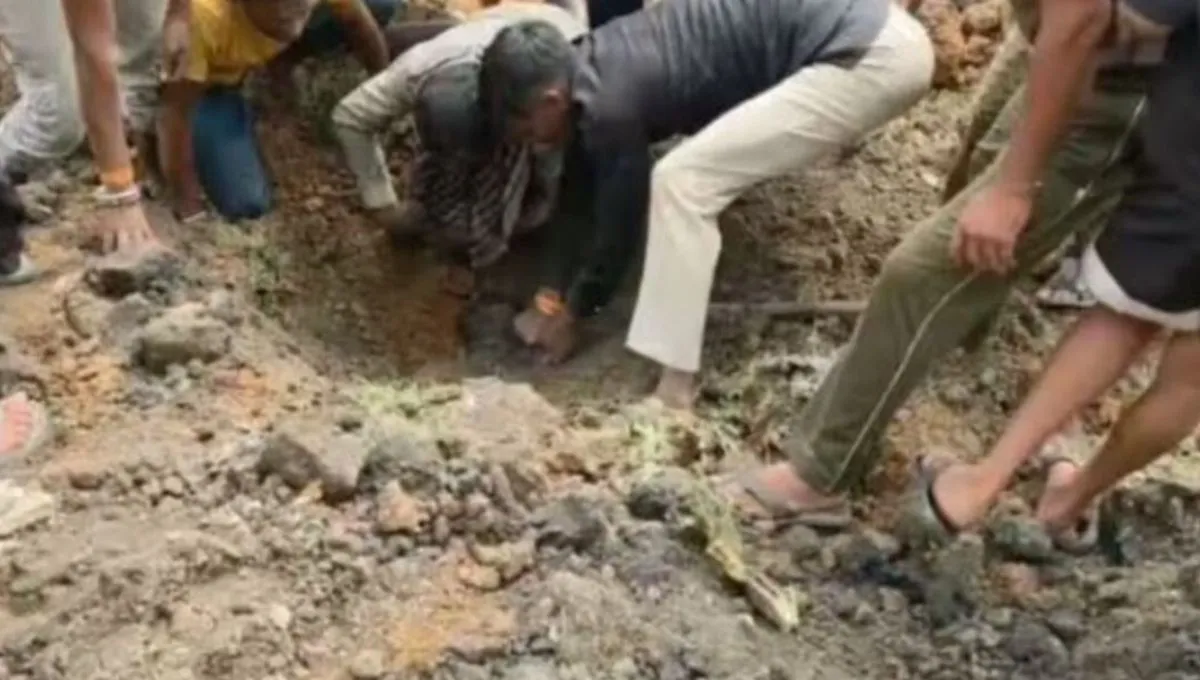
Bokaro, November 5: Three women died after a large coal heap collapsed at Central Coalfields Limited’s Kathara colliery in Jharkhand’s Bokaro district early Thursday, burying a group of people who had gone to collect coal from a stockyard. Police and colliery officials reached the site and began an investigation into the collapse, while the number of people injured remained inconsistent across the first reports.
The incident took place at Stockyard No. 5, within the jurisdiction of the Kathara police outpost in the Bermo subdivision. Local police and district officials placed the collapse at around 5 am. The New Indian Express reported that the victims had been collecting discarded coal for domestic use when the heap gave way. Jagran and other local outlets also reported that villagers had gone to the stockyard to gather coal for household fuel.
Three women were confirmed dead. The injured-person count varied: The New Indian Express and several local reports said four people were hurt, while a PTI report quoting Bokaro Deputy Commissioner Ajay Nath Jha described six people as injured, three of whom later died. That account would leave three survivors. Authorities had not issued a reconciled casualty statement in the reports reviewed for this article.
Bermo Sub-Divisional Police Officer Ravindra Singh confirmed that women were collecting coal when the heap collapsed and said the injured were taken for medical treatment. The New Indian Express reported that those rescued were first taken to the Central Coalfields Limited hospital and that some required referral to another medical centre. Police and colliery management began a joint inquiry at the site.
Initial accounts described a group of seven people—six women and one man—being caught beneath the coal. The New Indian Express said three women died and four others were injured. Jagran also reported seven people buried, with three deaths and four serious injuries. Deccan Chronicle, carrying a PTI report based on comments from the Bokaro Deputy Commissioner, reported three deaths and three other injuries. The difference may reflect separate stages of the rescue and casualty reporting, but the official count needs clarification before a definitive total can be stated.
The victims were described as local residents rather than CCL employees. Local news reports named some of the deceased, but spellings and identification details differed between accounts. The authorities had not released a single consolidated identification notice in the material reviewed for this article, so names have not been repeated here.
A CCL official described the incident as a case of coal theft, according to the PTI report. That is the company official’s characterisation, not a finding established by an investigation or a court. Other reporting said the women were collecting discarded coal for domestic use. The precise circumstances in which the group entered the stockyard, whether access was restricted and what permissions or local practices applied remain questions for the police and the company to establish.
The stockyard is part of the Kathara colliery complex operated by Central Coalfields Limited. The immediate cause of the collapse has not been publicly determined. Police and colliery management were reported to be examining the incident, and the post-mortem process was under way for those who died. No technical assessment had yet been released describing the height, stability or condition of the coal pile before it gave way.
The investigation will need to establish how the heap was formed and maintained, whether the stockpile had been inspected, and whether any warning signs were visible before the collapse. Coal piles can shift when material is added, removed or disturbed, but the available accounts do not establish which mechanism caused this particular heap to fail. A technical inspection will be required before responsibility can be assigned.
Investigators will also need to reconstruct the sequence of events at the stockyard. That includes when the group arrived, where each person was standing, what activity was taking place and how the rescue operation was organised. Records from the colliery, statements from employees and witnesses, and any available surveillance footage may help determine how the people entered the area and whether the site’s access controls were functioning.
For CCL, the inquiry will also raise questions about the safeguards used around stockpiles and the separation of operational areas from places where members of the public may enter. If the site was restricted, investigators will need to establish how access occurred and whether barriers, security patrols and warnings were adequate. If people were routinely entering to collect discarded coal, the company and local administration may need to examine why that practice was taking place and what risks it created.
The incident also points to the difficult circumstances faced by households that collect discarded fuel from industrial or mining areas. Reports from the location said the women were seeking coal for domestic use. That account should not be treated as a complete explanation of the event, but it is relevant to understanding why people may enter stockyards and other potentially hazardous places. Any response should distinguish the immediate investigation into the collapse from the wider questions of local access, household fuel needs and site safety.
Those wider questions do not reduce the responsibility to determine what happened at Kathara. The first task is to identify the physical cause of the collapse and establish whether any safety requirement was breached. The police inquiry must also determine whether the group entered a restricted area and whether any alleged offence occurred. Until those steps are complete, neither the description of the activity as theft nor any suggestion of negligence should be treated as a final conclusion.
The response from authorities will matter for workers and residents around other coal stockyards in the region. A review of access barriers, signage, inspection procedures and emergency response arrangements could help identify risks before another incident occurs. The review should be based on findings from the investigation rather than assumptions about how this particular heap collapsed.
For the families of the women who died and those receiving treatment, the immediate concerns are medical care, identification, post-mortem procedures and the return of the bodies. The conflicting injury figures also make a clear public update important. District authorities and CCL should publish a reconciled list of casualties and explain the next stages of the investigation once the initial site assessment is complete.
As of Thursday’s first reports, three women had died, several others had been injured and the cause of the coal-heap collapse remained unknown. Police and CCL officials were investigating. The next reliable update should clarify the final casualty count, the circumstances in which the group entered the stockyard and whether any lapse in the management or security of the site contributed to the deaths.



Comments (0)
Be the first to comment. Comments are published after moderation.