


Paris, November 5: More than a dozen passenger flights across Europe were targeted by bomb threats on Thursday, triggering diversions, fighter-jet escorts and security inspections at airports in several countries. All aircraft reported as having undergone checks landed safely, and authorities said no explosives or suspicious materials had been found in the inspections described so far.
The latest alerts affected services operated by Aer Lingus, Finnair, LOT Polish Airlines, Ryanair, Wizz Air and other carriers. The French, Italian and Bulgarian air forces were among those involved in escorting or responding to aircraft. The incidents came after similar alerts earlier in the week, making Thursday the third day on which European flights were affected by reported bomb threats.
The exact count varied as airlines and authorities updated their accounts. AFP reported at least 14 flights targeted on Thursday, while The Guardian’s running live tally later reached 15. The Associated Press described the number as more than a dozen. The variation reflects a developing response across different airports rather than a confirmed continent-wide total issued by a single authority.
One of the most prominent incidents involved an Aer Lingus Airbus A320 travelling from Dublin to Rome. The aircraft was diverted to the French military air base at Évreux after a threat was reported. French authorities said the plane was escorted by a military aircraft and landed safely. All 151 passengers and six crew members were moved to safety while bomb-disposal specialists examined the aircraft.
A Finnair service from Helsinki to Rome was escorted by Italian air force fighters and underwent checks after landing. The airline said nothing unusual was found. A separate Finnair flight to Vienna was also reported to have received a threat. In Bulgaria, three Ryanair flights bound for Sofia—from Madrid, Copenhagen and London Stansted—were affected. Two landed at Sofia, while the London service was diverted to Plovdiv. Bulgarian authorities said inspections found no explosives.
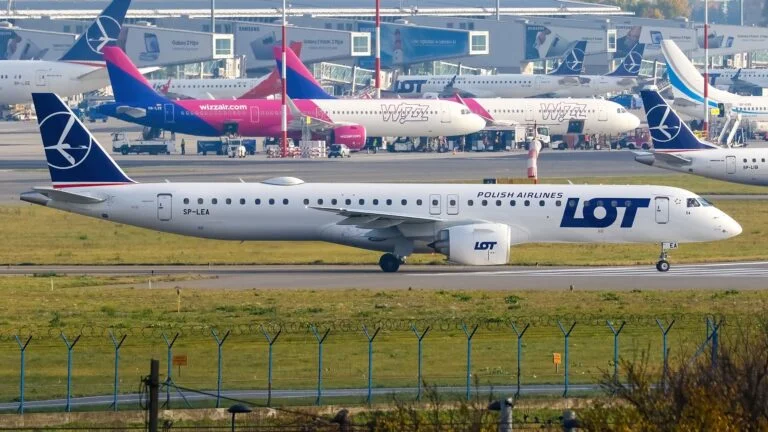
Other alerts involved flights approaching or departing from Prague, Warsaw, Milan and Bucharest. Czech police said security measures were activated after threats were received by email and that checks on several aircraft found no suspicious material. A LOT Polish Airlines service at Warsaw’s Chopin Airport was also checked, and part of the airport’s operations were temporarily affected while the response was under way. Wizz Air flights were among those rerouted or examined under local security procedures.
The incidents did not produce a single pattern of disruption. Some aircraft were diverted to an alternative airport or a military base; others landed at their planned destination and were inspected there. In each case, airlines and airport authorities followed their established procedures, which can include isolating an aircraft, checking luggage and passengers, using bomb-disposal teams and temporarily restricting movement around a stand or runway.
British Transport Secretary Heidi Alexander described the alerts as “malicious hoaxes”, according to the Associated Press. That characterisation reflects the assessment communicated by the British government; it does not establish that investigators have identified the sender or proved that every alert across Europe came from the same source.
European Union Transport Commissioner Apostolos Tzitzikostas said investigations were continuing and that an aviation-security information-sharing mechanism had been activated, AP reported. That coordination is intended to help national authorities and airlines exchange information when threats affect several countries or carriers in a short period. Police and security services in the countries involved have not publicly identified those responsible.
AFP reported that some of the threats arrived through anonymous emails. The origin, motive and relationship between the separate alerts remain unclear. Authorities have not confirmed that the incidents were directed by a state, a political organisation or a single criminal network. Nor have they established a cyberattack as the method used to generate the alerts.
The absence of explosives in the aircraft inspected so far is important, but it does not make the disruption inconsequential. A threat has to be assessed before it can be ruled out. Security teams cannot safely assume that an alert is false because earlier messages were hoaxes, particularly when aircraft are carrying passengers and are moving through crowded airspace and airports.
Airline and airport security procedures are designed to treat credible warnings seriously even when the eventual inspection finds no device. A diversion can require a new landing slot, an emergency response team, a secure parking position and a controlled disembarkation. Passengers may need to be screened again or moved to a separate area while an aircraft is examined. The plane may then be out of service until the operator and authorities complete their checks.
Those steps can affect other flights as well. When an airport restricts a runway, closes a stand or gives priority to an aircraft making an unscheduled landing, departures and arrivals can be delayed. Crews may approach their legal duty-time limits, passengers can miss connections and airlines may have to reposition aircraft or organise replacement services. The impact spreads beyond the flight named in a threat.
Fighter-jet escorts are also a visible but limited response. They allow military authorities to identify and monitor an aircraft when required; they are not proof that an explosive device was detected or that the aircraft was under attack. The use of military aircraft in Thursday’s incidents reflected precautionary security procedures by the countries involved.
The repeated alerts come at a time when European governments are already focused on a broader range of security concerns, including sabotage, cyber incidents, drone activity and threats to critical infrastructure. That context has led officials to examine possible hybrid risks, but it does not establish a connection between Thursday’s emails and any separate incident. Attribution requires evidence that has not been publicly presented.
For travellers, the immediate effect is uncertainty rather than a confirmed physical danger on the aircraft checked so far. Passengers should follow airline messages, airport announcements and instructions from police or security staff. Travellers should not go to an airport on the assumption that a delayed or diverted flight will depart from its original gate or schedule; the operating carrier remains the best source for individual booking information.
For airlines, the priority is to complete the required inspections and resume normal operations without compromising security. For investigators, the task is to establish whether the messages were sent by one person or several, whether any accounts or infrastructure were reused and whether the incidents share a common motive. A common pattern in timing or wording would be a lead, not proof of common authorship.
European authorities have not announced a final investigation finding. The confirmed picture on Thursday is that more than a dozen flights received bomb threats, several were diverted or escorted, and aircraft inspected in the reported incidents were cleared without explosives being found. Until investigators identify the source and determine whether the alerts were connected, the incidents should be treated as a series of serious security warnings rather than a proven coordinated operation.





Comments (0)
Be the first to comment. Comments are published after moderation.