


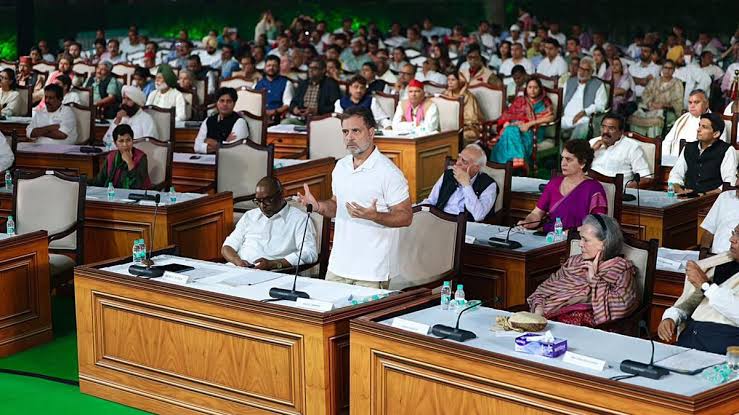
NEW DELHI, October 31, 2026: The INDIA bloc held a symbolic “public impeachment” meeting against Chief Election Commissioner Gyanesh Kumar at Congress president Mallikarjun Kharge’s residence on Saturday. Kharge presented a resolution listing six allegations against the poll chief, while Rahul Gandhi told the gathering that the opposition had evidence to seek his removal.
The meeting was a political event, not a proceeding of Parliament or a constitutional inquiry. It did not remove Kumar, establish the allegations, or by itself begin the formal process for removing a Chief Election Commissioner. The distinction matters because the phrase “public impeachment” was used for a symbolic exercise outside the constitutional procedure.
The proceedings began at Kharge’s residence in New Delhi during the afternoon. Former Lok Sabha Speaker Meira Kumar presided, and opposition MPs and civil-society participants attended. The Indian Express live blog logged the meeting’s opening at 4:25 pm IST and was updated at 8:42 pm IST with Rahul Gandhi’s remarks. The New Indian Express reported that the resolution was adopted after about three hours of speeches.
Kharge accused Kumar of six forms of alleged misconduct. The claims, as reported by The Indian Express and The New Indian Express, included:
- conspiring to influence or “steal” elections;
- deleting 13.2 crore voters from electoral rolls;
- changing the Form 6 process without parliamentary approval;
- using the ECINET platform to take control of electoral-roll data;
- not taking the views of the other two election commissioners into account; and
- acting at the direction of Prime Minister Narendra Modi and Union Home Minister Amit Shah.
These are allegations made by the INDIA bloc and should not be treated as established findings. The voter-roll figure also needs context. The New Indian Express reported that the Election Commission’s SIR exercise had placed electors in categories such as absent, shifted, dead, and duplicate. A total in those categories is not the same as a verified count of eligible voters unlawfully deleted. The Commission has said the revision is intended to identify ineligible or duplicate entries and provide a process through which eligible voters can seek inclusion.
Also read: Election Commission Orders Voter-Roll Revision in 17 States and UTs
Article 324(5) of the Constitution provides that the Chief Election Commissioner cannot be removed except in the same manner and on the same grounds as a judge of the Supreme Court. Article 124(4) sets out the corresponding process for a Supreme Court judge: removal requires a presidential order following an address by each House of Parliament, supported by the prescribed special majorities, on grounds of proved misbehavior or incapacity.
A meeting at a party leader’s residence cannot substitute for those parliamentary and constitutional steps. Meira Kumar said the opposition planned to convene a meeting to move a formal motion in the Rajya Sabha, with Kharge expected to introduce it. That was a statement of intended future action; the symbolic meeting itself was not a formal removal order or a finding against the CEC.
The Supreme Court has separately been asked to examine aspects of the voter-roll revision. Its notice to the Election Commission on Rahul Gandhi’s SIR petition was a procedural step and did not establish that the electoral rolls had been manipulated.
Also read: Supreme Court Seeks EC Response to Rahul Gandhi’s SIR Petition
Rahul Gandhi said during the meeting that Kumar would not remain in office and claimed the opposition had sufficient evidence. Those remarks reflect the opposition’s political position; they do not amount to a judicial finding or a decision by the Election Commission.
BJP MP Sambit Patra criticized the event, calling it a mockery of the democratic process and arguing that the SIR was intended to improve voter-list accuracy. The BJP’s response was a political rebuttal; it did not resolve the specific allegations raised by Kharge. The Election Commission’s published position on the revision and the evidence supporting individual voter-list changes remain central to assessing the claims.
The next concrete step to watch is whether the opposition submits a formal removal motion in Parliament and whether it meets the constitutional requirements for consideration. Separately, the Election Commission may be asked to respond in court to the SIR-related petition. Until those processes produce documents or decisions, allegations made at the symbolic event should remain attributed to the people who made them.



Comments (0)
Be the first to comment. Comments are published after moderation.