


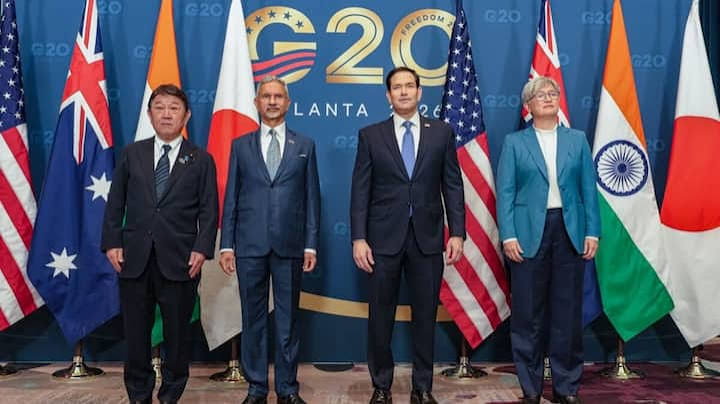
ATLANTA, October 31, 2026: The Quad foreign ministers have set out more than $85 million in technical and financial assistance to expand access to trusted artificial intelligence across the Indo-Pacific, while the United States committed $10 million for facilities that recover critical minerals from waste in India and ASEAN countries. The announcements were included in a joint press release issued after the ministers met in Atlanta on Saturday.
The meeting brought together India’s External Affairs Minister S. Jaishankar, US Secretary of State Marco Rubio, Japan’s Foreign Minister Toshimitsu Motegi, and Australia’s Foreign Minister Penny Wong. Japan’s Ministry of Foreign Affairs said the talks began shortly after 9 am local time and lasted about 40 minutes. It described the meeting as the third Quad foreign ministers’ meeting this year, following discussions in May and July.
The joint statement covers economic security, artificial intelligence, critical minerals, maritime cooperation, cybersecurity, and disaster response. The four governments said they would continue practical cooperation in support of a free and open Indo-Pacific, while raising concerns about economic coercion and restrictions that could disrupt critical supply chains.
The ministers said they intend to provide more than $85 million in technical and financial assistance to support access to trusted technology across the Indo-Pacific, including through the Quad SI Accelerator. The joint release uses the term “Super Intelligence” and includes a footnote explaining that, in Australia, India, and Japan, it refers to artificial intelligence. The statement does not provide a country-by-country breakdown of the $85 million or specify how the total will be divided among projects.
The Quad also plans to identify vulnerabilities in semiconductor and AI-hardware supply chains before they cause disruptions. The governments said they would work on trusted communications technologies, including 5G, 6G, and Open Radio Access Networks, and explore cooperation on AI-enabled radio access networks. These are areas for further cooperation; the statement does not announce a new semiconductor fabrication plant or a completed investment deal.
Also read: Google AI in India: $15 Million for MSMEs and New Farm Tools
Under the Quad Critical Minerals Initiative Framework announced in May 2026, the partners said they had strengthened cooperation on recovering minerals from electronic waste and scrap materials. The joint release welcomed private-sector investment in waste collection networks, processing plants, and refineries and recorded a US commitment of $10 million for infrastructure and facilities in India and ASEAN countries that recover critical minerals from waste.
The funding is intended to support recycling capacity rather than represent a direct payment to individual companies or a general grant for mining. The statement did not identify the facilities to be funded, the project-selection process, or the schedule for disbursing the commitment. It also said the partners would explore ways to streamline cross-border movement of recyclable materials while applying existing regulations.
The ministers reiterated the importance of safe navigation through the Strait of Hormuz, the Red Sea, and the Bab el-Mandeb Strait, without the imposition of tolls and in accordance with international law reflected in the UN Convention on the Law of the Sea. The statement links freedom of navigation to the uninterrupted flow of commerce and energy security.
The partners also reported that the second Quad-at-Sea Ship Observer mission sailed from Chennai to Perth between September 25 and October 7, carrying representatives from all four countries aboard an Indian Coast Guard offshore patrol vessel. They plan to hold the first exercise under the Indo-Pacific Maritime Surveillance Collaboration initiative at Sea Dragon 2027 and to convene a Quad maritime-domain-awareness symposium in early 2027.
Also read: INS Samarthak Commissioned as Navy Expands Indigenous Trials
The joint release condemned transnational groups that traffic people and force them to carry out online scams. The four governments committed to working to dismantle those operations and hold the groups and their leaders accountable. The statement said such networks steal tens of billions of dollars each year; it did not provide a separate audited estimate for each country.
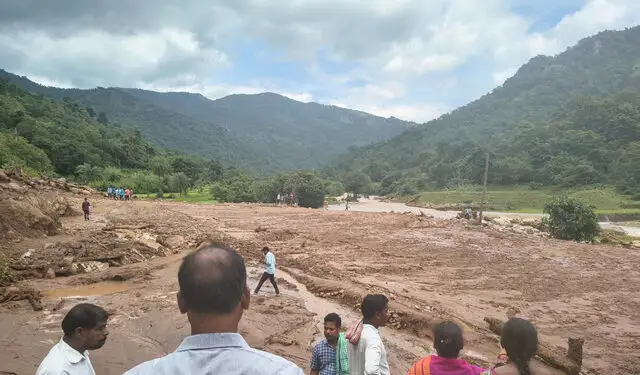
In disaster response, the ministers recognized India’s role as a first responder during the August 26 flash floods in Nepal. Australia, Japan, and the United States plan to send observers to India’s annual joint humanitarian assistance and disaster relief exercise in November. The governments said the exercise would help strengthen their ability to coordinate during regional emergencies.
The joint release sets out commitments and areas for cooperation, but several implementation details remain open. The partners have not published the allocation of the $85 million AI assistance, the list of recycling facilities eligible for the US $10 million commitment, or the timetable for the semiconductor supply chain mapping exercise. Those details will determine how quickly the announcements translate into projects.
Reuters reported earlier on Saturday that the ministers were meeting in Atlanta on the margins of the G20 foreign ministers’ gathering, with preparations continuing for a Quad leaders’ summit in Manila in November. The new joint statement adds specific initiatives to that diplomatic agenda, but it does not replace the need for follow-up decisions, project agreements, and published implementation timelines.
Sources: Quad Joint Press Release on Economic Prosperity and Security, October 31, 2026 (Japan Ministry of Foreign Affairs); Japan Ministry of Foreign Affairs meeting readout;

Comments (0)
Be the first to comment. Comments are published after moderation.