


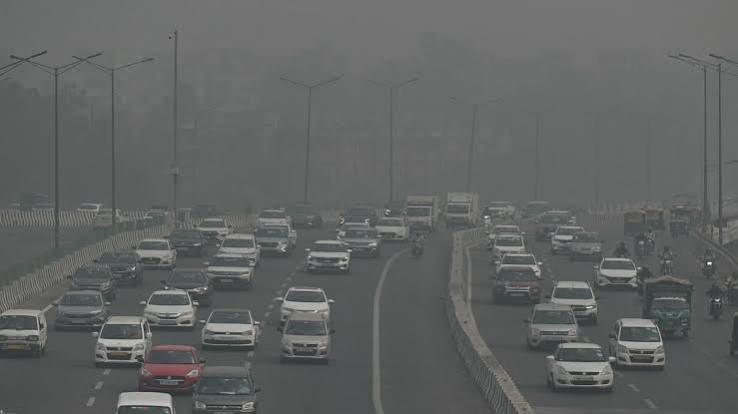
NEW DELHI, November 1, 2026—Delhi’s winter pollution-control framework moves into its enforcement period on Sunday, bringing a set of seasonal restrictions on vehicles, offices, parking, and construction activity as the capital enters the months when air quality is most vulnerable to deterioration.
The measures form part of a permanent Winter Pollution Master Plan notified by the Delhi government. The annual framework runs from November 1 to February 28 and is intended to bring recurring winter controls under one schedule rather than rely entirely on separate orders issued each season. The rules combine transport restrictions, dust-control measures, and changes to office operations, while the Centre and the Commission for Air Quality Management (CAQM) continue to oversee wider air-quality interventions across the National Capital Region.
For residents and people travelling into Delhi from neighbouring cities, the immediate change is a restriction on vehicles registered outside the capital that do not meet BS-VI emission standards. The plan also provides for 50 percent work-from-home arrangements in government and private offices, staggered office timings, doubled parking charges, and restrictions on dust-generating construction. The measures do not all run for the same period, making the dates and exemptions important for commuters, employers, and construction agencies.
From November 1 to January 31, vehicles registered outside Delhi and below BS-VI emission standards are not permitted to enter the national capital under the winter plan. The stated exemptions include CNG and electric vehicles, ambulances, fire services, and other essential vehicles. The restriction is aimed at reducing emissions from older vehicles entering the city during the winter pollution season.
The wording matters: this is not a blanket prohibition on every vehicle that does not meet BS-VI standards. The seasonal entry restriction specifically concerns vehicles registered outside Delhi. Motorists travelling from parts of the National Capital Region, including Gurugram, Faridabad, Noida, Greater Noida, and Ghaziabad, should check their vehicle’s registration details and emission standard before starting a journey into the capital.
A separate rule requires vehicles to have a valid Pollution Under Control (PUC) certificate to obtain fuel at petrol pumps and other fuel stations in Delhi. The permanent winter master plan describes this as a year-round requirement, rather than a restriction limited to the November-January period. The PUC condition is distinct from the non-BS-VI vehicle entry rule: a vehicle may fall outside the seasonal entry restriction but still needs a valid certificate to refuel in Delhi.
Also read: Delhi AQI Improves After Record October Rain, but Relief May Be Brief
Drivers should therefore check that their PUC certificate is valid and that the vehicle’s emission category and registration state are correctly recorded. Owners of CNG and electric vehicles should also carry or have ready the documents that establish the vehicle’s fuel or powertrain category if asked during enforcement. Emergency and essential-service vehicles are covered by exemptions identified in the government’s plan.
The winter framework provides for 50 percent of employees in government and private offices to work from home from November 1 through January 31. It also calls for staggered office timings, a measure intended to reduce the concentration of commuter traffic during peak hours.
The policy places employers in a central role. Organizations will need to plan staffing, attendance, and essential on-site operations around the work-from-home arrangement while maintaining services that cannot be delivered remotely. For workers, the practical details—including which teams must remain on site and how attendance will be organized—will depend on directions issued by their respective employers and departments.
Reducing daily journeys can lower traffic volumes, but the impact will depend on how consistently the arrangement is followed and whether people who continue to travel have workable public-transport options. Staggered timings may spread demand across a longer part of the day; they do not, by themselves, remove the emissions associated with private vehicles. The transport restrictions and office measures are designed to operate alongside one another.
Parking charges at authorized parking facilities are scheduled to double from November 1 to February 28. The measure is intended to discourage unnecessary private-vehicle use during the winter months. Its effect will depend on the availability, reliability, and convenience of alternatives such as buses, the Metro, shared transport, and walking connections.
Dust-generating demolition work and outdoor civil construction activity are also restricted from November 1 to January 31, subject to the provisions and exemptions for essential public infrastructure work. The government’s winter schedule further provides for a complete ban on construction and demolition activities from December 10 to January 20. Construction sites and large commercial buildings are expected to use anti-smog guns or mist systems where required under the plan.
Construction dust is one of the sources that can be addressed directly at work sites. The effectiveness of the restrictions will depend on inspections, dust suppression, covered material transport, safe storage of debris, and action against violations. A ban announced on paper will have limited value if earthmoving, demolition, or the movement of uncovered construction material continues unchecked.
The winter framework also calls for strict action against open burning of waste and assigns responsibilities beyond individual vehicle owners. Institutions and resident welfare associations are expected to participate in preventing burning and maintaining local areas, while the Delhi government has directed departments responsible for transport, traffic management, pollution control, and civic services to coordinate enforcement.
In its October 31 appeal, Chief Minister Rekha Gupta urged vehicle owners, construction agencies, institutions, resident welfare associations, and commercial establishments to follow the restrictions as they come into force. The government said the Environment Department had made preparations and that the Transport Department, Delhi Traffic Police, Delhi Pollution Control Committee, Municipal Corporation of Delhi, and other agencies had been asked to ensure compliance. Enforcement will include checks by dedicated teams and automated number-plate recognition cameras at entry points and other locations, with e-challans and other action against vehicles that breach the rules. Construction sites will also face inspections, work-stop notices, and environmental compensation penalties for violations, according to the Chief Minister’s Office statement reported by the Press Trust of India.
The plan also sits alongside broader monitoring and enforcement work. The Ministry of Environment, Forest and Climate Change said in September that Delhi’s mitigation program included hotspot-specific action, stronger industrial enforcement, more monitoring stations, and an AI-enabled command-and-control center. Those commitments are intended to improve the ability of agencies to identify pollution sources and track whether corrective steps are being carried out.
The seasonal master plan should not be confused with the Graded Response Action Plan, or GRAP. The winter framework sets out recurring measures with fixed calendar dates. GRAP is a separate, region-wide response system under which additional restrictions are imposed as air quality deteriorates or is forecast to deteriorate. The CAQM approved a revised GRAP schedule in September, including changes to the timing and scope of actions on transport, dust, and other pollution sources.
The two systems can operate together. Delhi’s seasonal rules do not mean that more stringent GRAP measures cannot be added if pollution levels or forecasts require them. Equally, the start of the winter plan does not by itself establish that the most severe GRAP stage is in force. Residents should follow the latest CAQM and Delhi government orders rather than assume that every restriction associated with a previous winter has automatically been activated.
- Before entering Delhi: Check whether a vehicle registered outside Delhi meets BS-VI standards or qualifies for an exemption, including CNG and electric vehicles.
- Before refueling: Ensure the vehicle has a valid PUC certificate; the government’s master plan describes the no-PUC, no-fuel rule as a year-round measure.
- For office travel: Check the employer’s work-from-home roster and staggered reporting instructions for the November-January period.
- For construction work: Confirm whether the activity is prohibited, whether an essential-infrastructure exemption applies, and what dust-control requirements must be followed.
- For changing restrictions: Monitor the latest Delhi government and CAQM directions, particularly if air quality worsens and additional GRAP actions are announced.
Delhi’s winter framework covers several sources of pollution at once, from vehicle emissions and traffic congestion to construction dust and waste burning. That breadth is important because no single restriction can address the capital’s air-quality problem on its own. The policy also recognizes that winter pollution is not confined to the city boundary: vehicle movement, industrial activity, and weather conditions connect Delhi with the wider NCR airshed.
But a wide list of measures is not the same as effective implementation. The vehicle rules require checks at entry points and clear communication about exemptions. Work-from-home provisions require employers to follow the arrangement without disrupting essential services. Construction restrictions need site-level inspections, while the no-PUC rule depends on consistent enforcement at fuel stations. Local bodies and resident groups will also need to act against open burning rather than treat it as a problem for another department.
The dates are now significant: the non-BS-VI restriction on vehicles registered outside Delhi, the work-from-home arrangement and the construction-dust curbs begin on November 1, with several of those measures scheduled to run through January 31. Parking charges are set to remain doubled through February 28, while the year-round PUC requirement continues beyond the winter window. The coming weeks will show whether the permanent framework produces more consistent compliance than earlier seasonal campaigns.




Comments (0)
Be the first to comment. Comments are published after moderation.