


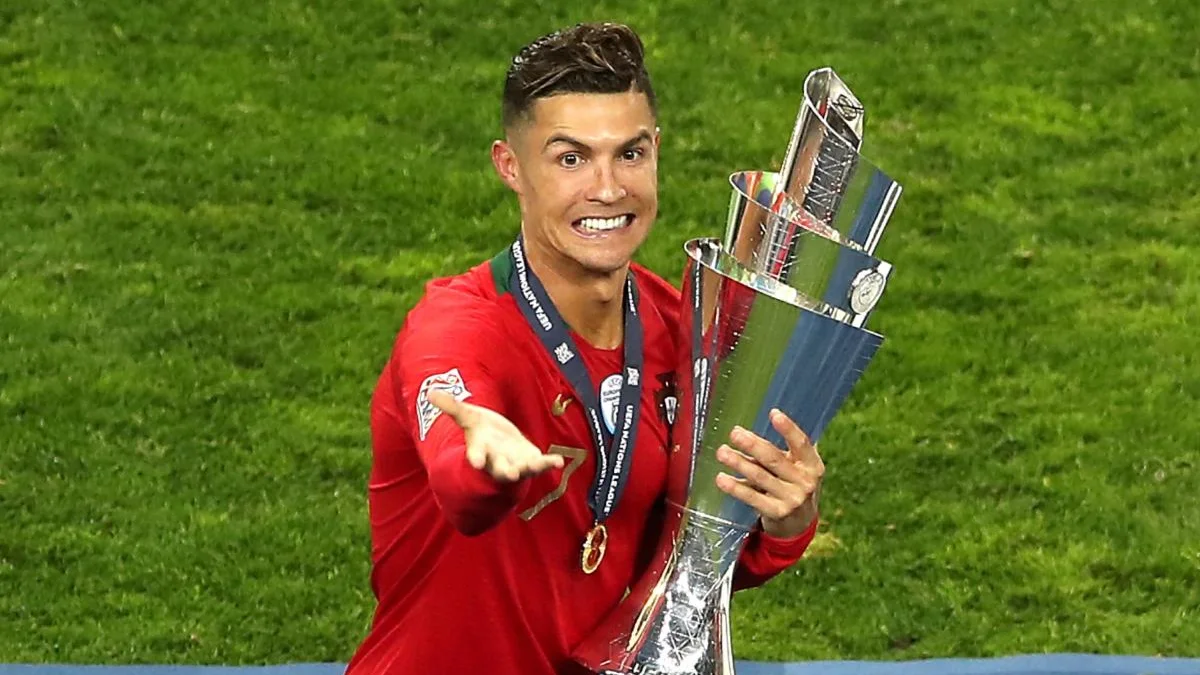
Lisbon, November 5: Cristiano Ronaldo has announced that he will retire from international football after the November break, bringing an end to a 23-year career with Portugal in which he became the men’s game’s record international goalscorer and most-capped player. The 41-year-old forward said he would hand back the national team’s No. 7 shirt after the upcoming international fixtures.
Ronaldo made the announcement in a video message shared on social media on Thursday. He described the decision as difficult but said the time had come to pass the shirt to the next generation. His international record stands at 234 appearances and 146 goals, figures that remain unmatched in men’s international football, according to FIFA and reporting by Reuters and The Associated Press.
The announcement brings clarity to a question that had followed Portugal’s campaign at the 2026 World Cup: whether Ronaldo would continue to represent his country after the tournament. He had previously indicated that the World Cup would be his final appearance at the competition, but had not confirmed when he would end his international career.
Ronaldo’s Portugal debut came in August 2003, before he had established himself as one of the leading forwards in European football. Over the following two decades, he became the central figure in the national team’s most successful era, captaining Portugal to the European Championship in 2016 and to UEFA Nations League titles in 2019 and 2025.
His 146 goals and 234 appearances place him at the top of the men’s international lists. The totals reflect an unusually long period at the highest level, spanning several generations of Portugal teams, multiple coaching regimes and six World Cup tournaments. He scored at each of those six editions, another milestone that distinguished his career.
Ronaldo’s role changed as Portugal evolved. Early in his international career he was a quick, wide attacker, using acceleration and close control to challenge defenders. As he matured, he moved into more central positions and became increasingly focused on penalty-area movement, aerial finishing and decisive moments. The shift allowed him to remain a major scoring presence even as his physical profile and the team’s tactical structure changed.
The defining team achievement came at Euro 2016 in France. Ronaldo captained Portugal through the tournament and helped establish the belief that the side could win its first major senior international trophy. He was forced off injured during the final against France, but remained involved from the touchline as Portugal secured a 1-0 extra-time victory.
Portugal added the inaugural UEFA Nations League title in 2019, with Ronaldo scoring a hat-trick in the semi-final against Switzerland. The team won the competition again in 2025, extending a period in which the national side collected trophies that had eluded earlier generations. Ronaldo’s presence was central to the public identity of those teams, even as younger players took on more responsibility.
His World Cup career stretched from Germany in 2006 to the 2026 tournament in North America. FIFA records that he scored at six editions, a unique achievement in the men’s competition. Portugal did not win the World Cup during his time, but his participation across so many tournaments made him one of the defining figures of the event’s modern era.
Ronaldo said he would complete his international commitments after the November break rather than leave the national team immediately. The distinction means Portugal’s next fixtures are expected to form the final chapter of his international career, although the precise match in which he makes his last appearance will depend on selection and fitness.
He is expected to continue playing club football for Al Nassr in Saudi Arabia. His international retirement therefore does not amount to an announcement that he is ending his playing career. It separates his future at club level from his decision to stop representing Portugal.
The timing also gives Portugal’s coaching staff an opportunity to plan the transition. The team will need to distribute leadership and attacking responsibility among a new generation of players, while preserving the standards built during a period in which Ronaldo was the side’s most recognisable figure. The captaincy, penalty duties and the symbolic weight of the No. 7 shirt will all attract attention as the national team moves forward.
Portugal’s next phase will not be defined by replacing Ronaldo with a single player. His contribution combined goals, longevity, commercial visibility and an ability to make the national side a global sporting story. The team can develop new attacking options, but the record of 146 goals and the sustained role he played across 23 years are unlikely to be replicated quickly.
The announcement also closes a long-running debate about how much longer a player in his forties could continue at international level. Ronaldo remained a central selection question because of his scoring record and profile, even as Portugal’s tactical needs and younger attacking options evolved. His decision removes that uncertainty and gives the coaching staff a clear point at which to begin the next stage.
For supporters, the final appearances will carry a significance beyond the result of any one match. Ronaldo’s career has connected Portugal’s national team to a global audience and delivered the country’s first major men’s international trophy. The closing fixtures will offer a last opportunity to see him in the shirt he has worn since 2003.
His retirement is a landmark for Portugal and international football, but the immediate facts are straightforward: he will finish his national-team career after the November break, having scored 146 goals in 234 appearances. His club career at Al Nassr is set to continue.

Comments (0)
Be the first to comment. Comments are published after moderation.