


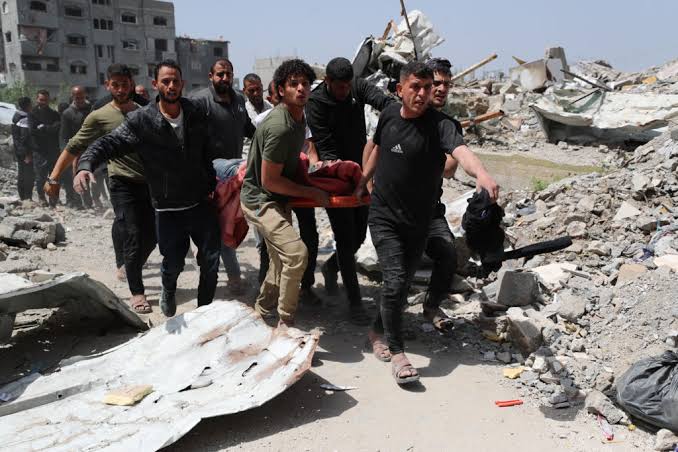
GAZA, November 10, 2026 — At least seven Palestinians were killed in Israeli strikes in Gaza on Tuesday, according to local health officials cited by Reuters. The dead included Fadi Rajab and his 13-year-old son, Abubakr, who medics said were killed when an airstrike hit the roof of a displacement shelter in Gaza City’s Zeitoun neighborhood. The Associated Press separately reported five deaths, citing hospital authorities. Israel’s military said it had targeted militants in Zeitoun and Daraj but did not immediately comment on the reported deaths in Khan Younis or Sabra.
The latest deaths underline how fragile the ceasefire remains for people living in a territory where large areas have been destroyed, many families remain displaced, and the central political questions of the truce are unresolved. The reports describe separate incidents in Gaza City and southern Gaza rather than one single strike. They also leave important details unanswered, including the intended targets, the circumstances of the Khan Younis shooting, and the precise number of people killed across all the incidents.
Reuters described four separate incidents. In Zeitoun, medics said the airstrike on a shelter used by displaced people killed the father and son. In Daraj, a separate strike near a school killed another Palestinian, local health officials said. In Khan Younis, medics said Israeli gunfire killed a man. Later on Tuesday, an airstrike on a metal foundry in Gaza City’s Sabra neighborhood killed three people, medics said, bringing the reported toll to at least seven. Reuters said the Israeli military had not immediately commented on the Khan Younis and Sabra incidents.
Also read: Israeli Strikes Kill Eight in Gaza, Including a Four-Year-Old Boy
The Associated Press reported five deaths: four people killed in three separate strikes in Gaza City, according to Shifa Hospital, and one person shot dead in Khan Younis, according to Nasser Hospital. Reuters’ account included the three deaths reported after an airstrike on the Sabra foundry, which brought its total to at least seven. The agencies’ reports differ in scope and tally, and the available information does not provide an independently reconciled count. The figures should therefore remain attributed to the health officials and hospitals cited by each outlet rather than combined into a single definitive total.
The Israeli military said it had struck militants in the two Gaza City locations. That statement is an account of the military’s stated target, not an independent assessment of who was present or whether the strikes complied with the laws of armed conflict. The public reporting reviewed for this article did not provide a detailed military account of the individual attacks, the evidence used to identify the targets, or a full explanation of the civilian casualties reported by hospitals.
The military’s position and the casualty reports answer different questions. The statement describes whom Israel says it intended to strike. The hospital and medical accounts describe people who were brought in dead or injured. Neither set of information, by itself, provides a complete reconstruction of what happened. A fuller assessment would require the timing and location of each strike, the weapons used, the identities and status of those killed, and any available military or independent investigation.
That distinction matters because the ceasefire has not ended the risk of lethal incidents. Israel has said its forces remain focused on threats and violations near the lines that divide areas under different forms of control. Palestinian officials and residents have repeatedly accused Israeli forces of continuing attacks despite the truce. The latest reports show that the dispute is not only about whether a particular strike was justified but also about how the ceasefire is being interpreted and enforced on the ground.
Also read: Gaza Officials Say Heavy Rain Flooded 70,000 Tents in Displacement Camps
Reuters reported that negotiations remain stalled over Hamas disarmament and the withdrawal of Israeli forces. Those issues sit at the center of the next phase of the agreement. Israel has said that it cannot accept an arrangement that leaves Hamas able to rebuild its military capabilities. Hamas has resisted demands for disarmament and has accused Israel of using security incidents to maintain control over territory. Mediators have yet to bridge those positions.
Israel controls about two-thirds of the Gaza Strip, Reuters reported, while most of the territory’s more than two million residents are concentrated in the remaining areas. That geography has a direct effect on civilian life. Families displaced from their homes often live in temporary shelters, damaged buildings, or crowded neighborhoods where access to safe roads, medical care, and basic services is limited. An attack on a shelter or near a school can therefore affect people who have already moved because of earlier fighting.
The ceasefire reduced the scale of the war compared with the most intense phases of Israel’s campaign, but it has not produced a stable security arrangement. The questions of who will administer Gaza, how armed groups will be handled, how far Israeli forces will withdraw, and who will oversee reconstruction remain unsettled. Until those questions are addressed, each new incident risks triggering further retaliation or undermining confidence in the agreement.
The casualty totals also need careful attribution. Palestinian health authorities have reported more than 1,600 Palestinians killed in Israeli attacks since the ceasefire, while Israel has reported four soldiers killed during the same period, Reuters said. The overall Palestinian death toll from the war that followed the Hamas-led attack of October 7, 2023, is above 74,000 in figures cited by Palestinian authorities. Those totals are not a complete independent accounting of every death, and the published reports do not provide a full civilian-combatant breakdown.
The humanitarian consequences extend beyond the immediate death toll. Gaza’s housing, health, water, and sanitation systems have been severely damaged, and displacement has left many families dependent on temporary shelter and aid deliveries. The United Nations and relief agencies have warned that insecurity and restrictions on movement complicate the delivery of food, medical supplies, and shelter materials. The latest incident reports do not establish how much aid was available in the affected neighborhoods or whether medical teams faced delays in reaching the casualties.
For residents, the distinction between a formal ceasefire and a reliable one is measured in whether they can move, seek medical help, return to damaged homes, and keep children away from danger. A truce that does not provide predictable rules for troop movements, security incidents, and investigations leaves civilians exposed to sudden violence. The deaths reported on Tuesday are a reminder that the agreement’s political framework has not yet translated into dependable protection on the ground.
The next developments to watch are whether Israel provides a fuller account of the strikes, whether Palestinian health authorities publish a reconciled casualty tally, and whether mediators can restart negotiations on the unresolved terms of the ceasefire. Any new military statement should be assessed separately from hospital casualty reports. Any revised death toll should be dated and attributed rather than merged with earlier figures.



Comments (0)
Be the first to comment. Comments are published after moderation.