


TRACY, California, November 11, 2026 — The Avtar Singh case moved to a new stage on November 9 when one of the three men indicted in the kidnapping and killing of the 57-year-old Sikh man appeared in a California court after being arrested in Mexico. Alberto Alonso Alencastro was arraigned on November 9 in San Joaquin County Superior Court, according to the county District Attorney’s Office. The two other defendants remain at large.
The arraignment followed Alencastro’s apprehension in the Mexican state of Jalisco on November 6 and his transfer to San Joaquin County. Prosecutors say he faces a murder charge carrying a special-circumstance allegation that the killing occurred during a kidnapping, along with a separate kidnapping count. He is being held without bail. The next court appearance is scheduled for November 30 at 8:30 a.m. in Department 8C.
Singh, 57, was taken from the Gurdwara Gur Nanak Parkash in Tracy on February 17. His body was found three days later near Monticello Dam in the Lake Berryessa area of Napa County. The San Joaquin County District Attorney’s Office said an autopsy determined that his death was a homicide caused by asphyxiation. The case has drawn attention well beyond the city because the abduction took place at a Sikh place of worship and because investigators say Singh may have been mistaken for another person.
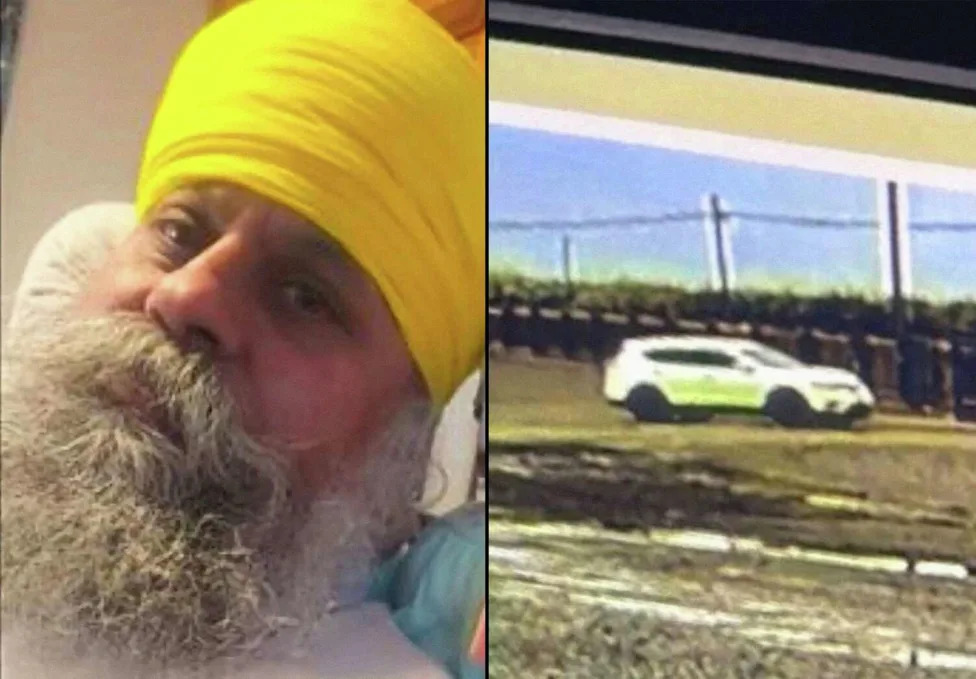
Surveillance footage from the gurdwara captured three men confronting Singh, struggling with him and forcing him into a white Nissan Rogue, the District Attorney’s Office said in its November 10 statement. The footage became a central part of the public account of the disappearance. Singh was reported missing after he was taken from the temple complex, where he lived with his family and served the congregation.
Singh was a husband, father and member of the local Sikh community. Reports from California and India said he had been caring for young triplets with his wife and was a long-time volunteer at the gurdwara. The District Attorney’s Office described him as a valued member of the community. His killing left relatives and congregants waiting for answers while investigators worked to identify the men seen in the surveillance recording.
Authorities later said the three men were from Vallejo. On June 16, a San Joaquin County grand jury returned an indictment naming Alencastro, Barnabe Antonio Segura and Alfonso Cresencio Segura. The Superior Court issued arrest warrants for all three. The indictment moved the Avtar Singh case from investigation into formal prosecution, but it did not resolve every question about why Singh was taken or who planned the crime.
Investigators have said they believe Singh was not the intended target. CBS Sacramento reported that authorities believed he was mistakenly targeted and that the kidnapping stemmed from a stolen-trailer dispute. The Times of India’s November 11 report said investigators believed the intended target lived in Canada and had been receiving threats connected to the trailer. Those accounts reflect the investigators’ working explanation; they are not findings established at trial. The District Attorney’s November 10 arraignment announcement did not set out a final determination of motive.
The arrest in Mexico required cooperation across jurisdictions. The District Attorney’s Office said Alencastro was apprehended in Jalisco on November 6 and transferred to the San Joaquin County Jail. It thanked the San Joaquin County Sheriff’s Office, the Federal Bureau of Investigation and Mexican federal law-enforcement authorities for their assistance. The cross-border operation brought one defendant into custody, but it has not ended the search for the other two men named in the indictment.
At the November 9 arraignment, Alencastro was formally called to answer two counts. The first is murder under California Penal Code section 187(a), with a special-circumstance allegation under section 190.2(a)(17)(B) that the murder was committed during the commission of a kidnapping. The second is kidnapping under section 207(a). The District Attorney’s Office said he is being held without bail.
A special-circumstance allegation can affect the range of penalties available if a defendant is convicted, but an allegation is not proof. The charges set out the prosecution’s case; they do not establish guilt. Alencastro is presumed innocent unless the prosecution proves the charges in court. The same principle applies to the two co-defendants, who have been indicted but have not yet been brought before the court.
The District Attorney’s Office said Alencastro faces a possible maximum sentence of life imprisonment without the possibility of parole or the death penalty. That is the prosecution’s description of the potential exposure under the charges and special-circumstance allegation; the actual legal outcome would depend on the proceedings, the evidence, applicable law and any decisions made by the court. No trial date was announced in the November 10 statement.
In a statement accompanying the arraignment announcement, District Attorney Ron Freitas said the case would continue to be pursued until all defendants were brought before the court. He thanked investigators and partner agencies and said Singh’s family and the affected communities deserved answers. The statement is a prosecutorial position, not a substitute for the evidence that will be tested through the court process.
Barnabe Antonio Segura and Alfonso Cresencio Segura remain wanted, the District Attorney’s Office said. The agency urged anyone with information about their whereabouts to contact law-enforcement authorities. The public should not approach or attempt to detain either man. The case remains active, and investigators have not announced that the search is over.
The fact that two defendants remain at large leaves an important part of the prosecution unresolved. Authorities have not said whether they believe the men are still in the United States, whether they have crossed another border or whether they are receiving assistance. The November 10 statement does not provide a new timetable for their capture. Until officials release verified information, speculation about their location would be premature.
For the Sikh community in Tracy, the case has a particular setting: Singh was taken from a gurdwara, a place used for worship, service and community life. That fact explains why the crime resonated with congregants and with Sikh communities beyond California. It does not, by itself, establish that the attack was motivated by religious hatred. Investigators’ reported mistaken-identity theory points to a different possible motive, and any conclusion about motive must remain tied to evidence rather than assumptions about the victim’s faith.
The Avtar Singh case also illustrates the practical limits of local investigations when suspects cross international borders. The arrest in Jalisco shows that cooperation between county investigators, federal agencies and Mexican authorities can move a case forward. It does not guarantee that every defendant will be located quickly, nor does it answer the questions that a trial may need to address about planning, individual roles and the events leading to Singh’s death.
The Avtar Singh case will return to San Joaquin County Superior Court on November 30, when Alencastro is due to appear at 8:30 a.m. in Department 8C. The next developments to watch are whether the two remaining defendants are apprehended, what evidence prosecutors disclose as the case proceeds and whether the court sets further dates. For Singh’s family and the community that knew him, the arraignment marks progress in the case, but it is not its conclusion.





Comments (0)
Be the first to comment. Comments are published after moderation.