


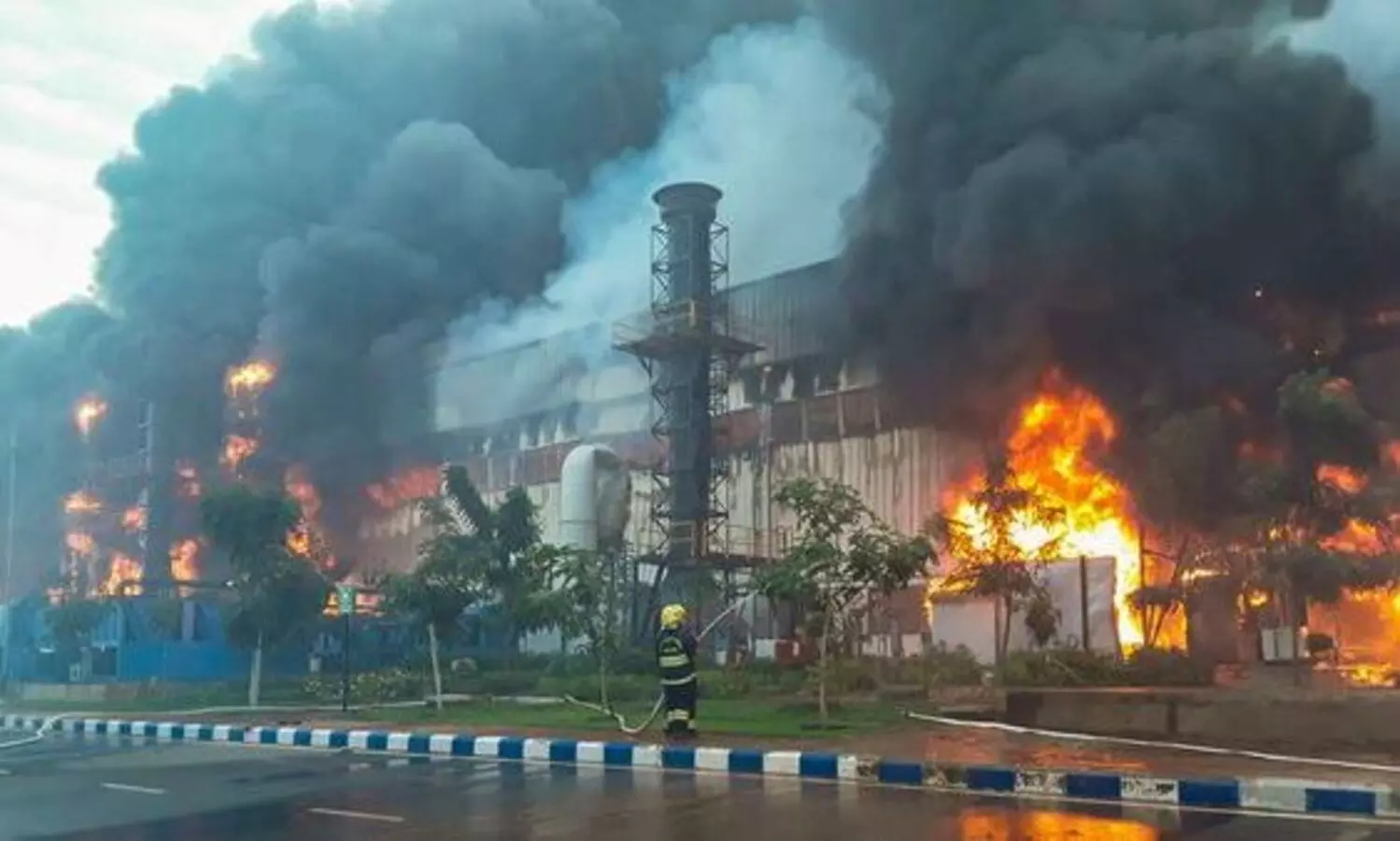
KRISHNAGIRI, Tamil Nadu, November 10, 2026 — Three contract workers died after collapsing during cleaning and maintenance inside a wastewater-treatment tank at a Tata Electronics plant in Krishnagiri district on Monday evening. Police are investigating suspected exposure to a hazardous atmosphere inside the tank, while the district administration has begun examining the safety arrangements at the site.
Nalco Water, an Ecolab company that operated the utility facility, said the three workers were engaged by a subcontractor and confirmed that it is cooperating with local authorities. The company said it was deeply saddened by the deaths and that supporting the families was a priority. Its statement does not identify the substance involved or explain who authorised entry into the tank.
Krishnagiri District Collector C. Dinesh Kumar told The Economic Times that Tata Electronics had been directed to review the performance and safety compliance of the agencies responsible for maintaining the effluent-treatment plant and submit a detailed Action Taken Report. The report is to cover the circumstances of the accident, lapses identified, corrective measures and a preventive plan. Kumar said the ETP would resume only after authorities verify that required safety measures are in place and grant clearance. He said there was no proposal at present to shut the entire Tata Electronics plant.
The collector said Nalco Water International had engaged four workers through another agency, Permacorp, for the maintenance work. Officials from the Tamil Nadu Pollution Control Board and the Directorate of Industrial Safety and Health are inspecting confined-space entry procedures, gas monitoring, protective equipment and emergency rescue arrangements. The contracting chain is now clearer, but responsibility for supervision, permits and the safety controls in force remains subject to investigation.
The reported sequence — one worker becoming unconscious after looking into the tank, followed by two colleagues entering in an attempt to help — remains an account attributed to the district collector. It is not yet a final technical reconstruction. The inspection and post-mortem findings will be needed to establish the atmosphere inside the tank and the precise cause of death.
Also read: Four Reported Dead in Asansol Power Plant Chimney Collapse
The incident occurred at the company’s plant near Uddanapalli, in the Hosur industrial belt. The company’s official plant-location listing identifies Uddanapalli in Krishnagiri district near Hosur as one of its electronics-manufacturing sites. The facility manufactures components for Apple iPhones, according to reporting by The New Indian Express and Reuters. The deaths have raised immediate questions about the precautions used when workers enter tanks and other enclosed industrial spaces, where a lack of oxygen or the accumulation of hazardous gases can turn routine maintenance into a fatal emergency.
Reuters later reported that the workers were inspecting an external nano-filtration tank at the effluent-treatment plant, which was operated by Nalco Water, a subsidiary of US-based Ecolab. Krishnagiri District Collector C. Dinesh Kumar identified the equipment in comments reported by Reuters. The available accounts do not identify the gas or chemical involved, and the operator’s role in running the treatment plant does not by itself establish who controlled the maintenance work or authorised entry into the tank. Those details remain part of the investigation.
The incident took place on Monday, November 9, at about 5.10 pm, according to NDTV’s report citing police. The workers were carrying out cleaning work in a nano-filtration feed tank associated with the plant’s effluent-treatment system. The tank forms part of the process used to handle wastewater generated by industrial operations. The New Indian Express identified the location as an effluent treatment plant at Tata Electronics Private Limited near Vanniyapuram and Uddanapalli.
The New Indian Express identified the workers who died as B Akmal, P Kaveri and M Sarathikumar. Their bodies were taken to the Government Medical College Hospital in Krishnagiri for post-mortem examination. The reports available on Tuesday did not include a final medical finding on the precise cause of death.
Accounts of the sequence inside the tank were attributed to the district collector and police. The New Indian Express reported that Akmal first tried to look inside the tank and collapsed after inhaling gas. A second worker then attempted to check on him and also fell unconscious. A third worker entered the tank and collapsed as well. A fourth member of the team raised the alarm. NDTV reported that the factory’s safety team rescued the three workers, gave them initial treatment at the occupational health centre and shifted them by ambulance to a private hospital in Hosur, where doctors declared them dead.
Early reports have not used identical descriptions of the deaths. The New Indian Express and NDTV reported suspected toxic-gas exposure or asphyxiation, while an earlier Times of India account described the incident as drowning during tank maintenance. Those descriptions should not be treated as a final determination. The post-mortem reports and the investigation will need to establish whether the workers were overcome by a toxic substance, an oxygen-deficient atmosphere, liquid inside the tank or a combination of factors.
Krishnagiri Collector C Dinesh Kumar told The New Indian Express that the workers were part of a team cleaning the effluent-treatment plant and said there were “no proper safety measures in place” while the work was being carried out. He also said the district administration was inquiring into the incident. That is an important preliminary official assessment, but it is not a completed finding on which safety requirements were breached or who was responsible. Those questions will depend on the site inspection, documents, witness accounts and technical evidence.
A wastewater-treatment tank is a confined industrial space. Depending on what has entered the system, the material inside it and the way the space is ventilated, the atmosphere can become unsafe even when a tank appears empty or has been opened for inspection. Some gases can displace oxygen; others can be toxic at concentrations that cannot be detected by smell. The available reports do not identify a particular chemical or gas in the Krishnagiri incident, and it would be premature to name one before investigators publish their findings.
For that reason, confined-space work is normally treated as a separate high-risk activity rather than as ordinary cleaning. Before entry, an employer and the site’s safety team need to assess the contents and history of the space, isolate connected flows and equipment, ventilate it and test the atmosphere with suitable instruments. Oxygen levels and possible toxic or flammable gases may need to be checked at different points in the tank, because conditions can vary between the opening and the lower sections. Where the risk assessment requires it, the atmosphere must continue to be monitored while work is under way.
A written entry permit, a trained attendant outside the space, reliable communication, suitable protective equipment and a rescue plan are also central safeguards. The precise controls depend on the hazard assessment and applicable rules. Respiratory protection must be selected for the actual atmosphere; an ordinary mask is not a substitute for breathing equipment designed for an oxygen-deficient or toxic environment. Rescue arrangements must be ready before entry, because an unplanned attempt by colleagues to reach an unconscious worker can expose additional people to the same danger.
The reported sequence at the Tata facility makes that last issue particularly important. If one worker collapsed inside the tank and others entered in an effort to help, investigators will need to establish whether a standby person was present, whether the team had been trained in confined-space rescue and whether retrieval equipment could have been used without sending another person into the hazardous area. The sequence is still based on early accounts and should be checked against statements from the surviving witness, the contractor and the plant’s safety personnel.
The investigation should also examine whether the tank was properly isolated, whether it had been drained and cleaned in the prescribed order, what substances had been used in the treatment process, when the atmosphere was last tested and who authorised the work. Maintenance records, permit-to-work documents, gas-monitor readings, training records and the condition of protective equipment could help reconstruct what happened. The authorities have not yet released those records or a technical assessment of the tank.
The three men were described in the reporting as contract workers rather than direct Tata Electronics employees. The New Indian Express quoted the collector as saying that another company had been engaged for maintenance of the water-filtration tank. Early accounts have not fully reconciled the name and role of the contracting entities. The exact chain of engagement, including who employed the workers, who supervised the job and who controlled access to the tank, needs to be established by the inquiry.
That distinction matters, but it does not make the safety question disappear. Investigators will need to determine how responsibilities were divided between the plant operator and the maintenance contractor. The questions include who carried out the risk assessment, who issued the work permit, who verified the atmosphere, who supplied protective equipment and who had authority to stop the job. A contractor may perform the work, but the site operator still has to ensure that the work is coordinated with the hazards and systems inside the facility.
Tamil Nadu Industries Minister Virudhai Magal Keerthana said worker safety and dignity must remain paramount and that the incident would be thoroughly investigated, with appropriate action based on the findings. The Times of India reported that she had also directed the district administration to extend support to the affected families. Reuters later reported that Apple, Tata Electronics and state authorities would investigate the deaths. The public reports reviewed for this update do not yet provide a detailed technical account from the companies of the tank’s condition, the maintenance contractor’s instructions or the permit-to-work process.
The plant’s connection to Apple’s iPhone supply chain gives the incident a wider industrial context, but it does not establish that Apple had any role in the maintenance work. Reuters reported that production was not affected because the facility was closed for Deepavali. The same report said Tata Electronics accounts for about 40% of iPhone assembly in India, with Foxconn handling the remainder; that figure describes Tata’s broader Indian operations, not necessarily the individual Hosur unit where the workers died. India has become a major manufacturing base for Apple, but the scale of the supply chain does not change the immediate question: why did three contract workers enter a tank in which the atmosphere may have been unsafe?
The case comes as Tamil Nadu continues to attract large investments in electronics and component manufacturing. Industrial expansion brings jobs, supplier networks and new production capacity, but it also increases the importance of maintenance, wastewater treatment, contractor management and occupational-health systems. The safety of workers who clean tanks, service pumps, inspect pipes or handle treatment chemicals is part of the operating infrastructure of a factory, not a secondary concern separate from production.
The New Indian Express also recalled a separate fire at a Tata Electronics chemical unit in the district in September 2024, when 11 people were reported to have suffered breathing problems. That earlier incident does not establish a connection with Monday’s deaths or prove a recurring cause. It does, however, underline why the current investigation should publish clear findings about the hazards present, the controls used and any corrective action required at the facility.
For the families of the three workers, the immediate issues are the post-mortem process, the return of the bodies and the support available from the employer, contractor and district administration. The minister has said assistance should be extended to the affected families. The authorities have not yet announced a final account of compensation, responsibility or any enforcement action arising from the incident.
Rayakottai police and officials from the district administration have visited the site, while the Directorate of Industrial Safety and Health has also been involved in the preliminary inquiry, according to The New Indian Express and DT Next. The police investigation and the industrial-safety examination will need to establish the physical cause of the deaths as well as whether work procedures, supervision or emergency arrangements failed.
The next reliable update should clarify the post-mortem findings, the substance or atmospheric condition involved, the contractor responsible for the maintenance task and the safety documents available for inspection. It should also explain whether the tank was entered under a written permit, whether atmospheric tests were recorded and what equipment was provided to the workers. Until those details are established, the deaths should be described as a suspected confined-space incident rather than attributed to a specific gas or a confirmed statutory violation.
The wider lesson is not that every industrial tank is unsafe, but that work inside one requires controls that can be verified before anyone enters. A permit, a gas test, ventilation, a trained attendant and a rescue plan are practical barriers between a maintenance task and a multiple-fatality event. The inquiry at Krishnagiri will need to show whether those barriers existed and, if they did, why they did not prevent three workers from dying.




Comments (0)
Be the first to comment. Comments are published after moderation.