


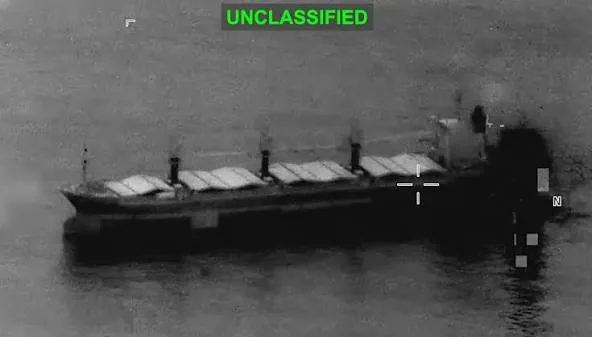
A Gulf of Oman cargo ship was disabled by US forces after it ignored repeated warnings and attempted to leave the region following a visit to an Iranian port, the US military said late on Saturday, November 7. US Central Command identified the ship as M/V Huda and said an aircraft fired precision munitions at its stern, disabling it. The command did not disclose the vessel’s cargo, operator or the condition of its crew, leaving key details about the incident unresolved.
Also read: Indian Sailors Killed in US Strike Near Oman
Also read: Trump Says US Carried Out New Limited Strike Near Iran’s Qeshm Island
The action is the latest use of force in Washington’s naval blockade of Iranian ports and comes as the United States expands efforts to restrict Tehran’s access to weapons, sanctioned goods and revenue through routes beyond the sea. The Associated Press said it was the first confirmed US strike on a cargo vessel in nearly a month. The latest incident also coincided with an Iranian military statement that two oil tankers had hit mines and caught fire in the Strait of Hormuz, a claim that has not been independently verified.
CENTCOM said the vessel had ignored multiple warnings and tried to leave the region after calling at an Iranian port. The command said the crew was directed to abandon the spaces that would be targeted before an aircraft fired at the ship’s stern. The statement described the action as an effort to enforce the blockade, but it did not say whether the vessel was seized, whether it remained afloat or whether any crew member was injured. No independent assessment of the damage was available in the reporting reviewed.
The ship’s St Kitts flag is important because the vessel was not described as Iranian-flagged. The US military’s position is that the blockade applies to commercial vessels attempting to enter or leave Iranian ports, regardless of their flag. That means the port call and the ship’s attempted departure, rather than its nationality alone, were central to the stated justification for the action. The vessel’s cargo and ownership have not been disclosed, so it is not yet possible to establish what it was carrying or who stood to benefit from the voyage.
The disabling of the M/V Huda comes as Washington broadens its pressure campaign from port enforcement to land and Caspian routes.
The latest strike follows a broader expansion of the US effort. On Saturday, CENTCOM announced Task Force Iron Gate, an approximately 20-person unit based at its headquarters in Tampa. The task force is intended to coordinate with other US government agencies to restrict the movement across Iran’s land borders and the Caspian Sea of advanced weapons systems, dual-use technologies, sanctioned materials and revenue streams that Washington considers illicit. The announcement extends the pressure campaign beyond ships approaching Iranian ports.
Admiral Brad Cooper, the head of CENTCOM, said the new unit would strengthen coordination between the military and other agencies. The Washington Post reported that the task force’s land and Caspian focus builds on the naval blockade of Iranian ports on the Persian Gulf and Gulf of Oman, which the United States began enforcing in its current phase in July. The command said the blockade had prevented Iran from exporting more than $25 billion in crude oil. That figure is CENTCOM’s own estimate and has not been independently verified as a trade or revenue calculation.
The task force does not, by itself, mean that US ground forces are being deployed inside Iran. The announcement describes an interagency coordination effort aimed at restricting transport routes and financial flows. Its practical effect will depend on how US agencies identify shipments, work with partner governments and apply sanctions or other restrictions at borders and ports. The Caspian Sea is particularly relevant because it offers Iran access to regional trading partners and routes that are not controlled by the same maritime chokepoints as the Gulf.
The combination of the naval blockade and Task Force Iron Gate suggests Washington is trying to make it harder for Iran to move goods and generate revenue even if it can reroute trade away from the Persian Gulf. The US says the measures are intended to constrain Iran’s ability to finance military activity and replenish weapons. Tehran is likely to view them as economic pressure imposed during an armed conflict. The two sides have not publicly agreed on a framework that would resolve the dispute over port access, sanctions or the wider terms of a ceasefire.
The latest vessel action also raises practical questions for commercial operators. Shipowners, charterers and insurers will need to assess whether a vessel has called at an Iranian port, what cargo it carried and whether it could be treated by US forces as attempting to breach the blockade. The operator of the M/V Huda has not been identified in the public statements reviewed, and there has been no detailed account of its route, cargo or destination. Without those details, other shipping companies cannot draw a complete picture of the circumstances that led to the strike.
The Iranian statement introduced a second set of unanswered questions about commercial shipping in the strait.
In a separate development, Iran’s Revolutionary Guards Navy said early on Sunday that two oil tankers had caught fire after hitting mines while trying to pass through what it described as an unauthorised route in the Strait of Hormuz. The Iranian military did not identify the vessels’ names, flags or destinations. Reuters and the Associated Press reported the statement, but neither had independently confirmed that the tankers struck mines or established the cause of the fires.
Iranian state television had earlier reported explosions in several southern areas, including Qeshm Island and the port of Jask. It suggested the sounds could be connected to military activity in the strategic waterway, while the semi-official Tasnim news agency cited a source saying the explosions on Qeshm were not caused by missile strikes. Iranian officials had not provided a verified damage assessment. Reuters said it was not immediately clear whether the tanker fires reported by the Guards Navy were connected to the explosions.
The two sets of events should not be treated as one confirmed exchange. The US statement concerns a commercial vessel that Washington says tried to breach its blockade after visiting an Iranian port. The Iranian statement concerns two unidentified tankers that Tehran says struck mines while using a restricted route. No evidence released publicly so far establishes that the M/V Huda was involved in the mine incidents or that the fires were caused by US action. The timing places the reports in the same period of heightened maritime tension, but does not prove a direct link.
The Strait of Hormuz and the adjacent Gulf of Oman are among the most sensitive shipping corridors in the world. The passage connects the Persian Gulf with the Arabian Sea and carries large volumes of crude oil, petroleum products, liquefied natural gas and other commercial cargo. A disruption can affect not only energy prices but also freight schedules, insurance premiums and the security decisions of crews operating under different flags. The AP reported that October saw the highest number of attacks on commercial ships in the strait since March, as Iran sought to increase economic pressure on Washington.
That pattern makes the condition of crews a central unanswered question in the M/V Huda incident. CENTCOM said the crew was warned before the ship was struck, but it did not provide their nationality, number or current location. It also did not say whether they were transferred to another vessel, taken ashore or remained aboard the disabled ship. The absence of those details is significant: a military action against a commercial vessel can have consequences for seafarers who may have had no role in decisions about the ship’s port calls or cargo.
The earlier US strike on the Palau-flagged tanker MT Settebello, in which three Indian seafarers were killed, shows why the crew question matters beyond the immediate operation. The M/V Huda is a different vessel and no connection to Indian crew has been reported. But the previous incident demonstrated that disabling a commercial ship in the same broad maritime area can have deadly consequences for workers who are not parties to the conflict. No casualty report has been issued for the latest action, and the two incidents should not be conflated.
The maritime confrontation is unfolding alongside diplomatic efforts to prevent a wider resumption of fighting. Qatar has continued to mediate between Washington and Tehran, with regional officials describing proposals that would sequence a reduction in military pressure, access to frozen funds and renewed nuclear inspections. No agreement has been announced. The latest US action may complicate those contacts, although there is no public evidence that the vessel was disabled to influence a specific negotiating session or that the operation ended the mediation effort.
For Iran, the blockade restricts an important source of export revenue and places pressure on shipping that serves its ports. For the United States, enforcement is intended to prevent Tehran from using commercial routes to finance military activity and obtain restricted materials. The dispute is not only about the individual vessel: it concerns who can regulate access to Iranian ports, how neutral-flagged ships are treated and whether the pressure campaign can be sustained without triggering further attacks on commercial traffic.
The next developments will determine whether the M/V Huda incident remains an isolated enforcement action or becomes part of a wider cycle of maritime retaliation. A fuller CENTCOM account could clarify the ship’s route, cargo and crew status. Iran may release details about the two tankers it says struck mines, while flag states and maritime operators may issue safety advisories if they can identify the vessels involved. Until those details are confirmed, claims about casualties, cargo or responsibility for the reported fires should be treated cautiously.
For now, the established facts are limited but consequential: the US military says it disabled the St Kitts-flagged M/V Huda after it visited an Iranian port and attempted to leave the region; Iran’s Guards Navy separately says two oil tankers hit mines and caught fire in the Strait of Hormuz; and Washington has announced a new task force to extend pressure on Iran’s land and Caspian routes. The crew’s condition, the cargo and the cause of the reported tanker fires remain unknown.



Comments (0)
Be the first to comment. Comments are published after moderation.