


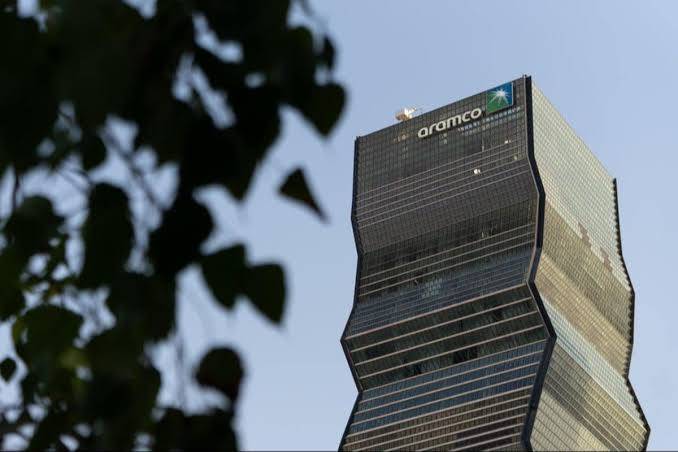
Riyadh | November 8, 2026 — A Saudi Aramco administrative building in Riyadh sustained minor damage from falling shrapnel after an attempted attack on the Saudi capital, the Energy Ministry said on Sunday, as Saudi air defences reported intercepting missiles aimed at Riyadh and other parts of the kingdom. No injuries or fatalities were reported at the facility.
The ministry’s account described damage to a building belonging to the state oil company but did not say that the structure had been directly hit by a missile. The distinction is important: Reuters and Agence France-Presse reported that Saudi officials attributed the damage to falling debris or shrapnel after an attempted attack, while witnesses cited by the Associated Press described damage across multiple floors of an Aramco building in the King Abdullah Financial District.
The Saudi-led coalition said its air defences intercepted two ballistic missiles and two cruise missiles targeting Riyadh and other regions early Sunday. The Houthis’ military spokesperson, Brigadier General Yahya Saree, separately claimed that the group had struck Riyadh’s financial district. The claim and the coalition’s interception account have not been independently reconciled in the public reporting available so far.
A Saudi Energy Ministry official said an administrative building belonging to Saudi Aramco had been subjected to an attempted attack and that falling shrapnel caused limited damage. The official said the relevant authorities responded and took the necessary measures. The ministry reported no deaths or injuries, and Reuters likewise reported that no casualties had been recorded.
Witnesses in Riyadh told the Associated Press they heard a loud explosion on Sunday morning and saw damage on several floors of an Aramco building in the financial district. Some floors appeared heavily damaged, the witnesses said. They spoke anonymously because of security concerns. AFP also cited multiple witnesses who said the Aramco tower had been damaged after the coalition announced missile interceptions, while the ministry’s official account described the damage as minor.
The different descriptions should not be collapsed into a single claim about the building being directly struck. The official statement attributes the damage to falling shrapnel. Witness descriptions establish that visible damage was reported at the building, but do not by themselves establish the exact point of impact, the source of each fragment or the intended target of the incoming weapons.
The coalition said it intercepted two ballistic missiles and two cruise missiles directed towards Riyadh and other areas. AFP’s report also described the interception of two ballistic missiles and a cruise missile over Riyadh. The reports do not provide a complete public account of where each weapon or fragment fell, or whether all the reported interceptions were connected to the damage at the Aramco building.
Saree said the Houthis had hit the financial district. He described the claimed action as a response to attacks on a village near Sanaa and a market in southwestern Yemen, which he said had caused deaths and injuries. Those accusations were presented by the Houthi spokesperson; the accounts reviewed do not independently establish the circumstances of the alleged attacks in Yemen or prove the full sequence of events behind the Riyadh incident.
The reported damage has drawn attention because the affected property belongs to Saudi Aramco, the state oil company at the centre of the kingdom’s energy economy. The building was identified by the Associated Press as being in the King Abdullah Financial District, a prominent business and financial development in Riyadh. AFP described the area as one of the visible symbols of Saudi Arabia’s economic and social reform programme, with office towers, retail spaces and public areas.
The incident does not, on the information released so far, indicate damage to oil production facilities, export terminals, pipelines or other operating infrastructure. Nor have Saudi authorities reported an interruption to Aramco’s production or exports as a result of the building damage. Those distinctions matter for energy markets: an incident at an administrative property can have security and confidence implications without necessarily affecting the physical flow of crude oil.
Even without a reported operational disruption, an attack attempt near a major corporate and financial district raises questions about the protection of civilian and commercial sites. Government offices, energy companies, financial institutions and businesses depend on the ability to operate without the threat of missile or drone activity. Repeated incidents can increase security costs, complicate travel and logistics, and place pressure on authorities to demonstrate that public areas and economic infrastructure remain protected.
The King Abdullah Financial District is part of Riyadh’s wider effort to expand the city’s role as a regional business centre. Damage at a prominent building therefore carries a symbolic dimension as well as a security concern. But the available evidence does not establish that the attackers specifically selected the Aramco property, nor does it show that the incident has altered any investment or corporate decision.
The wider conflict has become more dangerous for Saudi Arabia as fighting involving the Houthis has intensified again. AFP reported that a truce that had paused the long-running Yemen conflict fell apart in July. Since then, Saudi Arabia and the Houthis have exchanged attacks, with the group previously targeting Saudi airports and energy infrastructure. Reuters described the latest escalation as part of a broader regional war that has placed energy exports and shipping routes under pressure.
That history gives Sunday’s incident a wider context, but it does not settle responsibility for every element of the attack. The coalition accused the Houthis of launching the missiles it said were intercepted, while Saree claimed the group had hit Riyadh’s financial district. Saudi officials described damage from falling shrapnel after an attempted attack. These are distinct statements from different parties and should remain attributed until further evidence clarifies the sequence.
For Saudi Arabia, the immediate public priorities are the assessment of damage, the protection of people working and living in the capital, and the prevention of further attacks. For Aramco, the absence of reported casualties and the lack of any announced disruption to production or exports are material facts, but they do not remove the need to assess the security of its offices and staff. Any later statement about business interruption, additional damage or the results of an investigation would change the picture and should be treated as a separate update.
The next details to watch are whether Saudi authorities publish a fuller account of the attempted attack, whether the coalition releases additional information about the weapons it intercepted, and whether the Houthis provide evidence for their claim of hitting the financial district. Independent confirmation of the impact site, the type of debris and any damage beyond the administrative building would help clarify what happened. Until then, the confirmed position is limited: an Aramco administrative building was damaged by falling shrapnel, Saudi Arabia reported missile interceptions, and the Energy Ministry said there were no casualties.

Comments (0)
Be the first to comment. Comments are published after moderation.