


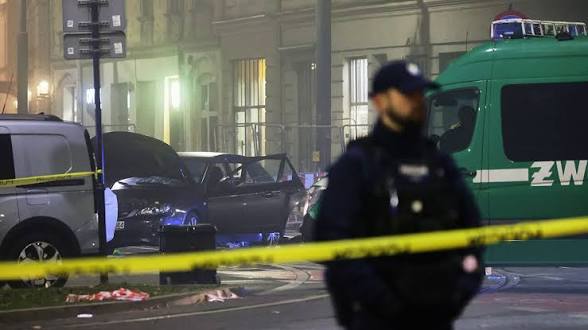
The Krakow shooting investigation widened after Prime Minister Donald Tusk said three bodies — two women and a man — were found at the home of the suspect arrested after six people were killed in the city centre. Interior Minister Marcin Kierwiński has also said preliminary indications point to possible far-right ideological influence. Neither the motive for the shooting nor the circumstances of the deaths at the home have been established, and authorities have not publicly confirmed how the two scenes are connected.
Also read: Six Killed, More Than a Dozen Wounded in Shooting at Poland’s Krakow Main Square
The discovery was reported late on Saturday, November 7. Tusk said there were strong indications that the three people found at the suspect’s home in Ostrowiec Świętokrzyski were members of his immediate family. He did not publicly identify them or explain when or how they died. Investigators must establish whether the deaths preceded the shooting, whether they are linked to it and what evidence supports any connection. Until those questions are answered, the three deaths should be treated as a separate part of the inquiry, not automatically counted among the victims of the public attack.
The shooting began shortly after 3 pm local time on Saturday near Sławkowska Street, close to the Main Market Square, one of Poland’s best-known public spaces. Police said the attacker fired from a moving car and struck people at several points around the square. Six people were killed, four women and two men, according to police and city authorities. The number of injured people has varied in public updates: the city’s municipal notice and an Associated Press report cited 15, while later Reuters and Guardian reports cited 16. The difference should be resolved through a consolidated police update.
Police officers shot and detained the suspect after confronting him a short distance from the initial shooting area. He was taken to hospital for treatment and surgery. Authorities have described him as a Polish citizen and later reports identified him as 25, although some early accounts gave his age as 24. The city’s official notice said he had not previously been recorded by police and held a firearms permit. Investigators will examine how he obtained the weapons and whether any warning signs had been reported before the attack.
Kierwiński told reporters that the suspect appeared to hold very radical views and was fascinated by far-right ideologies. The minister presented this as an initial assessment, not a final finding. Investigators will need to test it against the suspect’s communications, associations, online activity, previous conduct and material recovered from his home and vehicle. An ideological influence, if established, would not by itself explain the sequence of events or prove that another person or organisation was involved. Police have so far said that the attacker appeared to have acted alone.
Tusk said a drone was used to look inside the suspect’s home because officials believed a significant quantity of weapons might be inside. Local reports described an evacuation of residents from the building while counterterrorism officers and other services entered. Reuters reported that Poland’s Internal Security Agency and Military Counterintelligence Service were supporting the investigation. The response indicates that officials were treating the property as a potentially dangerous scene, but it does not establish that explosives or additional suspects were found there.
The weapons recovered from the suspect’s vehicle are another central line of inquiry. A Krakow police spokesperson said the attacker wore military-style clothing and used a long firearm, while police also found other weapons and ammunition in the car. Reuters reported that a police spokesperson told broadcaster TVN24 that an AR-15 rifle was used and that the suspect had a firearms licence. The city’s notice separately said he held a permit. Investigators will have to establish the precise weapons involved, their ownership and storage history, whether the licences covered them and whether any legal or administrative breach occurred.
The Polish defence minister, Władysław Kosiniak-Kamysz, described the shooting as an act of terror. That description conveys the government’s assessment of the attack, but it should not be confused with a completed legal determination. The investigation is still examining motive, the suspect’s background and the relationship between the Krakow shootings and the three deaths at the home. Police have not publicly named the suspect or the deceased people found at the property. Their identities, medical findings and the timeline of the deaths will be important to understanding whether the case involves more than one crime.
The attack has prompted both national and local mourning. The President’s spokesperson said Karol Nawrocki would declare national mourning for November 8 and 9. Krakow’s municipal authorities said the city’s mourning period would continue until November 11. In an official statement, the President expressed condolences to the families of those killed and injured and said the head of the National Security Bureau was travelling to Krakow. The immediate work remains with police, prosecutors and emergency services.
The victims included people of different nationalities. Reuters reported that one of the dead identified so far was a British citizen and that five foreign nationals were among those taken to hospital. The Portuguese Foreign Ministry said a Portuguese woman was among the injured. Authorities had identified four women and two men among those killed, but not all names had been released in the reports reviewed. The involvement of foreign visitors has added a consular dimension to the response, with governments needing confirmed information before notifying families and providing assistance.
Krakow’s Main Market Square is a major tourist destination and a daily gathering place for residents and visitors. The municipal transport company said a tram passing nearby was shot at and its driver’s cabin window was shattered; no passengers or crew were injured. The city asked people to avoid the square while emergency services worked. The incident disrupted an important public space, but officials said the suspect was in custody and the immediate scene was under control.
The case is likely to renew discussion of firearms access and public security in Poland, though current evidence does not show that licensing failure caused the attack. The Associated Press reported that about 411,000 people in Poland hold gun permits in a population of 37 million. The Guardian, citing police statistics, said a record 50,700 permits were issued in 2025. These figures provide context, not proof of a regulatory failure or an explanation of the suspect’s actions. Investigators will examine the specific licence, firearm records and how the weapons were acquired and stored.
Several questions remain open. Investigators need to determine whether the three people found at the suspect’s home were killed before or during the events in Krakow, whether the suspect was responsible for their deaths and whether there is any connection between the two locations. They must also establish the sequence of the shooting, the number and type of weapons used, the suspect’s movements and whether anyone assisted, encouraged or knew of his plans. The minister’s comments about far-right influence are an investigative lead, not a substitute for evidence or a finding by a court.
Authorities have said officers reached the attacker within minutes of the first report. Kierwiński credited the police response with preventing further deaths, while officials continued to secure the suspect’s home and examine the vehicle. Further reliable updates are likely to come from police and prosecutors after forensic work, victim identification and searches advance. Claims online about the suspect’s motives, the identities of the three people found at his home or alleged accomplices should be treated cautiously. The confirmed picture is grave: six people were killed in the square, at least 15 others were reported injured, and three additional bodies were found at the suspect’s residence.
The investigation now spans two locations and several questions: the killings in the city centre, the deaths at the suspect’s home, the source and legal status of the weapons, and the possible ideological background of the attacker. Officials have not yet provided a complete account tying those strands together. Their priority is to establish the facts, identify every victim, inform relatives and determine whether any continuing risk exists. For Krakow, mourning begins while the criminal inquiry moves from the emergency response to a detailed reconstruction of what happened.

Comments (0)
Be the first to comment. Comments are published after moderation.