


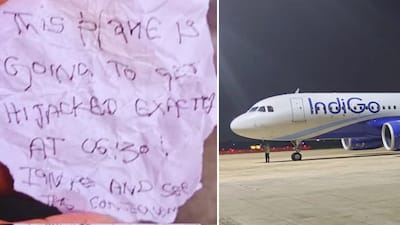
IndiGo flight 6E-451 returned to Bengaluru on Saturday evening after a passenger found a handwritten note in the aircraft’s lavatory warning that the plane would be hijacked. The aircraft, which was travelling from Bengaluru to Lucknow with 178 passengers, turned back as a precaution and landed at Kempegowda International Airport, where a full emergency was declared at Terminal 1. Security personnel isolated the aircraft and carried out anti-sabotage checks before the flight later resumed its journey, according to reports from The Times of India and LiveMint.
The note was discovered while the aircraft was in the air. A passenger alerted the cabin crew, who informed the pilot, and the flight crew notified air traffic control before returning to Bengaluru. NDTV reported that the aircraft had departed at about 5:50 pm and turned back roughly 30 minutes later. The message warned that a hijacking would take place at 6:30 and threatened consequences if it was ignored. Investigators have not publicly identified who wrote or placed the note.
The return was a precautionary response to a potential threat, not evidence that an attempt to seize the aircraft had taken place. There was no reported hijacking, and the reports reviewed did not describe any confrontation on board. The pilot’s decision to return the aircraft allowed security agencies to examine the plane and passengers on the ground rather than continue a flight while the warning remained unresolved. The airport’s emergency declaration reflected the need to treat the message seriously until checks were completed.
After landing, all 178 passengers were deboarded and the aircraft was moved into a controlled area for security procedures. The Times of India reported that the search lasted about 90 minutes. Airport security personnel and aviation law-enforcement authorities examined the aircraft, while police questioned passengers as part of the inquiry. The airline arranged refreshments and provided updates to travellers who were waiting for clearance. The disruption affected the flight’s schedule, but the reports did not indicate any injuries.
IndiGo said a security threat had been reported on flight 6E-451 operating from Bengaluru to Lucknow on November 7. In its statement, the airline said the relevant authorities were informed immediately and the pilots decided to return to the point of origin in line with standard operating procedures. It said the flight would resume after the necessary clearances and apologised for the inconvenience to customers. The statement emphasised the safety of passengers, crew and aircraft but did not identify the source of the note.
The response followed the standard safety sequence: report the warning, return the aircraft and complete checks before resuming service.
The sequence shows how a written threat can trigger a large response even when its credibility is unknown. Once the note was brought to the crew’s attention, the pilot had to treat it as a safety issue and coordinate with air traffic control. The return to Bengaluru allowed the aircraft to be handled by airport emergency services and security teams. The full emergency declaration made resources available for the aircraft’s arrival and examination; it did not mean that authorities had confirmed a hijacking plot.
Investigators will need to establish when the note was placed in the lavatory, who had access to the area and whether the message was intended to cause a diversion or was connected to a more serious plan. NDTV reported that police were questioning passengers and examining the possibility that the note had been planted by someone on board. That is an investigative line, not a confirmed finding. The public information released so far does not identify a suspect, describe any arrest or explain whether handwriting, camera footage or other evidence has produced a lead.
The distinction between a hoax and a credible threat is important for the investigation. A message can be false and still cause substantial disruption, while an apparently implausible warning cannot safely be dismissed before checks are complete. Airlines and airport authorities have to account for the possibility that a note may refer to a device, a person or an intended act that is not immediately visible. The response is designed to establish whether there is a danger before the aircraft is allowed to continue, not to determine the author’s motive in the air.
For passengers, the immediate consequences were a return to the departure airport, deboarding, security screening and a delay while the aircraft was examined. Some travellers may have had onward connections or time-sensitive plans in Lucknow, but no individual passenger accounts were available in the reports reviewed. IndiGo said ground staff were providing refreshments and regular updates. The airline did not publish a detailed timetable for the delay or say whether passengers were offered rebooking or other assistance beyond the immediate arrangements.
The investigation has not yet identified who placed the note or whether it was connected to any specific plan.
The most important unanswered question is who wrote the note and why. Investigators have not publicly said whether the message was linked to a passenger, an employee or someone who had access to the aircraft before boarding. They have also not disclosed whether the wording referred to a specific time zone or whether any other suspicious item was found. Without those details, it is not possible to say whether the note was intended as a prank, an attempt to disrupt the flight or a warning connected to an actual plan.
Authorities have not announced any arrest in the reporting reviewed. The airline’s statement was focused on the return and the safety checks, while the media accounts described the police inquiry without identifying a suspect. Further information may come from Bengaluru police, airport authorities or the Bureau of Civil Aviation Security if investigators establish a clear account of how the note reached the aircraft. Until then, claims circulating online about the author or the motive should not be treated as confirmed.
India’s aviation system relies on rapid reporting of suspicious objects and messages by passengers and crew. This incident illustrates why a threat note cannot be dismissed simply because it is handwritten or lacks details. The passenger who found it alerted the crew, the crew informed the pilot and the aircraft returned for checks. That chain of reporting allowed authorities to assess the situation before the flight continued. The investigation now has to determine whether anyone deliberately exploited those procedures or whether the message was an isolated hoax.
The flight’s return and subsequent departure brought the immediate disruption to an end, but the investigation remains open in the public reporting available. The confirmed sequence is that a note was found on board, the aircraft returned to Bengaluru with 178 passengers, a full emergency was declared, security teams searched the plane and the service later resumed to Lucknow. The author, motive and circumstances in which the note was placed remain unresolved. Those details will determine whether the incident is treated solely as a hoax or leads to further legal action.





Comments (0)
Be the first to comment. Comments are published after moderation.