


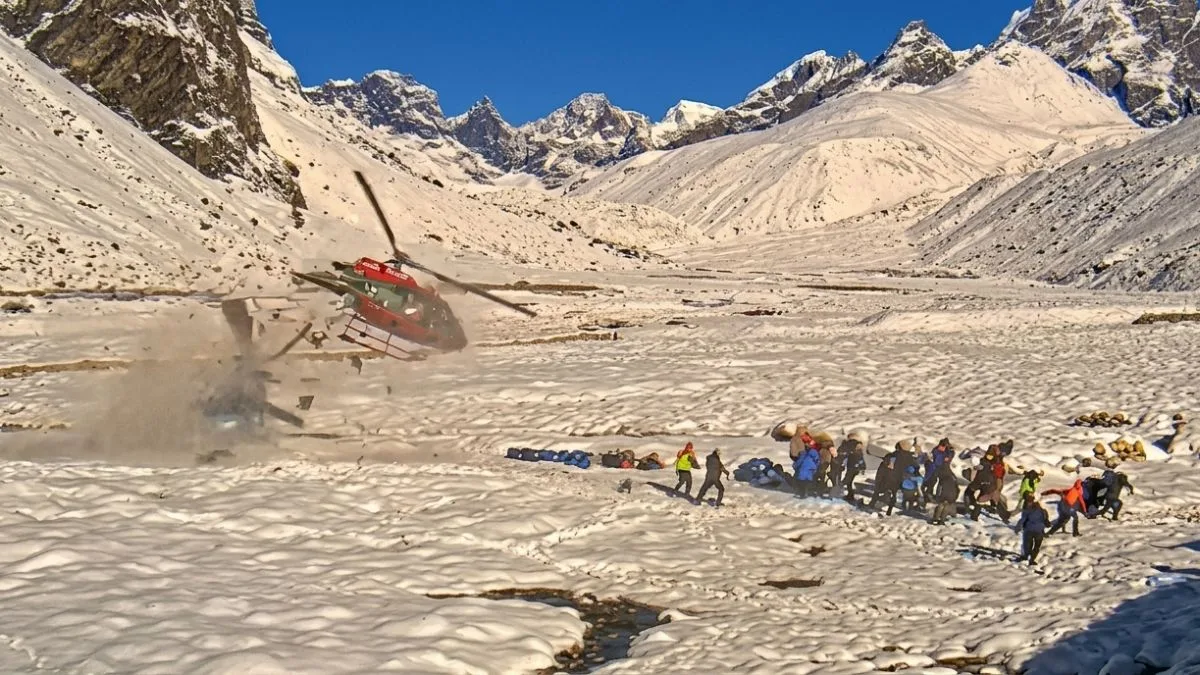
An Indian national was killed and a New Zealand tourist injured after two helicopters collided while preparing to land in Nepal’s Mount Everest region on Tuesday, November 3, according to Reuters, which cited local authorities. The accident occurred near Pheriche in Solukhumbu district, close to the Everest base camp area.
The helicopters were operated by Fishtail Air and Air Dynasty. Reuters reported that the Fishtail Air helicopter was carrying passengers who had been rescued from the Everest region when it crashed while landing. An Air Dynasty official told Reuters that the other helicopter was carrying cargo and had no passengers.
Reuters published its report at 5:04 a.m. UTC, or 10:34 a.m. India time, and said the Indian and New Zealand nationals aboard the passenger helicopter were tourists. The New Zealander was rescued, according to Solukhumbu district chief Kaman Singh Thapa Magar. The deceased person’s name had not been confirmed in the Reuters report.
Also read: Six Killed in Uttarakhand Helicopter Crash Near Joshimath
The collision happened as the aircraft were approaching a landing area in the Everest region. Local reporting placed the incident at Pheriche, a settlement used by trekkers and climbers travelling towards Everest base camp. The Annapurna Express reported that the two helicopters had departed from Lukla for flights in the Everest region before the collision near Pheriche.
Early reports differed on the number of people injured. Reuters confirmed that a New Zealand tourist was injured and rescued. The Times of India and some Nepal-based reports also referred to an injured pilot, but the total number of injured people was not consistent across the accounts reviewed. Authorities had not released a complete casualty statement in the material available for this report.
The cause of the collision has not been established. The reports reviewed do not provide an official finding on whether the aircraft struck each other during the final approach, whether a landing-area conflict was involved or whether weather and visibility played a role. Those possibilities should not be treated as findings while the investigation is under way.
Also read: Char Dham Helicopter Operators Threaten Suspension as Two-Pilot Rule Takes Effect
Helicopters are used in Nepal’s Everest region to transport trekkers, climbers, supplies and people requiring assistance. Reuters said the accident occurred during the peak trekking season, when aircraft regularly carry hikers and climbers across the high-altitude region. The concentration of flights around a small number of landing areas makes accurate coordination important, although the available reports do not establish that traffic density contributed to this collision.
Fishtail Air’s account, as reported by Reuters, said its helicopter was carrying passengers who had been rescued from the Everest region when the crash occurred during landing. The report did not provide details about the earlier rescue, the flight’s full passenger manifest or the condition of the aircraft after the collision.
The accident is separate from the October 30 helicopter crash near Joshimath in India’s Uttarakhand state, in which six people died. That aircraft was operated by Trans Bharat Aviation and was flying from Badrinath to Dehradun. The two incidents occurred in different countries and involved different operators; no connection between them has been reported.
Also read: Six Indian Tourists Out of Contact After Heavy Snowfall in Nepal’s Dolpa
Investigators will need to establish the sequence of events during the helicopters’ approach, identify the precise point of contact and examine the aircraft and available flight information. The operators’ accounts and the statements of local authorities may help establish the passenger and crew details, but the cause cannot be determined from early descriptions alone.
Authorities also need to confirm the full casualty count and release the deceased passenger’s identity through the appropriate official channels. Until then, reports naming the victim or giving a definitive injury total should be treated cautiously if they are not supported by an official confirmation.
For travellers in the Everest region, the immediate concern is the safety of people involved in the collision and any disruption to helicopter movements around Pheriche. The wider safety implications will depend on the findings of the investigation. The accident itself does not establish a systemic failure by either operator, and no cause has been confirmed.



Comments (0)
Be the first to comment. Comments are published after moderation.