


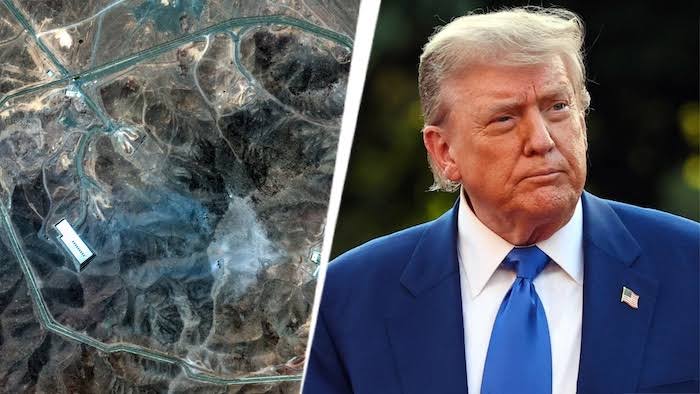
US President Donald Trump said the United States still has one or two targets in Iran, specifically naming the underground site known as Pickaxe Mountain. He did not announce a strike order or timetable, while Secretary of State Marco Rubio said the president had not made a decision on fresh military action.
Trump made the remarks to reporters at his Mar-a-Lago residence in Florida on Saturday, October 31. He said the United States had “one or two sites” left and could act “in 10 minutes.” He also described talks with Tehran as “going fine” while saying Iran was “not very reliable.” A video clip of the exchange was posted by Rapid Response 47 on X and embedded in NDTV’s report.
The earliest timestamped report located in this check was a live update by The Times of Israel at 03:30 local time on Sunday, November 1, approximately 07:00 IST. AFP’s report carried by BSS News also appeared on November 1. NDTV updated its report at 09:14 IST, while The Times of India updated its account at 09:37 IST. The later reports added context but did not announce a new US strike order.
At a G20 foreign ministers’ press conference in Atlanta on October 31, Rubio said Trump had not decided whether to authorize further strikes. He said the United States could pursue military objectives if required, but that the president preferred a diplomatic solution. Rubio also said there was no announcement to make about a new operation, according to The Times of Israel’s AFP report.
The distinction is important. Trump’s comments identify targets he says remain, but they do not establish that an attack has been ordered, scheduled, or approved. The public remarks from Rubio on Saturday indicated that the decision had not been taken at that point.
Also read: Qatari Mediators in Tehran as US-Iran Tensions Continue
Pickaxe Mountain, also known as Kuh-e Kolang Gaz La, is near Iran’s Natanz nuclear complex, south of Tehran. The Associated Press reported in July that construction was under way at the underground site and that experts believed it could be intended for uranium enrichment or centrifuge manufacturing. The agency also reported that the International Atomic Energy Agency had never inspected the facility, leaving its contents unknown. That limitation is central to assessing the claims: satellite images can show construction activity and changes to a site, but they cannot on their own establish which equipment is installed underground or whether uranium-related work is taking place. Analysts can compare imagery, construction patterns, and statements from officials, yet those assessments remain different from an inspection or independently verified access to the facility.
Iran has denied that nuclear work is being carried out at the site. Trump’s reference to Pickaxe Mountain therefore does not independently establish what is inside it or whether nuclear material or operating centrifuges are present. His broader assertion that earlier US strikes had disabled Iran’s nuclear capability is also a claim by the president, not an independent verification of the condition of Iran’s program. For that reason, reports about the site should distinguish three questions: what US officials say they may target, what outside analysts infer from visible construction, and what inspectors have actually been able to verify. Those are not interchangeable categories of evidence. Without inspection access or a transparent technical assessment, descriptions of the facility’s purpose should remain attributed rather than stated as established fact.
The Times of India, citing a Wall Street Journal report, also said Trump and Israeli Prime Minister Benjamin Netanyahu had spoken by phone on Saturday about the possibility of renewed military action. The report was attributed to people familiar with the conversation; no official readout confirming a decision to strike was cited.
Earlier on Saturday, Supreme Leader Mojtaba Khamenei warned that any new US or Israeli threat would be met with an immediate response without geographic limits, according to a written statement attributed to him and reported by Iranian state media. Dawn.com’s AFP report said he also directed the armed forces to update their target list. The warning preceded Trump’s later remarks at Mar-a-Lago and should not be described as a response to them.
The exchange comes amid a conflict that began with US-Israeli strikes on Iran on February 28 and has disrupted shipping through the Strait of Hormuz. Diplomatic contacts have continued, but the public statements from both sides show that the military option remains part of the discussion.
Also read: Iran Rejects US Talks, Vows Counter-Attacks After Strikes
The Strait of Hormuz is a major route for crude oil, petroleum products, and liquefied natural gas. The International Energy Agency’s February 2026 factsheet says an average of about 20 million barrels per day of oil and oil products passed through the strait in 2025, equal to around 25 percent of global seaborne oil trade. About 80 percent of those flows were destined for Asia. China and India together received 44 percent of the crude exports that crossed the route in 2025.
The IEA also estimates that the strait carried about 19 percent of global LNG trade in 2025. Any renewed military action could add risk to shipping, insurance, and energy flows, but Trump’s remarks alone do not establish a new disruption to supplies or a specific movement in oil prices. The figures describe 2025 trade flows and should not be read as a measure of current daily traffic.
Also read: Oman Evacuates 25 Crew After Vessel Fire Off Musandam
The next verifiable indicators will be any formal statement from the White House or Pentagon, a confirmed change in US military posture, an official Iranian response to the latest remarks, and developments in shipping through the Strait of Hormuz. The status of Pickaxe Mountain would require independent evidence or access by the IAEA; a political statement alone cannot establish the site’s contents.
There is also a difference between a target being discussed and a strike being militarily feasible or politically authorized. A heavily buried facility can present difficult questions about intelligence confidence, weapon selection, expected damage, and the risk of wider retaliation. Public reporting does not provide enough information to assess those operational questions, and analysts should not infer a specific weapon or strike plan from the president’s reference to the site. The consequences would depend on the scope of any operation, the response from Iran, the position of regional governments, and whether diplomatic channels remained open. Those outcomes are scenarios, not confirmed developments. The immediate factual question remains whether the administration moves beyond public statements to a documented decision or an action that can be independently corroborated. The reports reviewed did not include a formal strike order or an operational timetable.
Until an order or military action is confirmed, Trump’s comments should be treated as a public statement about possible targets, not proof that a new strike has been authorized. Rubio’s statement that no decision had been made remained the clearest public description of the administration’s position in the reports reviewed. The distinction is important: identifying a site in a public remark does not establish that an operational order has been issued, that a strike has been scheduled, or that the site’s current condition has been independently assessed. A reliable update would need a formal statement from the White House or Pentagon, corroborated reporting from multiple outlets, or independently verified evidence of military action. Social media video can help establish what was said, but it cannot by itself confirm the status of a facility or the timing of a possible operation.
Frequently Asked Questions
Did Trump announce a new strike order against Iran?
No. Trump said the United States still had one or two targets in Iran, but he did not announce an order or timetable. Secretary of State Marco Rubio said on October 31 that Trump had not made a decision on fresh strikes.
What is Pickaxe Mountain?
Pickaxe Mountain, also known as Kuh-e Kolang Gaz La, is an underground site under construction near Iran’s Natanz nuclear complex. The Associated Press reported that its contents remain unknown because the IAEA has not inspected it; Iran denies nuclear work at the site.
Was Iran’s warning a response to Trump’s latest remarks?
No. Supreme Leader Mojtaba Khamenei’s warning about an immediate response to any threat was issued earlier on Saturday, before Trump’s later comments at Mar-a-Lago.
Why does the Strait of Hormuz matter to India?
The IEA says about 20 million barrels per day of oil and oil products passed through the Strait in 2025, around 25 percent of global seaborne oil trade. China and India together received 44 percent of the crude exports that crossed the route that year.
Comments (0)
Be the first to comment. Comments are published after moderation.